AQA · A-Level · Chemistry
Course version: 7405 · Version from Sept 2016
Required practical 6 Tests for alcohol, aldehyde, alkene and carboxylic…
Full specification wording
Identification of functional groups by test-tube reactions: Required practical 6 Tests for alcohol, aldehyde, alkene and carboxylic acid.
In this practical you work through four tests on unknown liquids.
Checked against the AQA 7405 specification (opens in a new tab) on .
- Point 3 of 3
- 4 key terms
Study notes
From the checked teaching notes for this specification point.
The idea
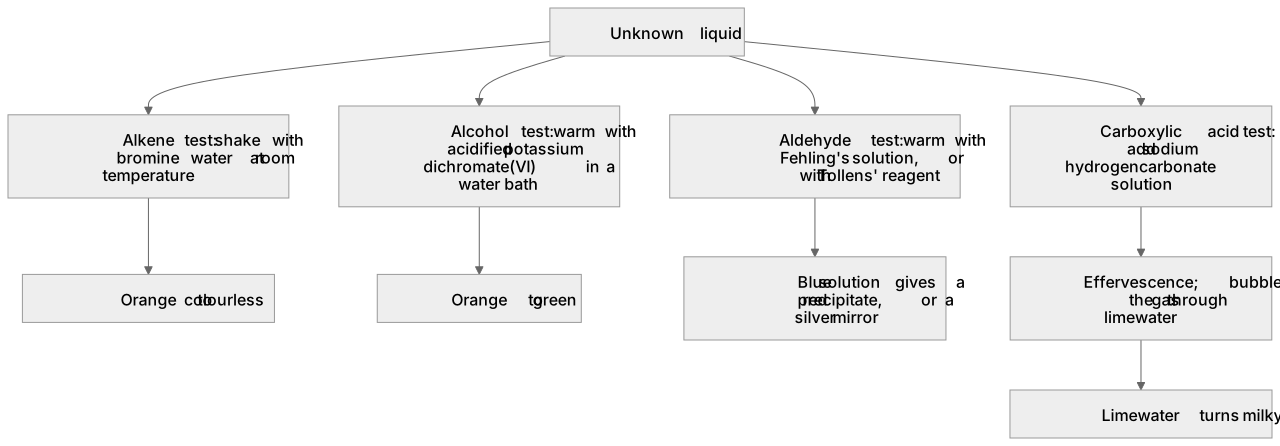
In this practical you work through four tests on unknown liquids. Alkene: shake with bromine water at room temperature and look for orange to colourless. Alcohol: warm with acidified potassium dichromate(VI) in a water bath and look for orange to green. Aldehyde: warm with Fehling's solution and look for the blue solution giving a red precipitate, or with Tollens' reagent for a silver mirror. Carboxylic acid: add sodium hydrogencarbonate solution, look for effervescence and bubble the gas through limewater, which turns milky. Warming is done in a water bath, not over a flame, because the liquids are flammable. AQA has set a flawed method in which Fehling's was cooled and the gas tested with a splint; both are errors.
What earns the marks
- Each reagent correctly matched to its functional group and observation.
- Warming in a water bath rather than over a flame, because the organic liquids are flammable.
- Bubbling the gas from the carbonate test through limewater rather than using a lighted splint.
- Stating the observation with a compound that gives a negative result.
Common mistakes and how to put them right
Heating a flammable organic liquid directly with a Bunsen flame.
Cooling the Fehling's tube in iced water, the error AQA planted in a candidate method.
Using a lighted splint on the gas from sodium hydrogencarbonate instead of limewater.
Warming the bromine water test, which is carried out at room temperature.
Exam tips
- When asked to spot mistakes in a method, check the temperature of each step first; that is where errors are usually hidden.
- Give the corrected instruction as well as naming the mistake.
- Carry the safety reason with you: flammable liquids mean a water bath, not a flame.
Try the lesson
The start of the Identification of functional groups by test-tube reactions: Required practical 6 Tests for alcohol, aldehyde, alkene and carboxylic acid. lesson, made from checked teaching notes for this specification point.
Have a go first
In Required practical 6, which reagent is added to an unknown compound to test for the presence of an alkene?
Listen
In this practical you work through four tests on unknown liquids. Alkene: shake with bromine water at room temperature and look for orange to colourless. Alcohol: warm with acidified potassium dichromate(VI) in a water bath and look for orange to green. Aldehyde: warm with Fehling's solution and look for the blue solution giving a red precipitate, or with Tollens' reagent for a silver mirror. Carboxylic acid: add sodium hydrogencarbonate solution, look for effervescence and bubble the gas through limewater, which turns milky. Warming is done in a water bath, not over a flame, because the liquids are flammable. AQA has set a flawed method in which Fehling's was cooled and the gas tested with a splint; both are errors. A strong answer earns marks for these points. each reagent correctly matched to its functional group and observation. warming in a water bath rather than over a flame, because the organic liquids are flammable. bubbling the gas from the carbonate test through limewater rather than using a lighted splint. stating the observation with a compound that gives a negative result. Exam tip: When asked to spot mistakes in a method, check the temperature of each step first; that is where errors are usually hidden.
See it
Key words
Say what each word means before you turn the card.
water bath heating
Try answering aloud or in your head before turning the card.
limewater for carbon dioxide
Try answering aloud or in your head before turning the card.
identifying method errors
Try answering aloud or in your head before turning the card.
flammable organic liquids
Try answering aloud or in your head before turning the card.
See every definition
- water bath heating
- Warming is done in a water bath, not over a flame, because the organic liquids are flammable.
- limewater for carbon dioxide
- Bubble the gas from the carbonate test through limewater, which turns milky, rather than using a lighted splint.
- identifying method errors
- Check the temperature of each step first, give the corrected instruction as well as naming the mistake, and carry the safety reason with you.
- flammable organic liquids
- Because the liquids are flammable, heating is done in a water bath rather than over a flame.
Label the diagram
Some boxes have lost their names. Pick the right name for each number.
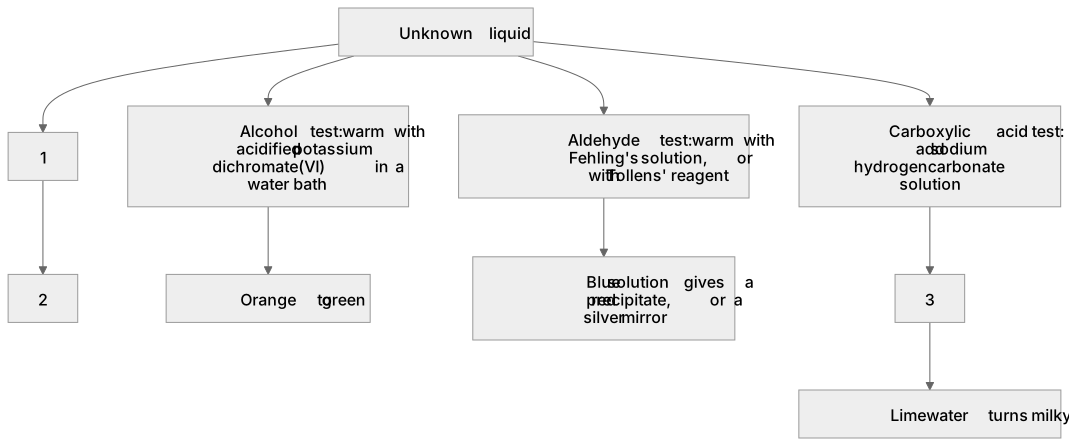
1Box 1
2Box 2
3Box 3
There is more to this lesson
The full lesson goes on to check your understanding and help you earn the marks. Create a free account to carry on, with your progress saved.
A week of Premium from your first lesson · Then the free plan continues · No card, no charge
Test your understanding of Identification of functional groups by test-tube reactions: Required practical 6 Tests for alcohol, aldehyde, alkene and carboxylic acid.
Active recall beats re-reading. Take an instant quiz now to test what you’ve learned and lock it into long-term memory.
A week of Premium from your first lesson · Then the free plan continues · No card, no charge