Study Notes
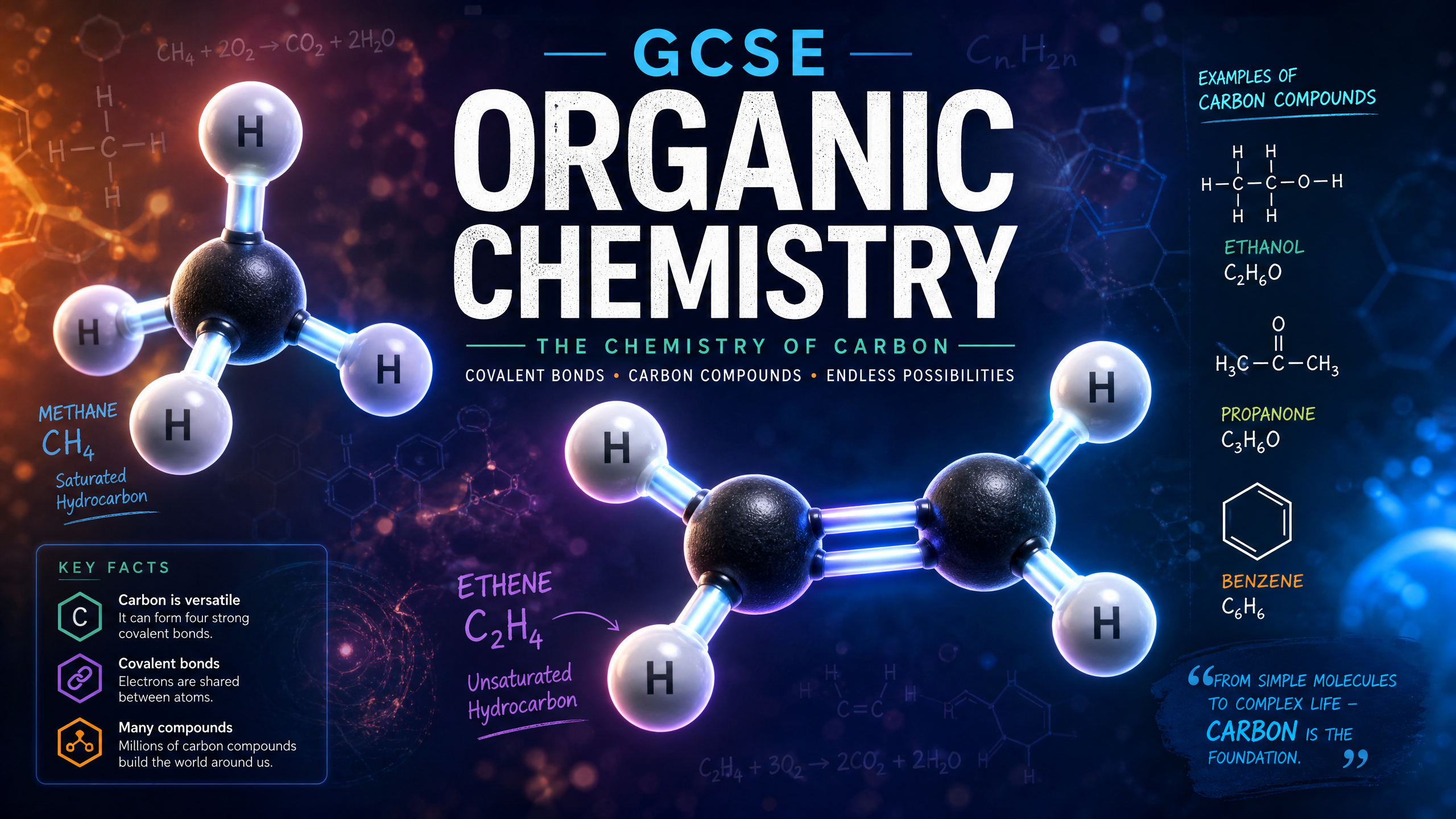
Introduction to Organic Chemistry: the GCSE mark-winning toolkit
Specification position. This is a board-neutral GCSE guide, anchored most closely to AQA GCSE Chemistry 4.7.1.1–4.7.1.4. The core GCSE material is hydrocarbons, alkanes, alkenes, crude oil, fractional distillation, cracking, combustion and bromine water. Full IUPAC branch naming, E/Z nomenclature, Cahn–Ingold–Prelog (CIP) priority and detailed arrow-pushing are useful stretch / A-level bridge content, not assumptions for every GCSE board. Check your own specification before spending revision time on the extension material. 1 2 3
1. What organic chemistry means — and why it earns marks
Organic chemistry is the chemistry of carbon compounds, especially hydrocarbons and their derivatives. A hydrocarbon contains carbon and hydrogen only. Carbon is valuable because each carbon atom can form four covalent bonds; carbon atoms can therefore join to make chains, branches and rings. In GCSE questions, candidates must move confidently between a name, a molecular formula, a displayed formula and an explanation of properties. Credit is given for exact chemical terms, not vague phrases such as “it has carbon in it”. 1
The first family to recognise is the alkanes. These are saturated hydrocarbons: they contain only single carbon–carbon bonds. Their general formula is CₙH₂ₙ₊₂. Methane, ethane, propane and butane are the first four names worth automatic recall. In an open-chain alkane, each carbon has four bonds in total. Count bond lines before committing to an answer: a carbon with five bonds is chemically impossible and loses a drawing mark.
The second family is the alkenes. They contain a carbon–carbon double bond, C=C, and are unsaturated. For the simple open-chain monoalkenes studied at GCSE, the general formula is CₙH₂ₙ. The double bond makes alkenes more reactive than alkanes and gives a distinctive test: bromine water changes from orange/brown to colourless when it reacts with an alkene. A correct answer must name the observation and identify the alkene as the reacting substance; “it goes clear” alone is often too imprecise. 1
2. Formula fluency: match the representation to the command word
A molecular formula gives only the number of each type of atom, for example C₄H₁₀. It does not show how the atoms join. A structural formula groups atoms along a chain, for example CH₃CH₂CH₂CH₃. A displayed formula shows every atom and every bond: when the question asks for displayed, writing CH₃CH₂CH₃ is not enough. A skeletal formula, in which every line end and vertex represents a carbon atom, is an extension representation used more routinely at A level.
Use the command word as a checklist. If asked to draw a displayed formula, put every hydrogen in. If asked to state the formula, do not draw unnecessary bonds. If asked to explain why two compounds are structural isomers, write both required ideas: “same molecular formula” and “different structural formula / different connectivity.” Marks are normally allocated point by point, so one excellent but incomplete sentence rarely earns both marks.
3. Names and isomers: core knowledge plus stretch
At GCSE, recognise the carbon prefixes meth-, eth-, prop-, but-; separate chemistry specifications may go further. The suffix -ane means an alkane and -ene means an alkene. For stretch IUPAC naming, find the longest continuous carbon chain, number it from the end that gives the main feature the lowest possible number, name branches with their positions, then apply the suffix. Thus CH₃CH=CHCH₃ is but-2-ene, not “2-butene” in modern preferred style.
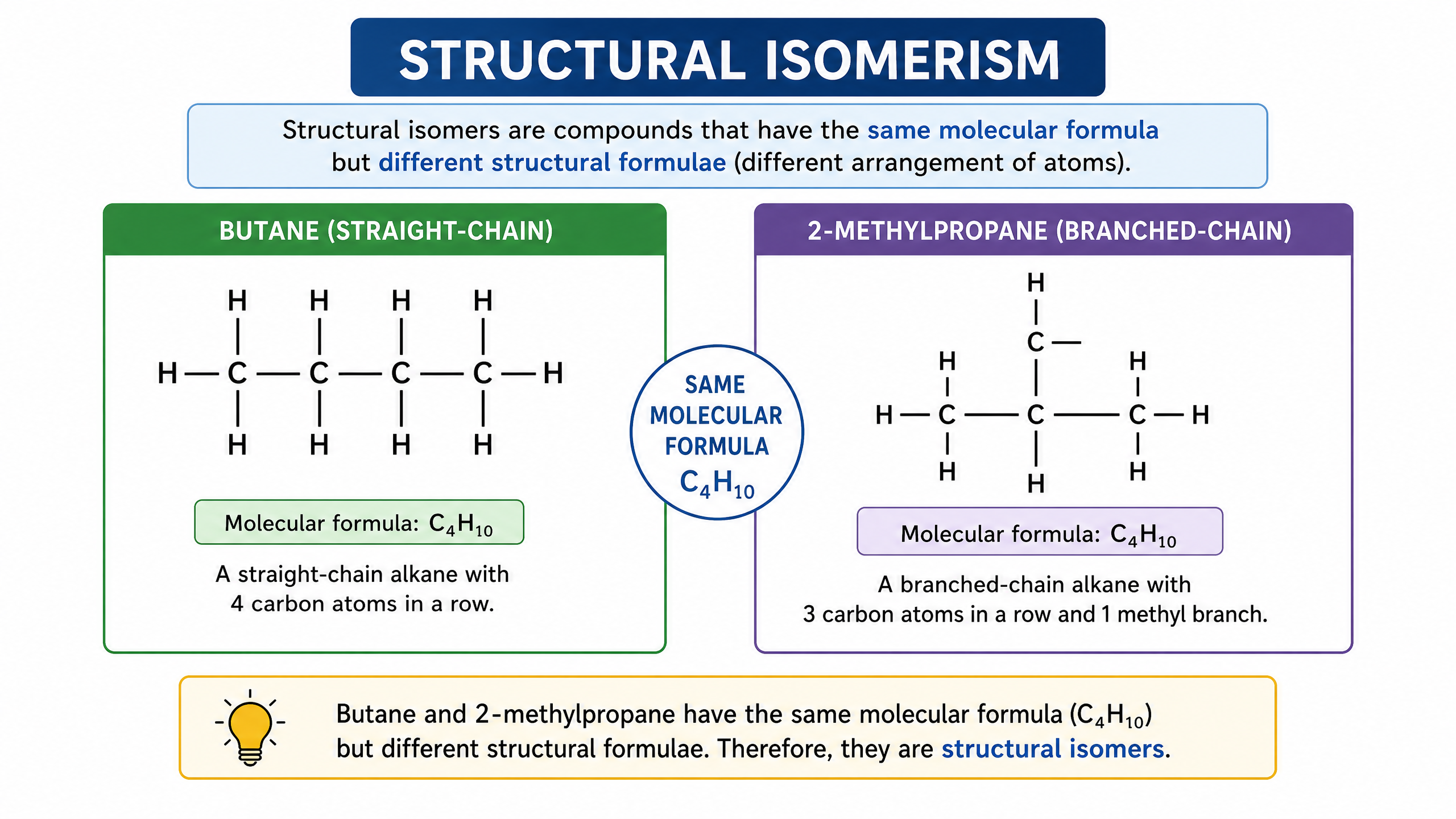
Structural isomers have the same molecular formula but different structural formulae. Butane and 2-methylpropane both have C₄H₁₀, yet one is straight-chain and the other is branched. They can have different boiling points because their shapes alter the strength of intermolecular forces. Do not call the same molecule an isomer merely because it has been drawn bent, upside down or rotated: connectivity must change.
Stretch: E/Z isomerism. A C=C bond cannot rotate freely. If each carbon of the double bond has two different groups, two spatial arrangements may exist. Apply CIP priority by comparing the atomic numbers of the atoms directly attached: higher atomic number means higher priority. The higher-priority groups on the same side are Z; on opposite sides are E. This is not normally a core GCSE demand, but it is a secure bridge into A-level organic chemistry.
4. Where hydrocarbons come from: crude oil, fractions and cracking
Crude oil is a finite resource formed from ancient biomass and is a mixture of many compounds, most of which are hydrocarbons. Fractional distillation separates the mixture because different hydrocarbons have different boiling points. In a high-mark explanation, state the sequence: crude oil is heated to vaporise; vapours enter a fractionating column; the column is hot at the bottom and cooler at the top; vapours cool and condense at different heights; fractions are collected. Candidates gain no credit for merely saying “they are separated by size” without linking the separation to evaporation, condensation and different boiling points. 1
As hydrocarbon molecules get larger, GCSE specifications expect you to know that boiling point and viscosity increase, while flammability decreases. Explain this with stronger intermolecular forces between larger molecules. A short-chain fraction such as refinery gas is therefore more volatile and flammable, while a long-chain fraction is thicker and less easily ignited. Plotting data should show molecular size on the x-axis and the measured property, including units, on the y-axis.
Cracking breaks long-chain hydrocarbons into shorter, more useful molecules. It may use a catalyst at high temperature or steam at high temperature. The products include shorter alkanes and alkenes. This is commercially useful because demand is high for small fuel molecules and alkenes are feedstock for polymers. When balancing a cracking equation, conserve atoms: for example, C₁₀H₂₂ → C₈H₁₈ + C₂H₄. Check carbon first, then hydrogen.
5. Reactions and environmental links
Complete combustion of a hydrocarbon produces carbon dioxide and water. For methane: CH₄ + 2O₂ → CO₂ + 2H₂O. Incomplete combustion, caused by insufficient oxygen, can produce carbon monoxide and/or carbon particulates (soot), as well as water. Carbon monoxide is toxic; particulates can harm respiratory health. In a comparison answer, never write that incomplete combustion “only produces CO₂”: that is the key distinction you are being tested on. 1
Alkenes react by addition across C=C. With bromine, the double bond becomes a single bond and bromine atoms add to the two carbon atoms. In chemistry-only GCSE courses, addition with hydrogen, water and halogens may also be specified. At the exam level, draw the reactant accurately, open the double bond to a single bond and add the new atoms; all atoms must be accounted for. 1
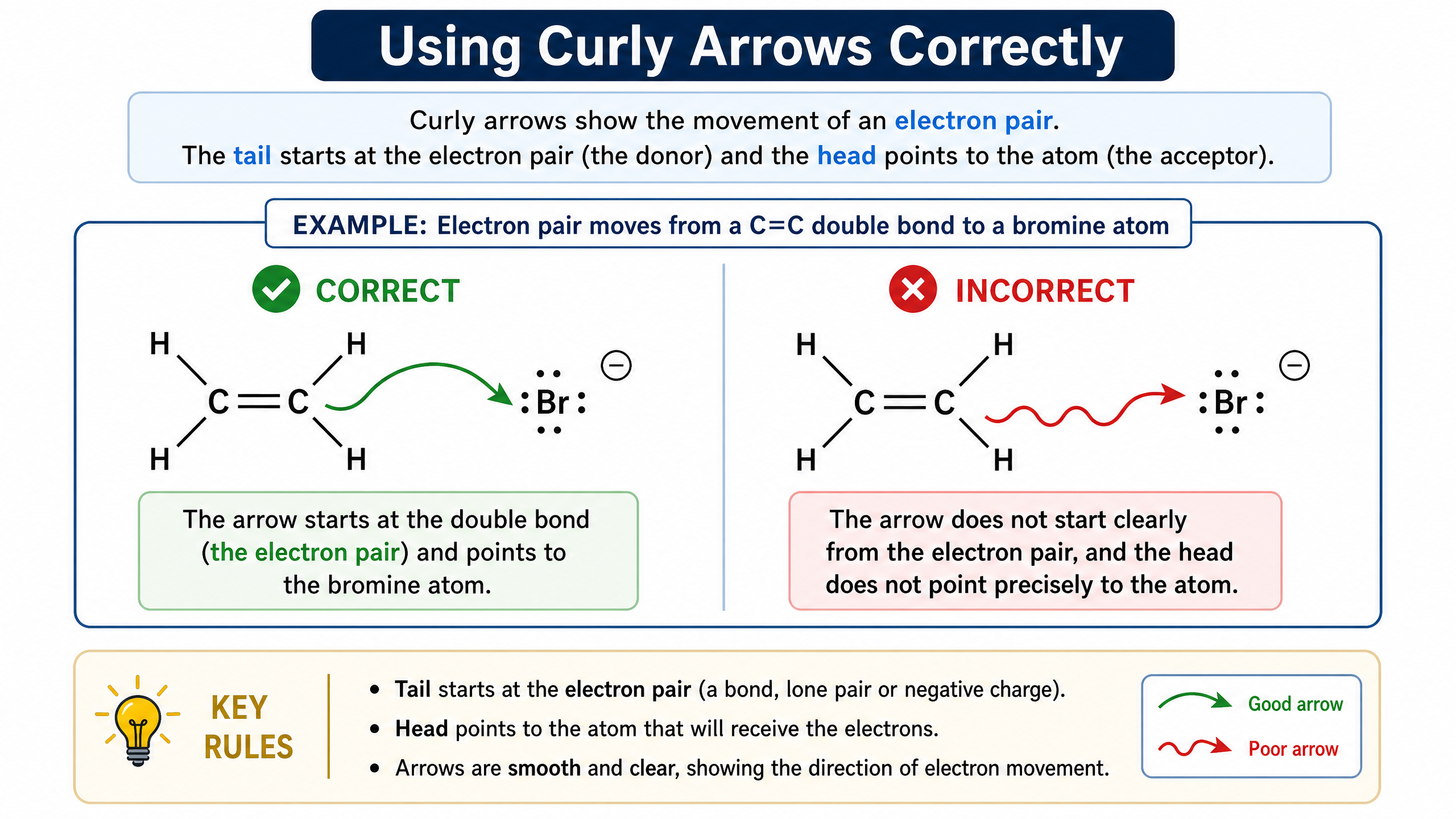
Stretch: mechanisms. A conventional double-headed curly arrow shows the movement of an electron pair. Its tail must begin at a bond or lone pair, and its head must point to the destination atom or bond. A single-headed “fishhook” arrow is used for one electron in a free-radical mechanism, for example a chlorine radical in alkane substitution. Do not add detailed mechanism arrows to a GCSE answer unless your teacher or question explicitly requires them: an immaculate displayed formula is usually more valuable at GCSE.
6. Exam execution: make every mark visible
For one-mark recall questions, use a precise definition. For two-mark explanations, write two distinct marking points. For a four- to six-mark process answer, make a logical chain using connectives such as “because”, “therefore” and “so that”. AQA states that its GCSE organic chemistry content expects fractional-distillation explanations, complete-combustion equations, cracking, and the bromine-water test; other boards organise content differently, so use the board-neutral language here then verify terminology against your own specification. 1 2 3
A sensible timing rule is about one minute per mark, with a brief final check. For formulae, count every carbon, then every hydrogen, then inspect whether every carbon has four bonds. For a data question, quote the numbers or trend before explaining it. For a practical-style question involving bromine water, name the control, the observation, the conclusion and the safety point. This turns a generic answer into an AO2 or AO3 answer.
7. Retrieval and final recall
Before an assessment, cover this page and say: “Hydrocarbon means carbon and hydrogen only. Alkane means saturated, CₙH₂ₙ₊₂. Alkene means C=C, unsaturated, CₙH₂ₙ. Structural isomers: same molecular formula, different structural formula. Cracking makes shorter alkanes and alkenes. Bromine water goes orange/brown to colourless with an alkene.” If you can say and then apply that sequence, you have the core knowledge needed for the majority of GCSE organic-chemistry questions.
Examiner’s 60-second final check
Before handing in, candidates should make the marking points visible. Circle every C=C that you have used, check that each carbon has four bonds, and scan every definition for the word only where it matters. In an equation, compare the number of each atom on the left and right; a correct product formula without a balanced equation can still lose the balancing mark. In an extended response, ensure that your final sentence answers the actual command word. For instance, an answer that describes fractional distillation but never explains why fractions form at different levels will not access all explanation marks. This final check rewards accuracy rather than extra length.
References
Visual Resources
2 diagrams and illustrations
Interactive Diagrams
2 interactive diagrams to visualise key concepts
Conceptual Flow Outline
Decision flowchart: classify a hydrocarbon using its carbon–carbon bonding.
Conceptual Flow Outline
Process diagram: the mark-winning sequence for fractional distillation.
Worked Examples
3 detailed examples with solutions and examiner commentary
Practice Questions
Test your understanding — click to reveal model answers
Define the term hydrocarbon. [1 mark]
Hint: Name both elements and state that no other elements are present.
A hydrocarbon has formula C6H14. State the homologous series and name the straight-chain compound. [2 marks]
Hint: Compare H with 2n + 2, then use the six-carbon prefix.
Explain why butane and 2-methylpropane are structural isomers. [2 marks]
Hint: Use the phrase 'same molecular formula' and then contrast the structure.
A student shakes bromine water with two unlabelled hydrocarbons. Tube A stays orange/brown; Tube B becomes colourless. Identify the likely family in Tube B and explain the observation. [2 marks]
Hint: Think about the unsaturated bond in the molecule.
Describe how fractional distillation separates crude oil into fractions, and explain why long-chain hydrocarbons are collected lower down the column. [6 marks]
Hint: Include heating, vapour, a temperature gradient, cooling, condensation, different boiling points and intermolecular forces.