AQA · A-Level · Chemistry
Course version: 7405 · Version from Sept 2016
The formulas of compound ions, eg sulfate, hydroxide, nitrate, carbonate…
Full specification wording
Ionic bonding: The formulas of compound ions, eg sulfate, hydroxide, nitrate, carbonate and ammonium.
Compound ions are groups of covalently bonded atoms carrying an overall charge, and they must be learned as complete units: sulfate SO₄²⁻, hydroxide OH⁻, nitrate NO₃⁻, carbonate CO₃²⁻ and ammonium…
Checked against the AQA 7405 specification (opens in a new tab) on .
- Point 2 of 3
- 4 key terms
Study notes
From the checked teaching notes for this specification point.
The idea
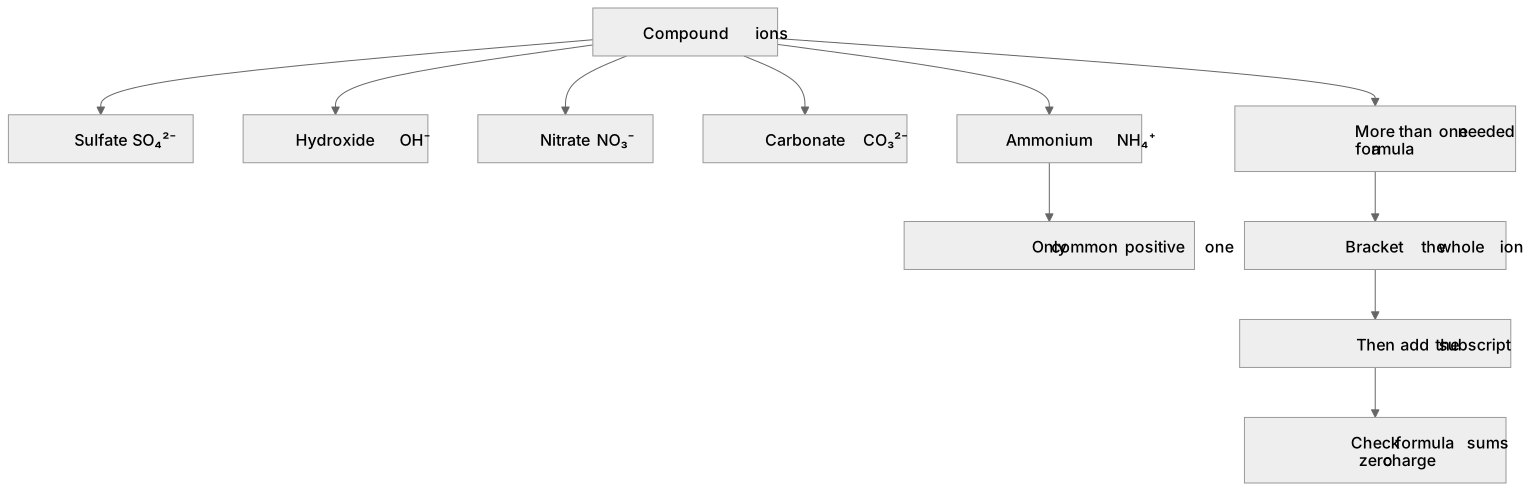
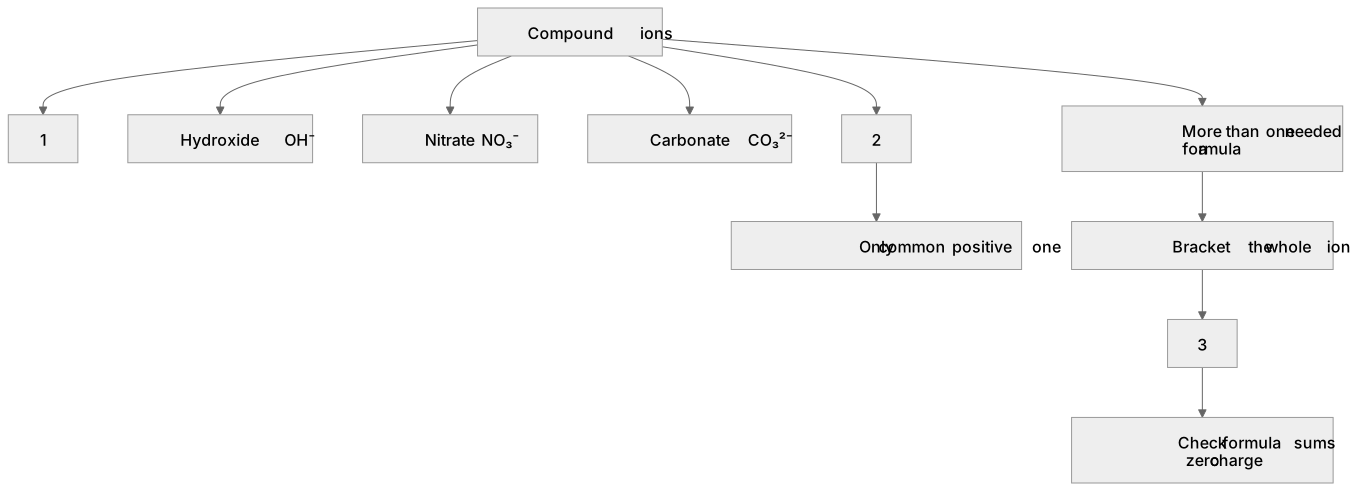
Compound ions are groups of covalently bonded atoms carrying an overall charge, and they must be learned as complete units: sulfate SO₄²⁻, hydroxide OH⁻, nitrate NO₃⁻, carbonate CO₃²⁻ and ammonium NH₄⁺. Ammonium is the only common positive one. In a formula the charge is balanced against the counter-ion, and if more than one compound ion is needed the whole ion is bracketed before the subscript, giving Ca(OH)₂, Al₂(SO₄)₃ and (NH₄)₂CO₃. The bracket matters for both the formula and its relative formula mass, since the subscript multiplies every atom inside it. Related ions differ only in oxygen count and charge, so learn hydrogencarbonate HCO₃⁻ alongside carbonate rather than deriving it.
What earns the marks
- The correct atoms in the compound ion.
- The correct charge on that ion.
- Brackets used whenever more than one compound ion appears in a formula.
- A formula with no overall charge once the ions are combined.
Common mistakes and how to put them right
Writing sulfate as SO₄⁻ or nitrate as NO₃²⁻.
Omitting brackets so calcium hydroxide is written as CaOH₂.
Giving ammonium as NH₃⁺ or leaving the charge off altogether.
Assuming carbonate and hydrogencarbonate carry the same charge.
Exam tips
- Memorise the five compound ions with their charges as a single list; they appear across the whole specification.
- Bracket first, then add the subscript, so no atom inside is missed.
- Check the finished formula sums to zero charge before moving on.
Try the lesson
The start of the Ionic bonding: The formulas of compound ions, eg sulfate, hydroxide, nitrate, carbonate and ammonium. lesson, made from checked teaching notes for this specification point.
Have a go first
Which formula represents the ammonium ion?
Listen
Compound ions are groups of covalently bonded atoms carrying an overall charge, and they must be learned as complete units: sulfate SO₄²⁻, hydroxide OH⁻, nitrate NO₃⁻, carbonate CO₃²⁻ and ammonium NH₄⁺. Ammonium is the only common positive one. In a formula the charge is balanced against the counter-ion, and if more than one compound ion is needed the whole ion is bracketed before the subscript, giving Ca(OH)₂, Al₂(SO₄)₃ and (NH₄)₂CO₃. The bracket matters for both the formula and its relative formula mass, since the subscript multiplies every atom inside it. Related ions differ only in oxygen count and charge, so learn hydrogencarbonate HCO₃⁻ alongside carbonate rather than deriving it. A strong answer earns marks for these points. the correct atoms in the compound ion. the correct charge on that ion. brackets used whenever more than one compound ion appears in a formula. a formula with no overall charge once the ions are combined. Exam tip: Memorise the five compound ions with their charges as a single list; they appear across the whole specification.
See it
Key words
Say what each word means before you turn the card.
compound ions
Try answering aloud or in your head before turning the card.
charges to learn
Try answering aloud or in your head before turning the card.
brackets in formulae
Try answering aloud or in your head before turning the card.
balancing charge
Try answering aloud or in your head before turning the card.
See every definition
- compound ions
- Groups of covalently bonded atoms carrying an overall charge, which must be learned as complete units.
- charges to learn
- The overall charge carried by each compound ion, memorised with the ion as a single list.
- brackets in formulae
- Used when more than one compound ion is needed, with the whole ion bracketed before the subscript.
- balancing charge
- The charge of a compound ion is balanced against the counter-ion so the finished formula sums to zero charge.
Label the diagram
Some boxes have lost their names. Pick the right name for each number.
1Box 1
2Box 2
3Box 3
There is more to this lesson
The full lesson goes on to check your understanding and help you earn the marks. Create a free account to carry on, with your progress saved.
A week of Premium from your first lesson · Then the free plan continues · No card, no charge
Test your understanding of Ionic bonding: The formulas of compound ions, eg sulfate, hydroxide, nitrate, carbonate and ammonium.
Active recall beats re-reading. Take an instant quiz now to test what you’ve learned and lock it into long-term memory.
A week of Premium from your first lesson · Then the free plan continues · No card, no charge