AQA · A-Level · Chemistry
Course version: 7405 · Version from Sept 2016
Students should be able to: define the term structural isomer draw the…
Full specification wording
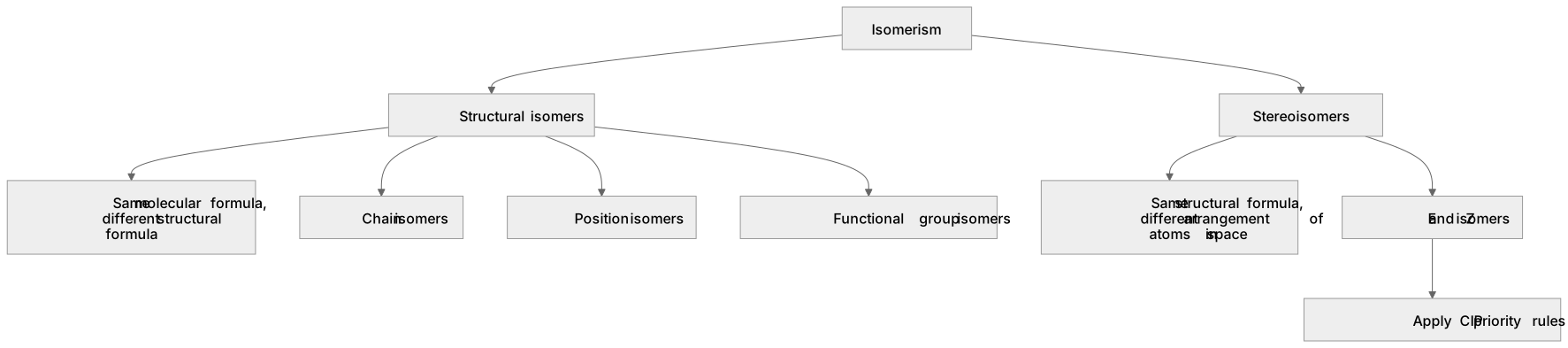
Isomerism: Students should be able to: define the term structural isomer draw the structures of chain, position and functional group isomers define the term stereoisomer draw the structural formulas of E and Z isomers apply the CIP priority rules to E and Z isomers.
This statement is the checklist for the whole isomerism topic, and C₄H₈ exercises all of it.
Checked against the AQA 7405 specification (opens in a new tab) on .
- Point 5 of 5
- 4 key terms
Study notes
From the checked teaching notes for this specification point.
The idea
This statement is the checklist for the whole isomerism topic, and C₄H₈ exercises all of it. As structural isomers you can draw but-1-ene and but-2-ene as position isomers, but-1-ene and 2-methylpropene as chain isomers, and cyclobutane as a functional group isomer with no double bond at all. As stereoisomers you can draw E-but-2-ene and Z-but-2-ene, which share a structural formula but differ in spatial arrangement. Applying CIP to but-2-ene is straightforward, because each doubly bonded carbon carries CH₃ and H, so the methyl group takes priority at both ends and Z has them on the same side. The definitions must be kept precise: structural isomers share a molecular formula, stereoisomers share a structural formula.
What earns the marks
- Defining structural isomers as having the same molecular formula but a different structural formula.
- Defining stereoisomers as having the same structural formula but a different arrangement of atoms in space.
- Each correctly drawn isomer in a required set, with the molecular formula unchanged.
- An E or Z label justified by CIP priorities rather than by appearance.
Common mistakes and how to put them right
Using the same definition for structural isomers and stereoisomers, which loses one of the two marks.
Drawing a set of isomers in which one has a different molecular formula from the rest.
Repeating the same structure in a list of isomers, drawn from a different angle.
Labelling E and Z without assigning priorities, so guessing wrongly when the four groups all differ.
Exam tips
- Learn the two definitions as a contrasting pair so that you never mix them up under pressure.
- When asked for a fixed number of isomers, count the atoms in each one before you stop.
- Show your priority assignments on the diagram whenever you apply CIP rules.
Try the lesson
The start of the Isomerism: Students should be able to: define the term structural isomer draw the structures of chain, position and functional group isomers define the term stereoisomer draw the structural formulas of E and Z isomers apply the CIP priority rules to E and Z isomers. lesson, made from checked teaching notes for this specification point.
Have a go first
Which statement defines a structural isomer?
Listen
This statement is the checklist for the whole isomerism topic, and C₄H₈ exercises all of it. As structural isomers you can draw but-1-ene and but-2-ene as position isomers, but-1-ene and 2-methylpropene as chain isomers, and cyclobutane as a functional group isomer with no double bond at all. As stereoisomers you can draw E-but-2-ene and Z-but-2-ene, which share a structural formula but differ in spatial arrangement. Applying CIP to but-2-ene is straightforward, because each doubly bonded carbon carries CH₃ and H, so the methyl group takes priority at both ends and Z has them on the same side. The definitions must be kept precise: structural isomers share a molecular formula, stereoisomers share a structural formula. A strong answer earns marks for these points. defining structural isomers as having the same molecular formula but a different structural formula. defining stereoisomers as having the same structural formula but a different arrangement of atoms in space. each correctly drawn isomer in a required set, with the molecular formula unchanged. an E or Z label justified by CIP priorities rather than by appearance. Exam tip: Learn the two definitions as a contrasting pair so that you never mix them up under pressure.
See it
Key words
Say what each word means before you turn the card.
structural isomer
Try answering aloud or in your head before turning the card.
stereoisomer
Try answering aloud or in your head before turning the card.
CIP priority rules
Try answering aloud or in your head before turning the card.
E and Z isomers
Try answering aloud or in your head before turning the card.
See every definition
- structural isomer
- A molecule with the same molecular formula as another but a different structural formula.
- stereoisomer
- A molecule with the same structural formula as another but a different arrangement of atoms in space.
- CIP priority rules
- Rules applied to assign priorities to the groups on each doubly bonded carbon so that an alkene can be labelled E or Z.
- E and Z isomers
- Stereoisomers that share a structural formula but differ in spatial arrangement, labelled using CIP priorities rather than appearance.
Label the diagram
Some boxes have lost their names. Pick the right name for each number.
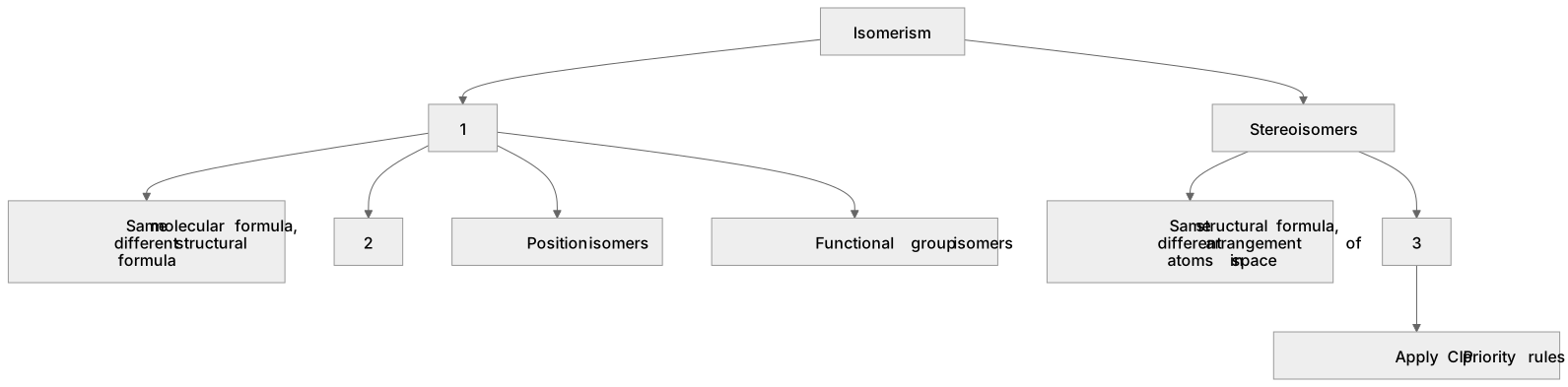
1Box 1
2Box 2
3Box 3
There is more to this lesson
The full lesson goes on to check your understanding and help you earn the marks. Create a free account to carry on, with your progress saved.
A week of Premium from your first lesson · Then the free plan continues · No card, no charge
Test your understanding of Isomerism: Students should be able to: define the term structural isomer draw the structures of chain, position and functional group isomers define the term stereoisomer draw the structural formulas of E and Z isomers apply the CIP priority rules to E and Z isomers.
Active recall beats re-reading. Take an instant quiz now to test what you’ve learned and lock it into long-term memory.
A week of Premium from your first lesson · Then the free plan continues · No card, no charge