AQA · A-Level · Chemistry
Course version: 7405 · Version from Sept 2016
Mass spectrometry can be used to determine relative molecular mass.
Full specification wording
Mass number and isotopes: Mass spectrometry can be used to determine relative molecular mass.
For a molecular sample, the peak at the highest mass-to-charge value that is not an isotope satellite is the molecular ion peak, formed when the whole molecule loses a single electron.
Checked against the AQA 7405 specification (opens in a new tab) on .
- Point 6 of 7
- 3 key terms
Study notes
From the checked teaching notes for this specification point.
The idea
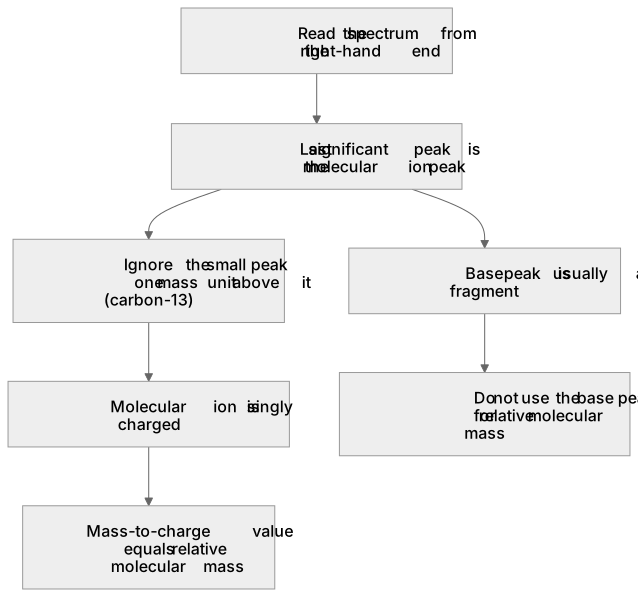
For a molecular sample, the peak at the highest mass-to-charge value that is not an isotope satellite is the molecular ion peak, formed when the whole molecule loses a single electron. For a singly charged ion its mass-to-charge value equals the relative molecular mass, so reading that peak gives the relative molecular mass directly. The tallest peak, the base peak, is usually a fragment and must not be used. A small peak one mass unit higher comes from the roughly one per cent of carbon present as carbon-13, and it is ignored when quoting relative molecular mass but can be used to estimate the number of carbon atoms.
What earns the marks
- Identifying the molecular ion peak as the peak at the highest mass-to-charge value.
- Stating that its mass-to-charge value equals the relative molecular mass when the ion is singly charged.
- Ignoring the small peak one mass unit above the molecular ion, which arises from carbon-13.
- Distinguishing the molecular ion peak from the base peak or fragment peaks.
Common mistakes and how to put them right
Using the tallest peak instead of the peak at the highest mass-to-charge value.
Quoting the peak one mass unit above the molecular ion as the relative molecular mass.
Forgetting that the reading equals relative molecular mass only for a singly charged ion.
Treating a fragment peak as evidence of a second compound in the sample.
Exam tips
- Read the spectrum from the right-hand end; the molecular ion is the last significant peak you meet.
- State that the ion is singly charged when you quote relative molecular mass from the axis.
- Use the size of the peak one mass unit above the molecular ion only when the question asks about the number of carbon atoms.
Try the lesson
The start of the Mass number and isotopes: Mass spectrometry can be used to determine relative molecular mass. lesson, made from checked teaching notes for this specification point.
Have a go first
Which quantity is determined directly from the molecular ion peak in a mass spectrum of a compound?
Listen
For a molecular sample, the peak at the highest mass-to-charge value that is not an isotope satellite is the molecular ion peak, formed when the whole molecule loses a single electron. For a singly charged ion its mass-to-charge value equals the relative molecular mass, so reading that peak gives the relative molecular mass directly. The tallest peak, the base peak, is usually a fragment and must not be used. A small peak one mass unit higher comes from the roughly one per cent of carbon present as carbon-13, and it is ignored when quoting relative molecular mass but can be used to estimate the number of carbon atoms. A strong answer earns marks for these points. identifying the molecular ion peak as the peak at the highest mass-to-charge value. stating that its mass-to-charge value equals the relative molecular mass when the ion is singly charged. ignoring the small peak one mass unit above the molecular ion, which arises from carbon-13. distinguishing the molecular ion peak from the base peak or fragment peaks. Exam tip: Read the spectrum from the right-hand end; the molecular ion is the last significant peak you meet.
See it
Key words
Say what each word means before you turn the card.
molecular ion peak
Try answering aloud or in your head before turning the card.
base peak
Try answering aloud or in your head before turning the card.
carbon-13 satellite
Try answering aloud or in your head before turning the card.
See every definition
- molecular ion peak
- The peak at the highest mass-to-charge value that is not an isotope satellite, formed when the whole molecule loses a single electron.
- base peak
- The tallest peak, which is usually a fragment and must not be used to obtain relative molecular mass.
- carbon-13 satellite
- A small peak one mass unit higher than the molecular ion, coming from the roughly one per cent of carbon present as carbon-13.
Label the diagram
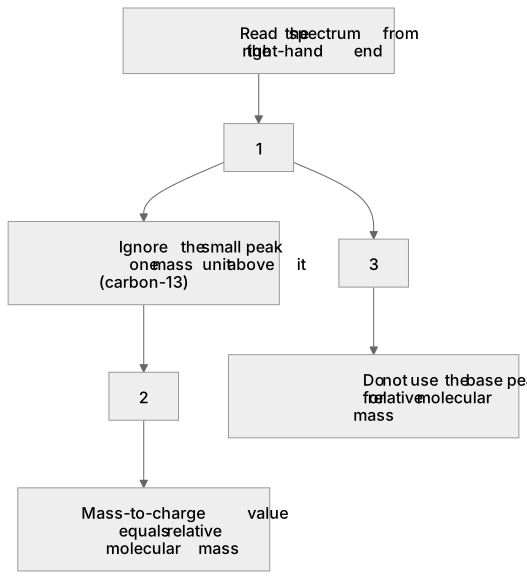
Some boxes have lost their names. Pick the right name for each number.
1Box 1
2Box 2
3Box 3
There is more to this lesson
The full lesson goes on to check your understanding and help you earn the marks. Create a free account to carry on, with your progress saved.
A week of Premium from your first lesson · Then the free plan continues · No card, no charge
Test your understanding of Mass number and isotopes: Mass spectrometry can be used to determine relative molecular mass.
Active recall beats re-reading. Take an instant quiz now to test what you’ve learned and lock it into long-term memory.
A week of Premium from your first lesson · Then the free plan continues · No card, no charge