AQA · A-Level · Chemistry
Course version: 7405 · Version from Sept 2016
Students should be able to: use precise atomic masses and the precise…
Full specification wording
Mass spectrometry: Students should be able to: use precise atomic masses and the precise molecular mass to determine the molecular formula of a compound.
Work from the precise atomic masses given in the question, for example ¹H = 1.00783, ¹²C = 12.00000, ¹⁴N = 14.00307 and ¹⁶O = 15.99491.
Checked against the AQA 7405 specification (opens in a new tab) on .
- Point 2 of 2
- 4 key terms
Study notes
From the checked teaching notes for this specification point.
The idea
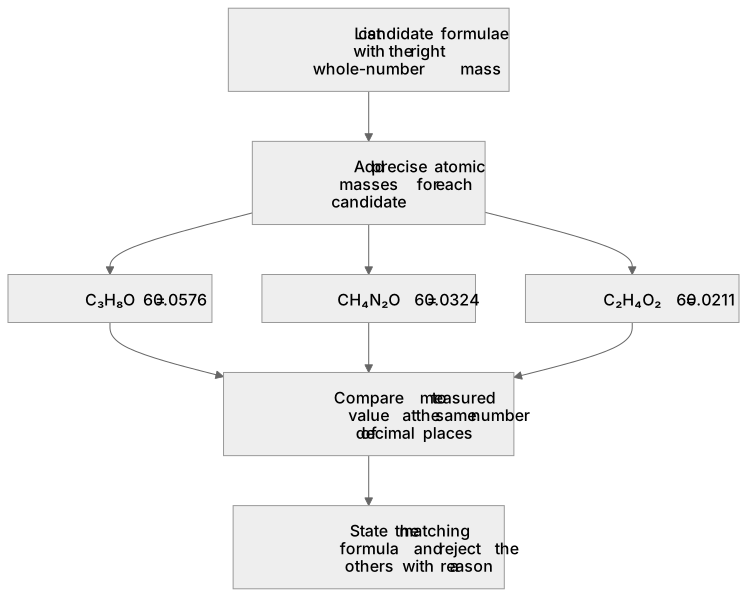
Work from the precise atomic masses given in the question, for example ¹H = 1.00783, ¹²C = 12.00000, ¹⁴N = 14.00307 and ¹⁶O = 15.99491. List the candidate formulae with the right whole-number mass, then add the precise masses for each. At a nominal mass of 60, C₃H₈O comes to 60.0576, CH₄N₂O to 60.0324 and C₂H₄O₂ to 60.0211, so a measured value of 60.0211 identifies the last of the three without ambiguity. Compare to the same number of decimal places the question quotes, and say which candidates you have rejected and why. Use the precise mass of the individual isotope, not the weighted average relative atomic mass in the periodic table, which already blends isotopes together.
What earns the marks
- Calculating the precise mass of one candidate formula from precise atomic masses.
- Calculating a second candidate for comparison.
- Comparing to the same number of decimal places as the measured value.
- Stating the formula that matches and rejecting the others with a reason.
Common mistakes and how to put them right
Using the periodic table's average relative atomic masses instead of the precise isotopic masses.
Rounding to two decimal places, at which two candidates can still look identical.
Assuming the nearest whole-number mass is enough to fix the formula.
Giving an empirical formula when the molecular formula was asked for.
Exam tips
- Set the arithmetic out element by element so a slip in one term is easy to find.
- Keep every decimal place through the working and compare only at the end.
- Always state the rejected candidate and the value that rules it out; the comparison carries a mark.
Try the lesson
The start of the Mass spectrometry: Students should be able to: use precise atomic masses and the precise molecular mass to determine the molecular formula of a compound. lesson, made from checked teaching notes for this specification point.
Have a go first
A compound of carbon, hydrogen and oxygen has a precise molecular mass of 74.0368. Using precise atomic masses C = 12.0000, H = 1.0078 and O = 15.9949, which molecular formula is consistent with this value?
Listen
Work from the precise atomic masses given in the question, for example ¹H = 1.00783, ¹²C = 12.00000, ¹⁴N = 14.00307 and ¹⁶O = 15.99491. List the candidate formulae with the right whole-number mass, then add the precise masses for each. At a nominal mass of 60, C₃H₈O comes to 60.0576, CH₄N₂O to 60.0324 and C₂H₄O₂ to 60.0211, so a measured value of 60.0211 identifies the last of the three without ambiguity. Compare to the same number of decimal places the question quotes, and say which candidates you have rejected and why. Use the precise mass of the individual isotope, not the weighted average relative atomic mass in the periodic table, which already blends isotopes together. A strong answer earns marks for these points. calculating the precise mass of one candidate formula from precise atomic masses. calculating a second candidate for comparison. comparing to the same number of decimal places as the measured value. stating the formula that matches and rejecting the others with a reason. Exam tip: Set the arithmetic out element by element so a slip in one term is easy to find.
See it
Key words
Say what each word means before you turn the card.
precise atomic masses
Try answering aloud or in your head before turning the card.
candidate formulae
Try answering aloud or in your head before turning the card.
comparison to several decimal places
Try answering aloud or in your head before turning the card.
rejecting alternatives
Try answering aloud or in your head before turning the card.
See every definition
- precise atomic masses
- The masses given in the question for individual isotopes, used instead of the weighted average relative atomic mass in the periodic table.
- candidate formulae
- Formulae with the right whole-number mass that are listed and then added up using the precise masses.
- comparison to several decimal places
- Comparing the calculated value to the same number of decimal places the question quotes, keeping every decimal place through the working.
- rejecting alternatives
- Stating the formula that matches and rejecting the others with a reason, quoting the value that rules each one out.
Label the diagram
Some boxes have lost their names. Pick the right name for each number.
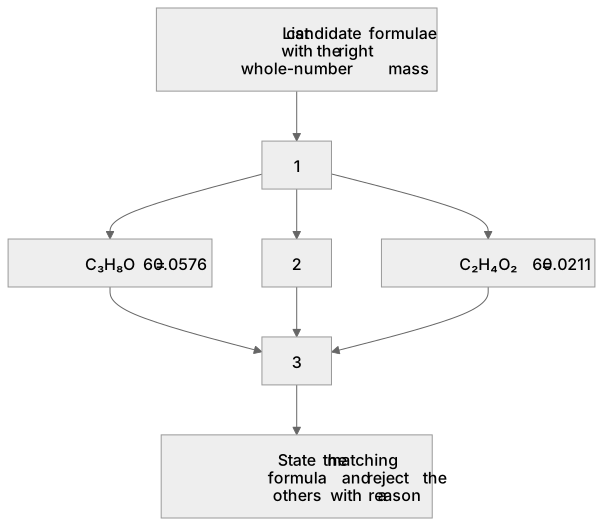
1Box 1
2Box 2
3Box 3
There is more to this lesson
The full lesson goes on to check your understanding and help you earn the marks. Create a free account to carry on, with your progress saved.
A week of Premium from your first lesson · Then the free plan continues · No card, no charge
Test your understanding of Mass spectrometry: Students should be able to: use precise atomic masses and the precise molecular mass to determine the molecular formula of a compound.
Active recall beats re-reading. Take an instant quiz now to test what you’ve learned and lock it into long-term memory.
A week of Premium from your first lesson · Then the free plan continues · No card, no charge