AQA · A-Level · Chemistry
Course version: 7405 · Version from Sept 2016
Metallic bonding involves attraction between delocalised electrons and…
Full specification wording
Metallic bonding: Metallic bonding involves attraction between delocalised electrons and positive ions arranged in a lattice.
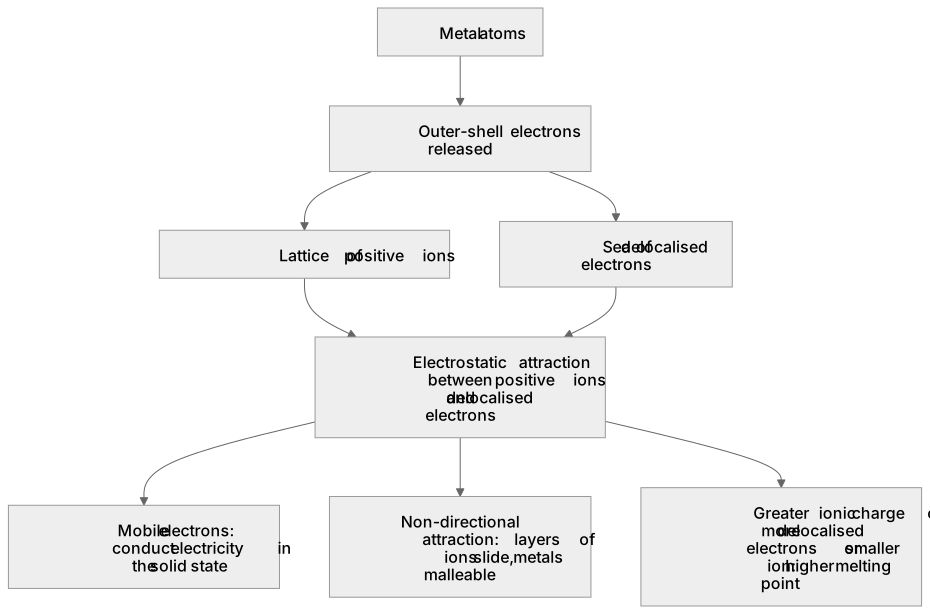
In a metal each atom releases its outer-shell electrons into the structure, leaving a regular lattice of positive ions in a sea of delocalised electrons that are free to move throughout the whole…
Checked against the AQA 7405 specification (opens in a new tab) on .
- 2 key terms
Study notes
From the checked teaching notes for this specification point.
The idea
In a metal each atom releases its outer-shell electrons into the structure, leaving a regular lattice of positive ions in a sea of delocalised electrons that are free to move throughout the whole solid. The bond is the electrostatic attraction between those positive ions and the delocalised electrons. Strength grows with the charge on the ion and with the number of electrons each atom releases, and falls as the ion gets larger, so magnesium with 2⁺ ions and two delocalised electrons per atom melts far above sodium. Because the electrons are mobile, metals conduct electricity in the solid state, and because the attraction is not directional, layers of ions can slide over each other, making metals malleable.
What earns the marks
- A lattice of positive ions or cations.
- Delocalised electrons released from the outer shell.
- Electrostatic attraction between the positive ions and the delocalised electrons.
- Linking a greater ionic charge, more delocalised electrons or a smaller ion to a higher melting point.
Common mistakes and how to put them right
Describing metallic bonding as attraction between atoms rather than between ions and electrons.
Saying the electrons come from the nucleus instead of from the outer shell.
Claiming the delocalised electrons still belong to individual atoms.
Saying that covalent bonds break when a metal melts.
Writing sea of electrons without naming the electrostatic attraction.
Exam tips
- Give all three components in a definition: positive ions, delocalised electrons, electrostatic attraction.
- When comparing metals, state the ionic charge and the number of delocalised electrons per atom explicitly.
- Explain conductivity by mobile electrons, and malleability by layers of ions sliding.
Try the lesson
The start of the Metallic bonding: Metallic bonding involves attraction between delocalised electrons and positive ions arranged in a lattice. lesson, made from checked teaching notes for this specification point.
Have a go first
In the metallic bonding model, which particles are delocalised and free to move throughout the structure?
Listen
In a metal each atom releases its outer-shell electrons into the structure, leaving a regular lattice of positive ions in a sea of delocalised electrons that are free to move throughout the whole solid. The bond is the electrostatic attraction between those positive ions and the delocalised electrons. Strength grows with the charge on the ion and with the number of electrons each atom releases, and falls as the ion gets larger, so magnesium with 2⁺ ions and two delocalised electrons per atom melts far above sodium. Because the electrons are mobile, metals conduct electricity in the solid state, and because the attraction is not directional, layers of ions can slide over each other, making metals malleable. A strong answer earns marks for these points. a lattice of positive ions or cations. delocalised electrons released from the outer shell. electrostatic attraction between the positive ions and the delocalised electrons. linking a greater ionic charge, more delocalised electrons or a smaller ion to a higher melting point. Exam tip: Give all three components in a definition: positive ions, delocalised electrons, electrostatic attraction.
See it
Key words
Say what each word means before you turn the card.
delocalised electrons
Try answering aloud or in your head before turning the card.
lattice of cations
Try answering aloud or in your head before turning the card.
See every definition
- delocalised electrons
- Outer-shell electrons released into the structure that are free to move throughout the whole solid.
- lattice of cations
- A regular arrangement of positive ions left behind when each atom releases its outer-shell electrons.
Label the diagram
Some boxes have lost their names. Pick the right name for each number.
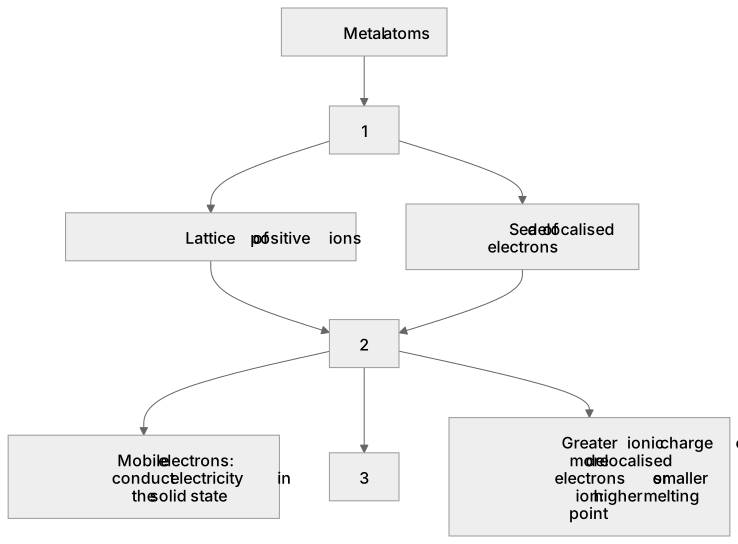
1Box 1
2Box 2
3Box 3
There is more to this lesson
The full lesson goes on to check your understanding and help you earn the marks. Create a free account to carry on, with your progress saved.
A week of Premium from your first lesson · Then the free plan continues · No card, no charge
Test your understanding of Metallic bonding: Metallic bonding involves attraction between delocalised electrons and positive ions arranged in a lattice.
Active recall beats re-reading. Take an instant quiz now to test what you’ve learned and lock it into long-term memory.
A week of Premium from your first lesson · Then the free plan continues · No card, no charge