AQA · A-Level · Chemistry
Course version: 7405 · Version from Sept 2016
Students should be able to represent: a covalent bond using a line a…
Full specification wording
Nature of covalent and dative covalent bonds: Students should be able to represent: a covalent bond using a line a co-ordinate bond using an arrow.
Representation carries its own marks.
Checked against the AQA 7405 specification (opens in a new tab) on .
- Point 4 of 4
- 4 key terms
Study notes
From the checked teaching notes for this specification point.
The idea
Representation carries its own marks. An ordinary covalent bond is drawn as a straight line between the two atoms, one line for each shared pair. A co-ordinate bond is drawn as an arrow whose head points from the atom supplying the lone pair towards the atom receiving it, so in the ammonium ion the arrow runs from nitrogen to the added hydrogen. Do not confuse this with a curly arrow, which is reserved for showing the movement of an electron pair in a mechanism and must start at a lone pair or a bond. A displayed formula must show every atom and every bond, and an ion needs its charge written outside a square bracket enclosing the whole species.
What earns the marks
- A straight line drawn for each shared pair in an ordinary covalent bond.
- An arrow drawn for the co-ordinate bond.
- The arrowhead pointing from the donor atom towards the acceptor atom.
- The overall charge shown outside a bracket enclosing the whole ion.
Common mistakes and how to put them right
Drawing a curly arrow, which means the movement of an electron pair, in place of the straight dative arrow.
Pointing the arrow from the acceptor back to the donor.
Drawing four plain lines in the ammonium ion so the dative bond cannot be identified.
Leaving the charge off the ion or placing it on a single atom rather than outside the bracket.
Exam tips
- Read the question: if it says show the co-ordinate bond, a plain line will not score.
- In a displayed formula show all bonds and all atoms, including every hydrogen.
- Keep diagrams unambiguous; a structure open to two readings earns nothing.
Try the lesson
The start of the Nature of covalent and dative covalent bonds: Students should be able to represent: a covalent bond using a line a co-ordinate bond using an arrow. lesson, made from checked teaching notes for this specification point.
Have a go first
In a displayed structure, which symbol is used to show a co-ordinate bond?
Listen
Representation carries its own marks. An ordinary covalent bond is drawn as a straight line between the two atoms, one line for each shared pair. A co-ordinate bond is drawn as an arrow whose head points from the atom supplying the lone pair towards the atom receiving it, so in the ammonium ion the arrow runs from nitrogen to the added hydrogen. Do not confuse this with a curly arrow, which is reserved for showing the movement of an electron pair in a mechanism and must start at a lone pair or a bond. A displayed formula must show every atom and every bond, and an ion needs its charge written outside a square bracket enclosing the whole species. A strong answer earns marks for these points. a straight line drawn for each shared pair in an ordinary covalent bond. an arrow drawn for the co-ordinate bond. the arrowhead pointing from the donor atom towards the acceptor atom. the overall charge shown outside a bracket enclosing the whole ion. Exam tip: Read the question: if it says show the co-ordinate bond, a plain line will not score.
See it

Key words
Say what each word means before you turn the card.
lines for covalent bonds
Try answering aloud or in your head before turning the card.
arrows for dative bonds
Try answering aloud or in your head before turning the card.
arrow direction
Try answering aloud or in your head before turning the card.
charges on ions
Try answering aloud or in your head before turning the card.
See every definition
- lines for covalent bonds
- A straight line is drawn between the two atoms, one line for each shared pair in an ordinary covalent bond.
- arrows for dative bonds
- An arrow is drawn for a co-ordinate bond, whose head points from the atom supplying the lone pair towards the atom receiving it.
- arrow direction
- The arrowhead points from the donor atom towards the acceptor atom, so in the ammonium ion the arrow runs from nitrogen to the added hydrogen.
- charges on ions
- An ion needs its charge written outside a square bracket enclosing the whole species.
Label the diagram
Some boxes have lost their names. Pick the right name for each number.
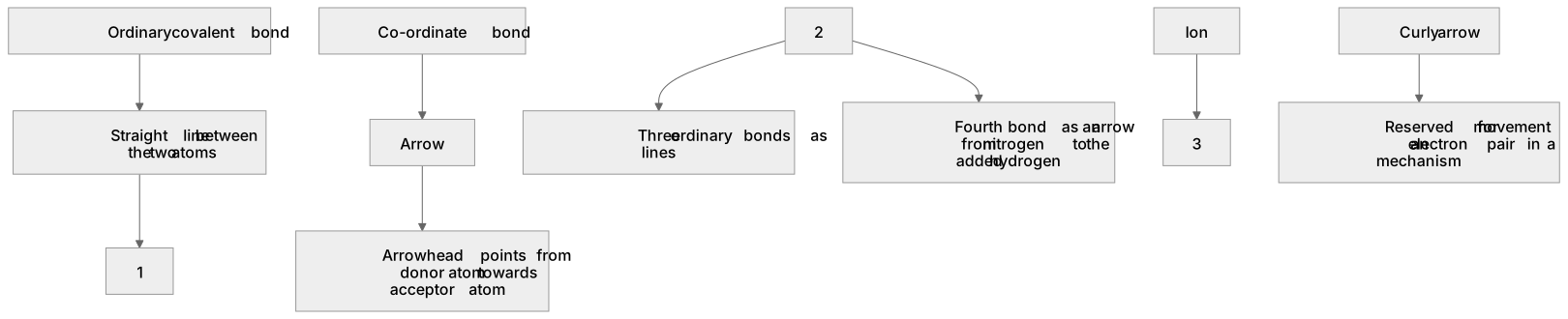
1Box 1
2Box 2
3Box 3
There is more to this lesson
The full lesson goes on to check your understanding and help you earn the marks. Create a free account to carry on, with your progress saved.
A week of Premium from your first lesson · Then the free plan continues · No card, no charge
Test your understanding of Nature of covalent and dative covalent bonds: Students should be able to represent: a covalent bond using a line a co-ordinate bond using an arrow.
Active recall beats re-reading. Take an instant quiz now to test what you’ve learned and lock it into long-term memory.
A week of Premium from your first lesson · Then the free plan continues · No card, no charge