Study Notes
Specification Scope and Overview
Important scope note: The supplied code, 3.3.7, maps to AQA A-level Chemistry 7405, where optical isomerism is explicitly labelled A-level only. The exam board was listed as unknown, so this guide uses AQA-compatible wording while prioritising transferable A-level chemistry skills. It is not GCSE Foundation or Higher content. 1
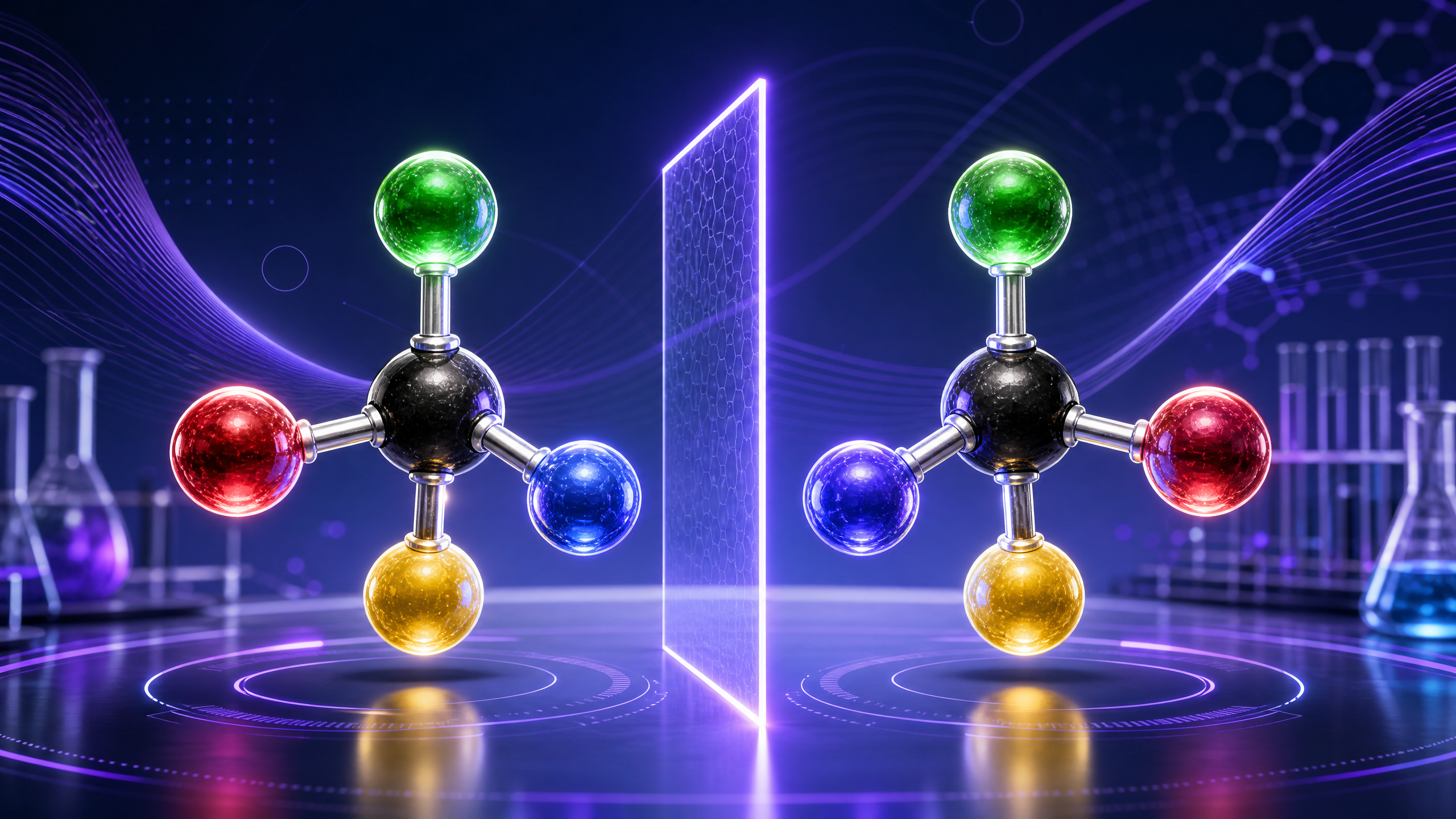
Optical isomerism is the part of organic chemistry where a molecule's three-dimensional shape becomes examinable. Two molecules can have the same molecular formula, the same displayed formula and the same bonds, yet behave differently because their atoms occupy different positions in space. This matters in examinations because candidates must move beyond flat formulae: they need to recognise a chiral centre, draw stereochemical bonds accurately, and explain what happens when plane-polarised light passes through a sample.
The topic connects directly to nucleophilic addition to aldehydes and ketones, amino acids, enzymes and pharmaceuticals. A typical paper begins with a short AO1 task such as identifying a chiral carbon. It then moves into AO2 by asking candidates to draw an enantiomer or explain why a synthesis gives a racemic mixture. The strongest responses use a precise causal sequence rather than an isolated definition: planar carbonyl → attack from either side → equal enantiomers → opposite optical rotations cancel.
Key Concepts
1. Where Optical Isomerism Fits
Isomers have the same molecular formula but differ in some way. Structural isomers have different atom connectivity: the atoms are joined in a different order. Stereoisomers have the same structural formula and the same connectivity, but their atoms are arranged differently in space. Optical isomerism is one form of stereoisomerism; E/Z isomerism is another. Candidates lose simple marks when they call enantiomers structural isomers, so start every answer with the correct classification.
| Comparison point | Structural isomers | Optical isomers / enantiomers |
|---|---|---|
| Connectivity of atoms | Different | The same |
| Arrangement in space | May differ as a result of connectivity | Different 3D arrangement |
| Key exam language | Different structural formulae | Non-superimposable mirror images |
| Common test | Identify chain, position or functional-group isomerism | Identify chirality, draw 3D mirror images |
The AQA specification limits this content to molecules with a single chiral centre. Do not waste time trying to apply advanced R/S naming or multiple-chiral-centre cases unless your own board specifically requires them. 1
2. Chirality and the Asymmetric Carbon Atom
A chiral centre is an asymmetric carbon atom bonded to four different groups or atoms. This exact phrase is the safest one-mark definition. The carbon is usually tetrahedral, so the four groups point into three-dimensional space. If every group is different, the arrangement has a handedness: it can exist as a left-handed or right-handed form.
Use a deliberate checking routine in a question. First, select a carbon with four single bonds. Second, list the four things attached to it. Third, compare the complete groups, not merely the first atom. For example, in 2-chlorobutane, carbon-2 is attached to H, Cl, CH₃ and C₂H₅. These are four different groups, so carbon-2 is chiral. In propan-2-ol, the central carbon is attached to OH, H and two CH₃ groups. The repeated methyl group means it is not chiral.
This is a frequent discriminator question. A carbon with four bonds is not automatically a chiral carbon: saturated carbon atoms normally make four bonds. The examiner awards credit only when candidates establish four different attachments. In a displayed formula, put an asterisk beside the relevant carbon if the question asks you to identify it.
3. Enantiomers: Non-Superimposable Mirror Images
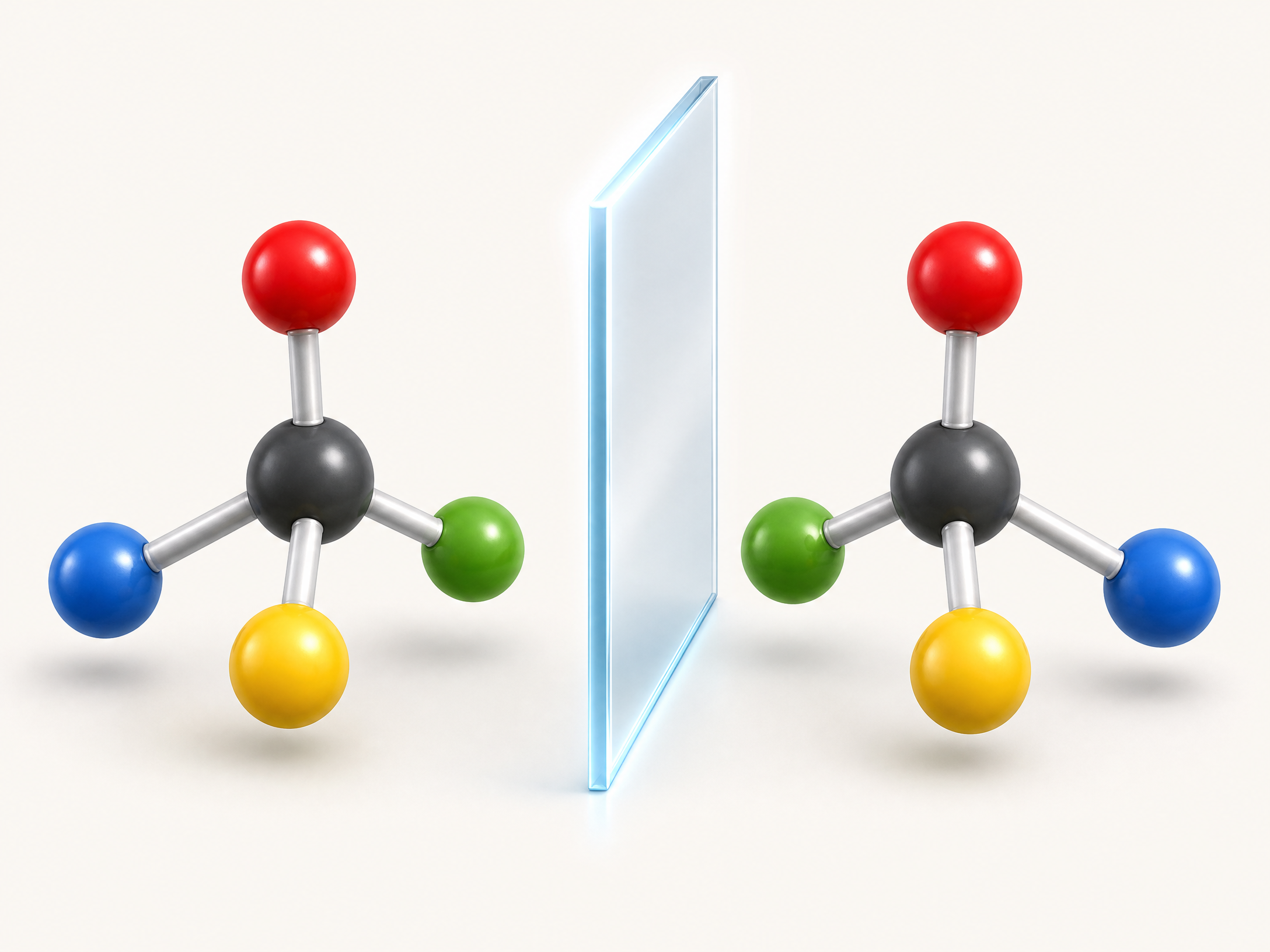
When a molecule contains one chiral centre, it can form two optical isomers called enantiomers. They are mirror images of each other, but cannot be placed exactly on top of one another by rotation. The hands analogy is useful: your left and right hands have the same components, but a left glove will not fit a right hand. The critical examiner phrase is non-superimposable mirror images. Writing only “mirror images” is incomplete because a molecule could be mirror-symmetrical and therefore superimposable.
To draw a 3D representation, use a central carbon with four bonds in a tetrahedral arrangement. An ordinary line represents a bond in the plane of the paper. A solid wedge represents a bond projecting towards the reader. A dashed wedge represents a bond projecting behind the paper. Draw one enantiomer first, then draw a vertical dashed mirror line and reflect every group across it. The groups must be the same, connectivity must stay the same and the wedge/dash directions must be the exact reflected arrangement.
| Drawing feature | Meaning | Mark-scheme risk |
|---|---|---|
| Ordinary line | Bond lies in the paper's plane | Acceptable only as part of a full 3D drawing |
| Solid wedge | Bond projects towards the reader | Reversing it changes stereochemistry |
| Dashed wedge | Bond projects away from the reader | Omitting it can make the drawing ambiguous |
| Mirror line | Helps construct the second enantiomer | Not required, but prevents drawing the same isomer twice |
A pair of 2D structures that can be rotated to overlap is not a pair of enantiomers. When in doubt, use the mirror-line method instead of redrawing from memory.
4. Plane-Polarised Light and Optical Activity
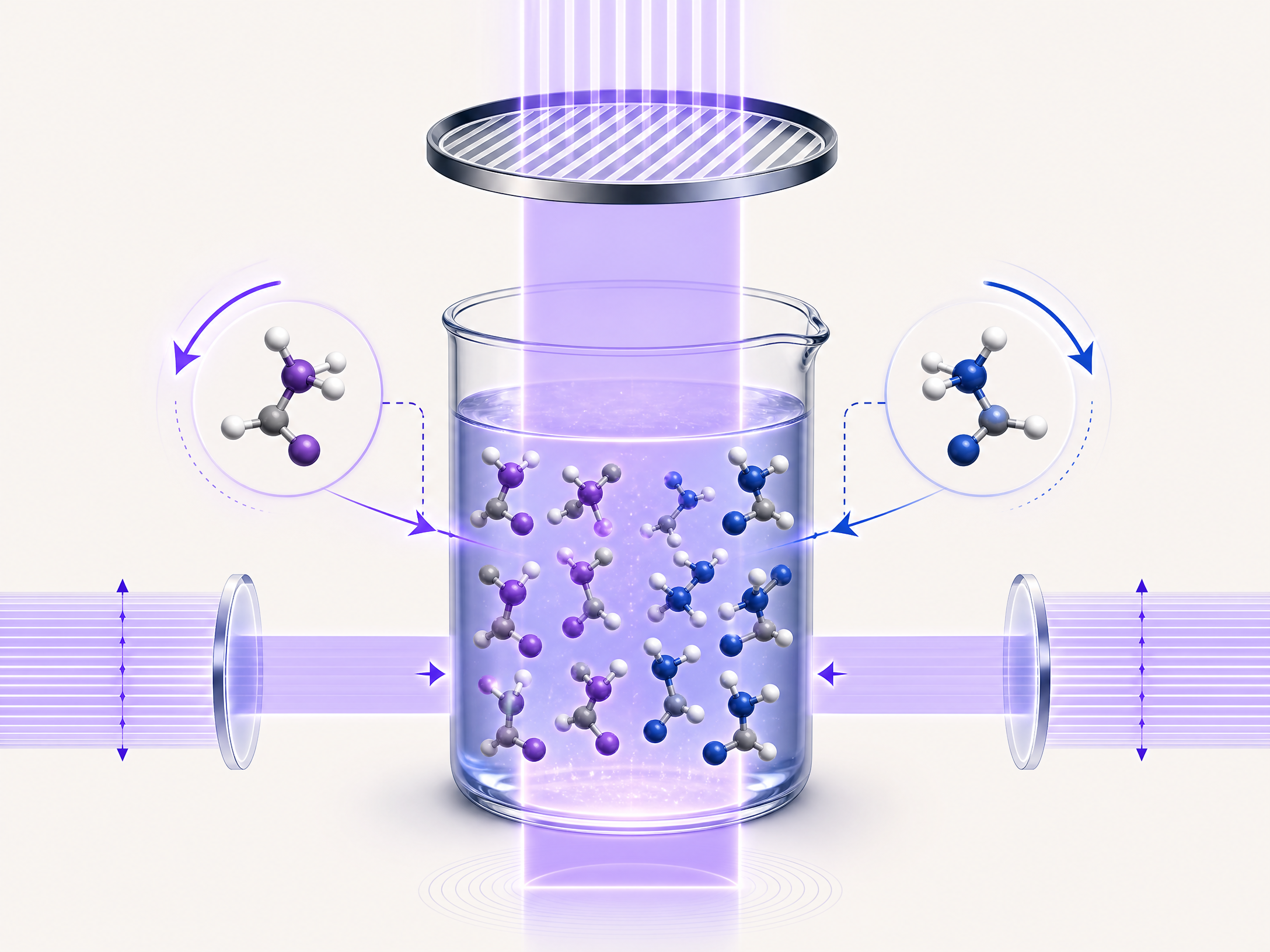
The word “optical” comes from the interaction with plane-polarised light. Normal light vibrates in many planes. After passing through a polarising filter, its vibrations are confined to one plane. A solution containing one pure enantiomer rotates that plane: one enantiomer rotates it clockwise and its partner rotates it anticlockwise by the same angle, under identical conditions.
A pure enantiomer is therefore optically active. The two enantiomers otherwise have identical formulae, connectivity and many physical properties in an achiral environment. Do not claim that one enantiomer is automatically “more reactive” or has a different boiling point. Their handedness becomes important when the molecule meets another chiral object, such as an enzyme, receptor or chiral reagent.
Candidates do not need to predict whether an unlabelled displayed formula is clockwise- or anticlockwise-rotating. A formula alone does not identify the sign of rotation. If a question asks how to distinguish enantiomers, the correct method is to pass plane-polarised light through separate samples and observe equal rotation in opposite directions.
5. Racemic Mixtures: Equal and Opposite
A racemic mixture, also called a racemate, contains equal amounts of the two enantiomers. It is a 50:50 mixture, not merely a sample containing “both isomers”. That equality explains its key property: it is optically inactive.
The full explanation is worth learning as a linked chain. Each enantiomer rotates plane-polarised light. One rotates it clockwise by an angle θ; the other rotates it anticlockwise by the same angle θ. In an equal mixture, the rotations cancel. The net rotation is zero, so the sample has no overall effect on the plane of polarisation.
The phrase “the racemate does not rotate light” is too loose for a high-mark explanation because it skips the mechanism of cancellation. Credit is given for saying that equal amounts of enantiomers cause equal and opposite rotations, which cancel. This distinction is particularly important when the command word is explain rather than state.
6. Why Carbonyl Reactions Often Form Racemates
This is the most valuable synoptic link. In an aldehyde or ketone, the carbonyl carbon is trigonal planar. That means the C=O part of the molecule is flat. During nucleophilic addition, a nucleophile such as CN⁻ can attack from above the plane or below the plane. In an achiral reaction environment, both directions are equally likely.
If the reaction creates a new chiral centre, attack from one side creates one enantiomer and attack from the other side creates its mirror image. Equal likelihood produces equal quantities. Therefore, the reaction produces a racemic mixture, which is optically inactive because its opposite rotations cancel. This is an explanation chain in which every statement can be a separate marking point.
Six-mark sequencing: planar carbonyl group → nucleophile attacks from either face → two enantiomers are formed → equal quantities form a racemate → opposite rotations of plane-polarised light cancel → no overall rotation.
Mathematical and Scientific Relationships
There is no numerical formula to calculate in this specification. However, candidates should use the following symbolic relationship to organise a written explanation:
| Relationship | Status | What it means in an answer |
|---|---|---|
| Net optical rotation = (+θ) + (−θ) = 0° | Must understand, not a formula-sheet equation | Equal enantiomer amounts make the overall rotation zero |
| Chiral centre = carbon bonded to four different groups | Must memorise | This is the standard one-mark definition |
| Racemate = 50:50 enantiomer mixture | Must memorise | “Equal amounts” is essential for full credit |
There are no unit conversions required. Rotation may be described in degrees, but calculation of specific rotation is beyond this topic. Likewise, there is no compulsory graph skill. If a data question presents polarimeter readings, interpret a positive and negative reading as opposite rotations and a reading of 0° as no net rotation; do not infer that no enantiomers are present without considering a racemate.
Practical Opportunity: Polarised Light (Not a Required Practical)
AQA lists passing polarised light through a sucrose solution as a practical-skills opportunity, rather than a named compulsory required practical for this section. 1 It can nevertheless be examined as a method, observation or data-interpretation context.
| Aspect | Revision-ready answer |
|---|---|
| Apparatus | Light source, polariser, transparent cell containing a solution, analyser, polarimeter or rotation scale, appropriate eye protection |
| Method | Pass light through the polariser, then through the sample. Rotate the analyser until the transmitted light reaches the chosen reference condition. Record the angular change. Repeat for reliability. |
| Expected result | A single optically active substance changes the angle; a racemic mixture gives no net change. |
| Common errors | Comparing unequal concentrations or path lengths; treating a zero reading as proof that no chiral molecules exist; failing to use the same temperature or wavelength. |
| How examiners test it | Identify a control variable, explain a zero reading, distinguish accuracy from reliability, or link readings to the composition of a sample. |
Practical Applications and Synoptic Meaning
Optical isomerism matters because biological molecules are often chiral. Enzymes and receptors have precise three-dimensional shapes. A drug enantiomer may fit a receptor differently from its mirror image, so chemists may aim to produce or separate a particular enantiomer. In an exam, the credit-worthy explanation is that the molecules and biological targets have complementary 3D shapes; avoid an unsupported claim that one mirror image must always be harmful.
The topic also reinforces two other parts of the specification. First, it develops your understanding of organic mechanisms: the geometry of an intermediate or reactant controls the product mixture. Second, it makes amino acid and protein chemistry more meaningful, because most amino acids contain a chiral centre. Third, it helps with classification questions that distinguish E/Z isomerism from optical isomerism.
Final Examiner Checklist
Before moving on, cover the guide and check that you can do all of the following without help. You should be able to define a chiral centre using the word different; identify one in a complex displayed formula; draw a pair of enantiomers with wedges and dashes; define a racemate as equal amounts of enantiomers; and explain optical inactivity using the word cancel. Candidates who write each causal step explicitly are awarded marks more reliably than candidates who rely on vague phrases such as “they balance out”.
References
Visual Resources
2 diagrams and illustrations
Interactive Diagrams
2 interactive diagrams to visualise key concepts
Conceptual Flow Outline
A decision route for identifying a chiral centre and the resulting enantiomers.
Conceptual Flow Outline
How attack on either face of a planar carbonyl group can form an optically inactive racemate.
Worked Examples
4 detailed examples with solutions and examiner commentary
Practice Questions
Test your understanding — click to reveal model answers
State the condition needed for a carbon atom to be a chiral centre. [1 mark]
Hint: Use the word 'different'.
Identify the chiral centre in 3-methylhexane and explain your choice. [2 marks]
Hint: Compare the groups attached to carbon-3, not just their first atom.
Explain how two enantiomers can be distinguished experimentally. [2 marks]
Hint: The clue is in the word 'optical'.
A sample contains equal amounts of two enantiomers. Explain its effect on plane-polarised light. [3 marks]
Hint: State the direction and size of the two rotations before concluding.
Aldehyde X reacts with HCN and the product has a new chiral centre. Explain why the product is expected to be a racemic mixture. [4 marks]
Hint: Start with the geometry of the C=O group.
Evaluate why a pharmaceutical company may prefer a single enantiomer to a racemic mixture for a chiral medicine. [4 marks]
Hint: Make a balanced point about activity, safety and the cost or complexity of production.