AQA · A-Level · Chemistry
Course version: 7405 · Version from Sept 2016
Primary alcohols can be oxidised to aldehydes which can be further…
Full specification wording
Oxidation of alcohols: Primary alcohols can be oxidised to aldehydes which can be further oxidised to carboxylic acids.
A primary alcohol has two hydrogen atoms on the carbon carrying the hydroxyl group, so it can be oxidised twice.
Checked against the AQA 7405 specification (opens in a new tab) on .
- Point 2 of 6
- 4 key terms
Study notes
From the checked teaching notes for this specification point.
The idea
A primary alcohol has two hydrogen atoms on the carbon carrying the hydroxyl group, so it can be oxidised twice. The first step gives an aldehyde, CH₃CH₂OH + [O] → CH₃CHO + H₂O; the second gives a carboxylic acid, CH₃CHO + [O] → CH₃COOH. The method decides which you isolate. To stop at the aldehyde, add the oxidising agent slowly to the alcohol and distil the aldehyde off as it forms, since it boils lower than the alcohol, having no hydrogen bonding. To reach the carboxylic acid, heat under reflux with an excess of oxidising agent so the aldehyde is returned to the flask and oxidised again. Acidified dichromate turns from orange to green as it works.
What earns the marks
- The first equation using [O], with water shown as a product.
- The second equation using [O], with no water formed at that step.
- Distilling the aldehyde off as it forms, so it is not oxidised further.
- Heating under reflux with excess oxidising agent to obtain the carboxylic acid.
Common mistakes and how to put them right
Omitting the water from the first oxidation so the equation does not balance.
Swapping the methods, saying reflux gives the aldehyde and distillation gives the acid.
Explaining that the aldehyde distils off because it is more soluble, rather than because it boils lower.
Adding water to the second equation, when no hydrogen is removed from the aldehyde.
Exam tips
- Balance [O] equations by counting oxygen last; each [O] supplies exactly one oxygen atom.
- State the apparatus, distillation or reflux, as part of any answer about which product forms.
- Explain the low boiling point of the aldehyde by its lack of hydrogen bonding.
Try the lesson
The start of the Oxidation of alcohols: Primary alcohols can be oxidised to aldehydes which can be further oxidised to carboxylic acids. lesson, made from checked teaching notes for this specification point.
Have a go first
Which product is formed when a primary alcohol is oxidised and the aldehyde produced is then oxidised further?
Listen
A primary alcohol has two hydrogen atoms on the carbon carrying the hydroxyl group, so it can be oxidised twice. The first step gives an aldehyde, CH₃CH₂OH + [O] → CH₃CHO + H₂O; the second gives a carboxylic acid, CH₃CHO + [O] → CH₃COOH. The method decides which you isolate. To stop at the aldehyde, add the oxidising agent slowly to the alcohol and distil the aldehyde off as it forms, since it boils lower than the alcohol, having no hydrogen bonding. To reach the carboxylic acid, heat under reflux with an excess of oxidising agent so the aldehyde is returned to the flask and oxidised again. Acidified dichromate turns from orange to green as it works. A strong answer earns marks for these points. the first equation using [O], with water shown as a product. the second equation using [O], with no water formed at that step. distilling the aldehyde off as it forms, so it is not oxidised further. heating under reflux with excess oxidising agent to obtain the carboxylic acid. Exam tip: Balance [O] equations by counting oxygen last; each [O] supplies exactly one oxygen atom.
See it
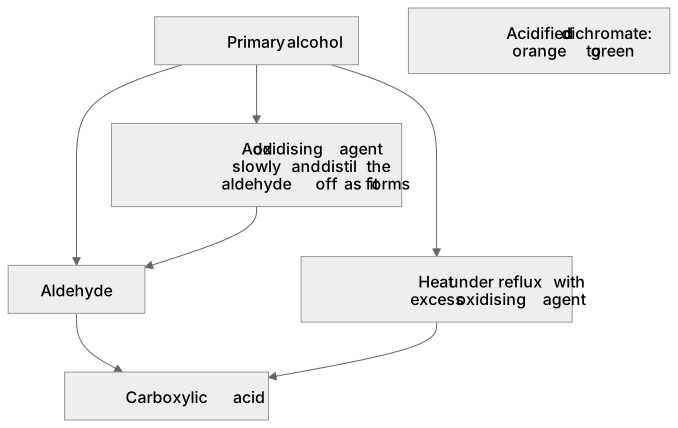
Key words
Say what each word means before you turn the card.
two stage oxidation
Try answering aloud or in your head before turning the card.
aldehyde then carboxylic acid
Try answering aloud or in your head before turning the card.
distillation against reflux
Try answering aloud or in your head before turning the card.
orange to green colour change
Try answering aloud or in your head before turning the card.
See every definition
- two stage oxidation
- A primary alcohol has two hydrogen atoms on the carbon carrying the hydroxyl group, so it can be oxidised twice.
- aldehyde then carboxylic acid
- The first step gives an aldehyde and the second gives a carboxylic acid.
- distillation against reflux
- Distilling the aldehyde off as it forms stops at the aldehyde, while heating under reflux with excess oxidising agent reaches the carboxylic acid.
- orange to green colour change
- Acidified dichromate turns from orange to green as it works.
Label the diagram
Some boxes have lost their names. Pick the right name for each number.
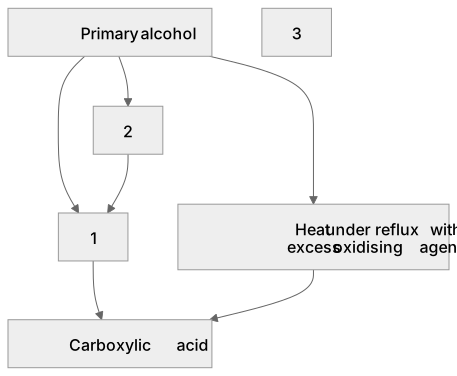
1Box 1
2Box 2
3Box 3
There is more to this lesson
The full lesson goes on to check your understanding and help you earn the marks. Create a free account to carry on, with your progress saved.
A week of Premium from your first lesson · Then the free plan continues · No card, no charge
Test your understanding of Oxidation of alcohols: Primary alcohols can be oxidised to aldehydes which can be further oxidised to carboxylic acids.
Active recall beats re-reading. Take an instant quiz now to test what you’ve learned and lock it into long-term memory.
A week of Premium from your first lesson · Then the free plan continues · No card, no charge