AQA · A-Level · Chemistry
Course version: 7405 · Version from Sept 2016
Students should be able to: work out the oxidation state of an element in…
Full specification wording
Oxidation, reduction and redox equations: Students should be able to: work out the oxidation state of an element in a compound or ion from the formula write half-equations identifying the oxidation and reduction processes in redox reactions combine half-equations to give an overall redox equation.
Half equations separate a redox reaction into the electron loss and the electron gain.
Checked against the AQA 7405 specification (opens in a new tab) on .
- Point 4 of 4
- 4 key terms
Study notes
From the checked teaching notes for this specification point.
The idea
Half equations separate a redox reaction into the electron loss and the electron gain. Build each one in a fixed order: balance the element being oxidised or reduced, balance oxygen by adding H₂O, balance hydrogen by adding H⁺, then balance the charge by adding electrons to the more positive side. For manganate(VII) this gives MnO₄⁻ + 8H⁺ + 5e⁻ → Mn²⁺ + 4H₂O, and for ethanedioate C₂O₄²⁻ → 2CO₂ + 2e⁻. To combine them, scale each so the electrons cancel, here by two and by five, then add and cancel anything appearing on both sides: 2MnO₄⁻ + 5C₂O₄²⁻ + 16H⁺ → 2Mn²⁺ + 10CO₂ + 8H₂O. Check that the atoms and the total charge balance on both sides.
What earns the marks
- Each correctly balanced half equation, with H₂O and H⁺ used to balance oxygen and hydrogen.
- Electrons added to the correct side so that the charges balance.
- Scaling the half equations so the electrons cancel exactly.
- The combined equation with electrons cancelled and both atoms and charge balanced.
Common mistakes and how to put them right
Adding OH⁻ to balance oxygen in an acidified reaction, where H₂O and H⁺ are required.
Putting the electrons on the wrong side, so an oxidation is written as a reduction.
Adding two half equations without scaling them first, leaving electrons in the final equation.
Balancing the atoms but not checking the total charge on each side.
Leaving H⁺ and H₂O uncancelled when they appear on both sides of the combined equation.
Exam tips
- Work through the order every time: element, oxygen with water, hydrogen with H⁺, charge with electrons.
- Write the number of electrons under each half equation and find the lowest common multiple before adding.
- Finish by totalling the charge on both sides; it is the fastest check that the equation is right.
Try the lesson
The start of the Oxidation, reduction and redox equations: Students should be able to: work out the oxidation state of an element in a compound or ion from the formula write half-equations identifying the oxidation and reduction processes in redox reactions combine half-equations to give an overall redox equation. lesson, made from checked teaching notes for this specification point.
Have a go first
In the half-equation Fe²⁺ → Fe³⁺ + e⁻, which process is occurring?
Listen
Half equations separate a redox reaction into the electron loss and the electron gain. Build each one in a fixed order: balance the element being oxidised or reduced, balance oxygen by adding H₂O, balance hydrogen by adding H⁺, then balance the charge by adding electrons to the more positive side. For manganate(VII) this gives MnO₄⁻ + 8H⁺ + 5e⁻ → Mn²⁺ + 4H₂O, and for ethanedioate C₂O₄²⁻ → 2CO₂ + 2e⁻. To combine them, scale each so the electrons cancel, here by two and by five, then add and cancel anything appearing on both sides: 2MnO₄⁻ + 5C₂O₄²⁻ + 16H⁺ → 2Mn²⁺ + 10CO₂ + 8H₂O. Check that the atoms and the total charge balance on both sides. A strong answer earns marks for these points. each correctly balanced half equation, with H₂O and H⁺ used to balance oxygen and hydrogen. electrons added to the correct side so that the charges balance. scaling the half equations so the electrons cancel exactly. the combined equation with electrons cancelled and both atoms and charge balanced. Exam tip: Work through the order every time: element, oxygen with water, hydrogen with H⁺, charge with electrons.
See it
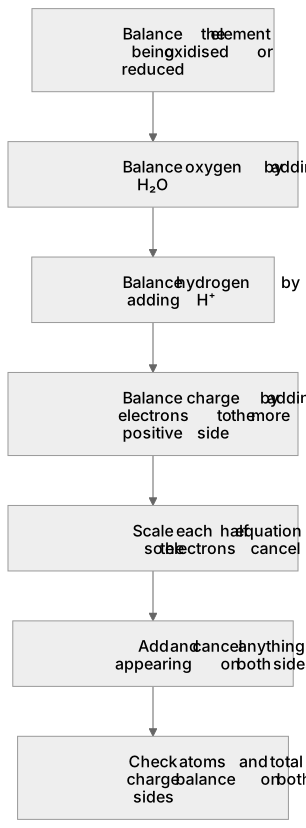
Put it in order
Put these steps in the order they happen.
- 1. Check atoms and total charge balance on both sides
- 2. Add and cancel anything appearing on both sides
- 3. Balance hydrogen by adding H⁺
- 4. Scale each half equation so the electrons cancel
- 5. Balance the element being oxidised or reduced
- 6. Balance oxygen by adding H₂O
- 7. Balance charge by adding electrons to the more positive side
Key words
Say what each word means before you turn the card.
half equations
Try answering aloud or in your head before turning the card.
balancing with H₂O and H⁺
Try answering aloud or in your head before turning the card.
electron balance
Try answering aloud or in your head before turning the card.
combining half equations
Try answering aloud or in your head before turning the card.
See every definition
- half equations
- Separate a redox reaction into the electron loss and the electron gain, built in a fixed order.
- balancing with H₂O and H⁺
- Balance oxygen by adding H₂O and balance hydrogen by adding H⁺.
- electron balance
- Balance the charge by adding electrons to the more positive side.
- combining half equations
- Scale each so the electrons cancel, then add and cancel anything appearing on both sides.
Label the diagram
Some boxes have lost their names. Pick the right name for each number.
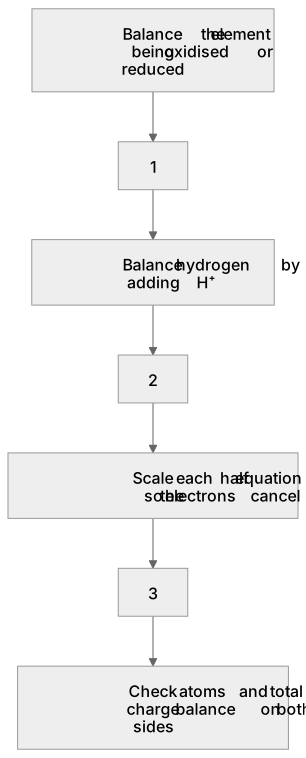
1Box 1
2Box 2
3Box 3
There is more to this lesson
The full lesson goes on to check your understanding and help you earn the marks. Create a free account to carry on, with your progress saved.
A week of Premium from your first lesson · Then the free plan continues · No card, no charge
Test your understanding of Oxidation, reduction and redox equations: Students should be able to: work out the oxidation state of an element in a compound or ion from the formula write half-equations identifying the oxidation and reduction processes in redox reactions combine half-equations to give an overall redox equation.
Active recall beats re-reading. Take an instant quiz now to test what you’ve learned and lock it into long-term memory.
A week of Premium from your first lesson · Then the free plan continues · No card, no charge