Study Notes

Scope, Specification and Exam Focus
Specification reference: AQA A-level Chemistry (7405), 3.2.1 Periodicity. The supplied code and the required treatment of s, p, d and f blocks, first ionisation energy, and Period 3 physical properties are A-level content, rather than a standalone GCSE topic. GCSE candidates can use the bonding and periodic-table foundations here, but the orbital-based explanations and ionisation-energy anomalies are the A-level extension. AQA lists Periodicity within its inorganic chemistry content, including the physical properties of the Period 3 elements. [1]
Periodicity means the recurring pattern in physical and chemical properties when elements are arranged in order of atomic number. Examiners reward candidates who do more than state a trend. In any explain question, credit is given for a causal chain: identify the structural change, state how the force changes, and link that force to the observed property. The command word describe only needs the direction or shape of a pattern; explain needs the reason.
Mark-winning rule: For trends across Period 3, do not write “more electrons therefore stronger attraction” on its own. Write “increasing nuclear charge, with similar shielding, produces stronger electrostatic attraction between the nucleus and the outer electron(s).”
1. Blocks, Periods and Electron Configuration
A period is a horizontal row. Moving across Period 3 means moving from sodium, Na, to argon, Ar. The table is divided into blocks by the sub-shell that receives the highest-energy electron:
| Block | Position and examples | Electron-configuration cue | Examiner language |
|---|---|---|---|
| s-block | Groups 1–2; Na and Mg | Final electron enters an s sub-shell | “The outer electron is in an s sub-shell.” |
| p-block | Groups 13–18; Al to Ar | Final electron enters a p sub-shell | “The outer electron is in a p sub-shell.” |
| d-block | Central transition metals | Final electron enters a d sub-shell | “The element is in the d block.” |
| f-block | Lanthanides and actinides | Final electron enters an f sub-shell | “The element is in the f block.” |
For example, sodium has the configuration 1s² 2s² 2p⁶ 3s¹; its final electron is in a 3s sub-shell, so it is an s-block element. Aluminium is 1s² 2s² 2p⁶ 3s² 3p¹, so it is a p-block element. Do not confuse the block with the period: both sodium and aluminium are in Period 3, but they occupy different blocks.
Memory hook — “Last letter wins.” Look at the final sub-shell letter in the configuration: final s means s-block; final p means p-block.
2. Atomic Radius Across Period 3
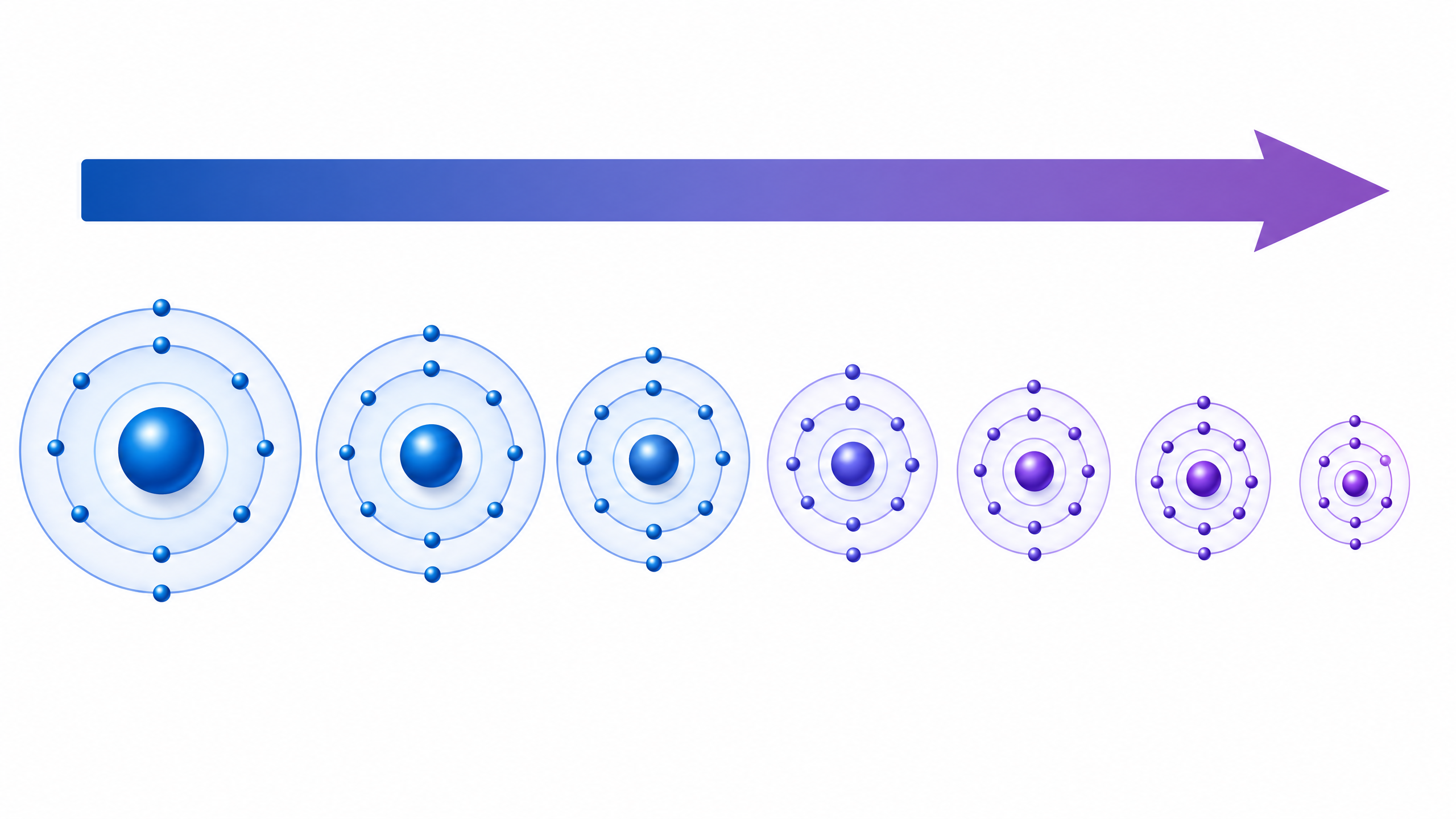
The atomic radius decreases from Na to Ar. Atomic radius is defined operationally as half the distance between the nuclei of two covalently bonded atoms of the same element. In a graph question, candidates must say decreases across the period, rather than “gets smaller up the table”.
The explanation is a three-link chain. First, the proton number rises across the period, so the nuclear charge increases. Second, the added electrons enter the same principal energy level, the third shell, so the shielding from inner shells is broadly similar. Third, the stronger attraction between the increasingly positive nucleus and outer electrons draws the electron cloud closer. The atomic radius therefore becomes smaller.
Atomic-radius graph and data skills
If presented with a radius-versus-atomic-number graph, use the following method. State the overall negative correlation first. Then identify that the sharpness of the decline is not the key feature here: it is a steady trend caused by nuclear charge rising while shielding stays similar. Finally, use comparative language. For example: “Aluminium has a smaller atomic radius than magnesium because it has one more proton but its outer electrons remain in the same shell.” The word because is the bridge between the data statement and the scientific explanation.
There is no compulsory numerical formula for atomic radius in this topic. If values are given in nanometres or picometres, retain the unit supplied. The useful conversion is 1 nm = 1000 pm; do not convert unless the question requires it.
3. First Ionisation Energy: Trend and Exceptions
Definition worth learning exactly: First ionisation energy is the energy required to remove one mole of electrons from one mole of gaseous atoms to form one mole of gaseous 1+ ions.
The corresponding general equation is:
X(g) → X⁺(g) + e⁻
| Relationship or equation | Formula-sheet status | What an examiner credits |
|---|---|---|
X(g) → X⁺(g) + e⁻ | Must memorise | Correct gaseous state symbols and one electron removed |
| First ionisation energy definition | Must memorise | “One mole”, “gaseous atoms”, “one mole of gaseous 1+ ions” |
| Atomic-radius or melting-point trend | No numerical formula | A correct trend plus a linked explanation |
Across Period 3, first ionisation energy shows a general increase. The same core logic applies as for atomic radius: nuclear charge rises, shielding is similar, and the outer electron is held by stronger electrostatic attraction. More energy is therefore needed to remove it.
However, a high-mark response must recognise two exceptions. There is a fall from magnesium to aluminium. Magnesium loses a 3s electron, whereas aluminium loses a 3p electron. A 3p electron is higher in energy and slightly more shielded than a 3s electron, so it is easier to remove. There is another fall from phosphorus to sulfur. Phosphorus has 3p³, with three singly occupied 3p orbitals. Sulfur has 3p⁴, so one 3p orbital contains a pair of electrons. Repulsion between paired electrons makes removal easier than from a singly occupied 3p orbital.
Memory hook — “Al is a p-step; sulfur shares space.” Aluminium’s 3p electron takes a higher-energy step. Sulfur has shared orbital space, so electron–electron repulsion creates the second dip.
A frequent non-creditworthy answer is “sulfur wants a full shell”. This does not explain the data. Candidates must name the paired electrons, repulsion, and 3p orbital to access the marks.
4. Melting Points Across Period 3
Melting point does not follow a simple rise or fall across Period 3. It depends on structure and bonding, not merely atomic size. The broad pattern is a rise from Na to Al, a very high peak at Si, then a dramatic fall for P, S, Cl and Ar. A credible chemistry source explains this as a change from metallic structures, through giant covalent silicon, to simple molecular or atomic substances. [2]

| Element(s) | Structure and bonding | Evidence-based explanation of melting point |
|---|---|---|
| Na, Mg, Al | Giant metallic lattice | Melting point rises from Na to Al: metal ions have increasing charge, more delocalised electrons are available, and the ions are smaller. This strengthens electrostatic attraction in the metallic bond. |
| Si | Giant covalent structure | Silicon has the highest melting point. Many strong covalent bonds throughout the lattice must be broken, requiring a very large amount of energy. |
| P₄, S₈, Cl₂ | Simple molecular | Covalent bonds within molecules remain intact during melting; only London dispersion forces between molecules are overcome. Larger molecules with more electrons have stronger forces. S₈ therefore melts higher than P₄ and Cl₂. |
| Ar | Monatomic | Argon has only weak London forces between individual atoms, so it has the lowest melting point in this part of the period. |
The standard three-mark comparison of magnesium and sodium is a model of how to write about metallic bonding. Both are giant metallic structures. Magnesium produces Mg²⁺ ions rather than Na⁺ ions and contributes more delocalised electrons per atom. The electrostatic attraction between the ions and the electron sea is stronger in magnesium, so more energy is required to break the metallic lattice. Do not use the vague phrase “stronger forces” without identifying the particles and force.
Structure-to-property decision route
Before answering a melting-point question, ask: What structure does the substance have? A giant metallic or giant covalent structure requires disruption of strong bonding throughout a lattice. A simple molecular substance only needs weak intermolecular forces to be overcome. This distinction is the reliable route to high marks.
5. Required Practical, Tiering and Real-World Context
There is no named AQA A-level required practical solely for Periodicity. Nevertheless, exam questions may use observations of Group 2 or Period 3-related reactions, or unfamiliar melting-point and ionisation-energy data, to assess the same ideas. When analysing data, label axes with variables and units, use a smooth curve only when appropriate, identify anomalies, and avoid claiming a causal reason that the data alone cannot prove.
For GCSE routes, the atomic structure, periodic table, metallic bonding, giant covalent structures and simple molecular structures are the essential foundation. The s, p, d and f block classifications, detailed electron configurations, and the magnesium-to-aluminium and phosphorus-to-sulfur ionisation-energy anomalies are A-level-only extension material, rather than Foundation/Higher tier content. This guide intentionally makes the level distinction explicit so candidates revise the specification they are actually entered for.
Silicon’s giant covalent lattice is connected to its use as a semiconductor. The point is not that “silicon is strong”; it is that its bonding produces high thermal stability and a structure that can be engineered to control electrical behaviour. This gives a useful synoptic bridge between periodicity, bonding, materials chemistry and electronics.
6. Exam Strategy: Convert Knowledge into Marks
Allow approximately one minute per mark, then reserve a final minute to check terminology and state symbols. For a trend-explanation question, follow State → Because → Therefore. State the direction. Explain the particle-level cause. Then conclude the effect on the property.
For a comparison, name both substances and use comparatives: “higher than”, “more strongly attracted”, “smaller”, “whereas”. For an equation, include the correct species and state symbols before worrying about formatting. For an extended answer, organise one paragraph per structure or element group, rather than giving one unstructured list.
Final memory phrase: “Radius reduces right; ionisation rises right; silicon is the sky-high melting peak.” If you can explain each clause with precise vocabulary, you are working at the level that earns the explanation marks.
References
[1] AQA, A-level Chemistry 7405: Inorganic chemistry—Periodicity
[2] Chemguide, The structures of the Period 3 elements
Visual Resources
2 diagrams and illustrations
Interactive Diagrams
2 interactive diagrams to visualise key concepts
Conceptual Flow Outline
Flowchart showing how structure type determines melting point in Period 3.
Conceptual Flow Outline
Logical sequence explaining the decrease in atomic radius across a period.
Worked Examples
3 detailed examples with solutions and examiner commentary
Practice Questions
Test your understanding — click to reveal model answers
Write the equation, including state symbols, for the first ionisation energy of sodium. [2 marks]
Hint: Remember that ionisation energy is defined for gaseous atoms.
State which element in Period 3 has the highest melting point and explain why. [3 marks]
Hint: Think about which element forms a giant covalent lattice.
Explain why the atomic radius of aluminium is smaller than the atomic radius of magnesium. [2 marks]
Hint: Compare their proton numbers and shielding.
Explain the difference in melting points between phosphorus (P_4) and sulfur (S_8). [3 marks]
Hint: Both are simple molecular. What determines the strength of the forces between them?
Explain the general increase in first ionisation energy across Period 3. [3 marks]
Hint: Use the same principles as the atomic radius explanation.