AQA · A-Level · Chemistry
Course version: 7405 · Version from Sept 2016
Students should be able to: perform calculations for these titrations…
Full specification wording
pH curves, titrations and indicators (A-level only): Students should be able to: perform calculations for these titrations based on experimental results.
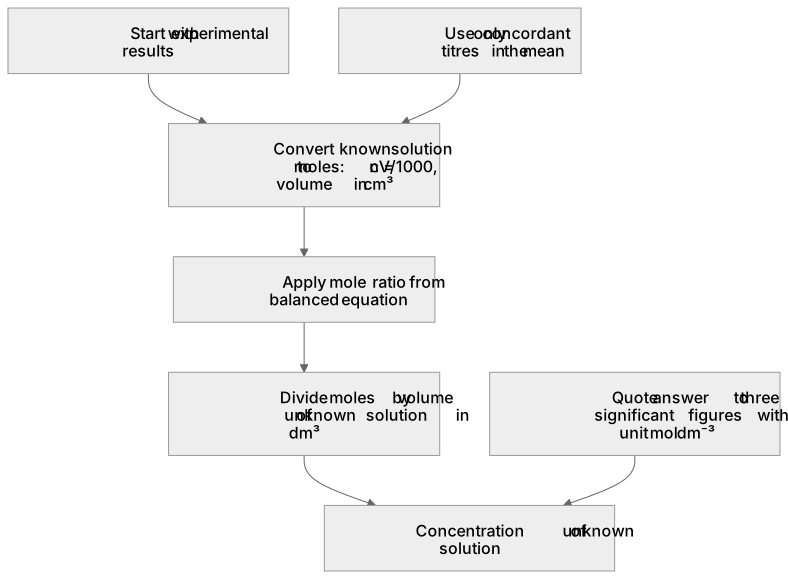
Every titration calculation follows the same three steps.
Checked against the AQA 7405 specification (opens in a new tab) on .
- Point 2 of 5
- 4 key terms
Study notes
From the checked teaching notes for this specification point.
The idea
Every titration calculation follows the same three steps. Convert the known solution to moles with n = cV/1000, using the volume in cm³. Apply the mole ratio from the balanced equation; this is where most marks are lost, because 2HCl + Ba(OH)₂ → BaCl₂ + 2H₂O is a 2 : 1 ratio, not 1 : 1. Then divide the moles by the volume of the unknown solution in dm³ to get its concentration. If 25.0 cm³ of hydrochloric acid needs 22.40 cm³ of 0.100 mol dm⁻³ barium hydroxide, n(Ba(OH)₂) = 2.24 × 10⁻³ mol, so n(HCl) = 4.48 × 10⁻³ mol and c(HCl) = 0.179 mol dm⁻³. Use only concordant titres in the mean, and quote answers to three significant figures, because burette readings support that precision.
What earns the marks
- Converting a volume in cm³ to dm³ before multiplying by the concentration.
- Applying the mole ratio from the balanced equation, such as 2 : 1 for HCl with Ba(OH)₂.
- Dividing the moles by the volume of the unknown solution to obtain its concentration.
- The answer to three significant figures with the unit mol dm⁻³.
- Carrying an earlier incorrect value forward consistently, credited as error carried forward.
Common mistakes and how to put them right
Dividing by 1000 twice, or not at all.
Using a 1 : 1 ratio with a diprotic acid or with a Group 2 hydroxide.
Including the rough titre in the mean before calculating.
Quoting the answer to one significant figure when the burette readings justify three.
Calculating the concentration of the solution in the burette when the question asks for the one in the flask.
Exam tips
- Write the balanced equation at the top of your working, even when the question does not ask for it; the ratio mark depends on it.
- Percentage uncertainty in a titre uses two readings, so double the burette uncertainty before dividing by the titre.
Try the lesson
The start of the pH curves, titrations and indicators (A-level only): Students should be able to: perform calculations for these titrations based on experimental results. lesson, made from checked teaching notes for this specification point.
Have a go first
A 25.0 cm³ sample of 0.100 mol/dm³ sodium hydroxide is used to titrate a 20.0 cm³ sample of hydrochloric acid. Calculate the concentration of the hydrochloric acid in mol/dm³.
Listen
Every titration calculation follows the same three steps. Convert the known solution to moles with n = cV/1000, using the volume in cm³. Apply the mole ratio from the balanced equation; this is where most marks are lost, because 2HCl + Ba(OH)₂ → BaCl₂ + 2H₂O is a 2 : 1 ratio, not 1 : 1. Then divide the moles by the volume of the unknown solution in dm³ to get its concentration. If 25.0 cm³ of hydrochloric acid needs 22.40 cm³ of 0.100 mol dm⁻³ barium hydroxide, n(Ba(OH)₂) = 2.24 × 10⁻³ mol, so n(HCl) = 4.48 × 10⁻³ mol and c(HCl) = 0.179 mol dm⁻³. Use only concordant titres in the mean, and quote answers to three significant figures, because burette readings support that precision. A strong answer earns marks for these points. converting a volume in cm³ to dm³ before multiplying by the concentration. applying the mole ratio from the balanced equation, such as 2 : 1 for HCl with Ba(OH)₂. dividing the moles by the volume of the unknown solution to obtain its concentration. the answer to three significant figures with the unit mol dm⁻³. Exam tip: Write the balanced equation at the top of your working, even when the question does not ask for it; the ratio mark depends on it.
See it
Key words
Say what each word means before you turn the card.
moles from concentration and volume
Try answering aloud or in your head before turning the card.
stoichiometric ratio
Try answering aloud or in your head before turning the card.
concordant titres
Try answering aloud or in your head before turning the card.
significant figures
Try answering aloud or in your head before turning the card.
See every definition
- moles from concentration and volume
- Convert the known solution to moles with n = cV/1000, using the volume in cm³.
- stoichiometric ratio
- The mole ratio from the balanced equation, such as 2 : 1 for HCl with Ba(OH)₂.
- concordant titres
- Only these are used in the mean before calculating.
- significant figures
- Quote answers to three significant figures, because burette readings support that precision.
Label the diagram
Some boxes have lost their names. Pick the right name for each number.
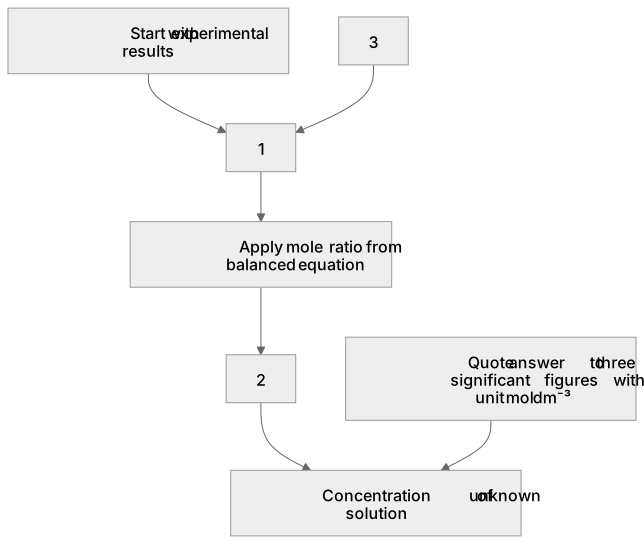
1Box 1
2Box 2
3Box 3
There is more to this lesson
The full lesson goes on to check your understanding and help you earn the marks. Create a free account to carry on, with your progress saved.
A week of Premium from your first lesson · Then the free plan continues · No card, no charge
Test your understanding of pH curves, titrations and indicators (A-level only): Students should be able to: perform calculations for these titrations based on experimental results.
Active recall beats re-reading. Take an instant quiz now to test what you’ve learned and lock it into long-term memory.
A week of Premium from your first lesson · Then the free plan continues · No card, no charge