AQA · A-Level · Chemistry
Course version: 7405 · Version from Sept 2016
Students should be able to: draw the structure of a peptide formed from up…
Full specification wording
Proteins (A-level only): Students should be able to: draw the structure of a peptide formed from up to three amino acids draw the structure of the amino acids formed by hydrolysis of a peptide identify primary, secondary and tertiary structures in diagrams explain how these structures are maintained by hydrogen bonding and S–S bonds calculate Rf values from a chromatogram.
This pulls the section's skills together.
Checked against the AQA 7405 specification (opens in a new tab) on .
- Point 7 of 7
- 4 key terms
Study notes
From the checked teaching notes for this specification point.
The idea
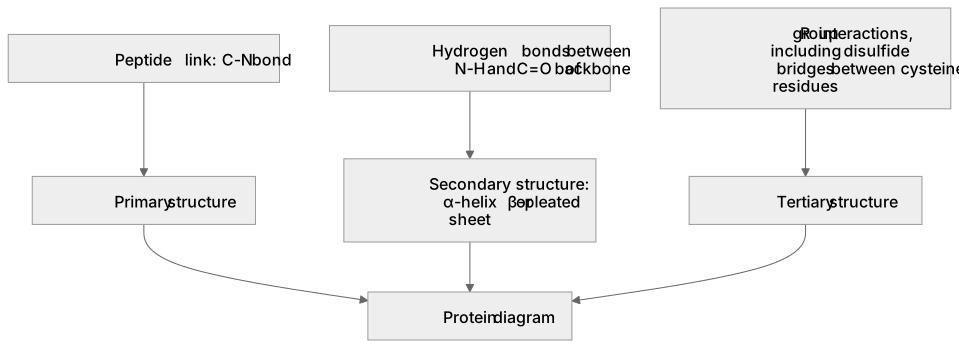
This pulls the section's skills together. Building a peptide: join the -COOH of one residue to the -NH₂ of the next, remove a water molecule at each junction and keep the residues in the stated order. Taking one apart: cut every C-N bond of a link, give the carbonyl carbon an -OH and the nitrogen an -H, and adjust for acid or alkaline conditions. Reading a diagram: peptide links mean primary structure, backbone hydrogen bonds mean an α-helix or a β-pleated sheet, and R group interactions, including disulfide bridges between cysteine residues, mean tertiary structure. Reading a chromatogram: divide the distance the spot moved by the distance the solvent front moved, both from the pencil line.
What earns the marks
- Each peptide link drawn correctly when a di- or tripeptide is built.
- The correct amino acids obtained by cutting every link and adding water back.
- Naming the bond or force that maintains a labelled feature in a protein diagram.
- An Rf value calculated as spot distance over solvent front distance from the baseline.
Common mistakes and how to put them right
Building a tripeptide with an R group attached to a carbonyl carbon instead of the α-carbon.
Cutting the chain at a C-C bond rather than at the C-N bond of the peptide link.
Labelling an α-helix as tertiary structure.
Dividing the solvent front distance by the spot distance, giving an Rf greater than 1.
Exam tips
- Draw the backbone first, N to C, then hang the R groups on the α-carbons; most structure marks are lost on the skeleton, not the side chains.
- Show the division as a fraction with both measured distances before you evaluate it.
Try the lesson
The start of the Proteins (A-level only): Students should be able to: draw the structure of a peptide formed from up to three amino acids draw the structure of the amino acids formed by hydrolysis of a peptide identify primary, secondary and tertiary structures in diagrams explain how these structures are maintained by hydrogen bonding and S–S bonds calculate Rf values from a chromatogram. lesson, made from checked teaching notes for this specification point.
Have a go first
A dipeptide is hydrolysed completely. Which products are formed when a dipeptide is hydrolysed completely?
Listen
This pulls the section's skills together. Building a peptide: join the -COOH of one residue to the -NH₂ of the next, remove a water molecule at each junction and keep the residues in the stated order. Taking one apart: cut every C-N bond of a link, give the carbonyl carbon an -OH and the nitrogen an -H, and adjust for acid or alkaline conditions. Reading a diagram: peptide links mean primary structure, backbone hydrogen bonds mean an α-helix or a β-pleated sheet, and R group interactions, including disulfide bridges between cysteine residues, mean tertiary structure. Reading a chromatogram: divide the distance the spot moved by the distance the solvent front moved, both from the pencil line. A strong answer earns marks for these points. each peptide link drawn correctly when a di- or tripeptide is built. the correct amino acids obtained by cutting every link and adding water back. naming the bond or force that maintains a labelled feature in a protein diagram. an Rf value calculated as spot distance over solvent front distance from the baseline. Exam tip: Draw the backbone first, N to C, then hang the R groups on the α-carbons; most structure marks are lost on the skeleton, not the side chains.
See it
Key words
Say what each word means before you turn the card.
building peptides
Try answering aloud or in your head before turning the card.
hydrolysis products
Try answering aloud or in your head before turning the card.
identifying protein structure
Try answering aloud or in your head before turning the card.
Rf calculation
Try answering aloud or in your head before turning the card.
See every definition
- building peptides
- Join the -COOH of one residue to the -NH₂ of the next, remove a water molecule at each junction and keep the residues in the stated order.
- hydrolysis products
- Cut every C-N bond of a link, give the carbonyl carbon an -OH and the nitrogen an -H, and adjust for acid or alkaline conditions.
- identifying protein structure
- Peptide links mean primary structure, backbone hydrogen bonds mean an α-helix or a β-pleated sheet, and R group interactions mean tertiary structure.
- Rf calculation
- Divide the distance the spot moved by the distance the solvent front moved, both from the pencil line.
Label the diagram
Some boxes have lost their names. Pick the right name for each number.
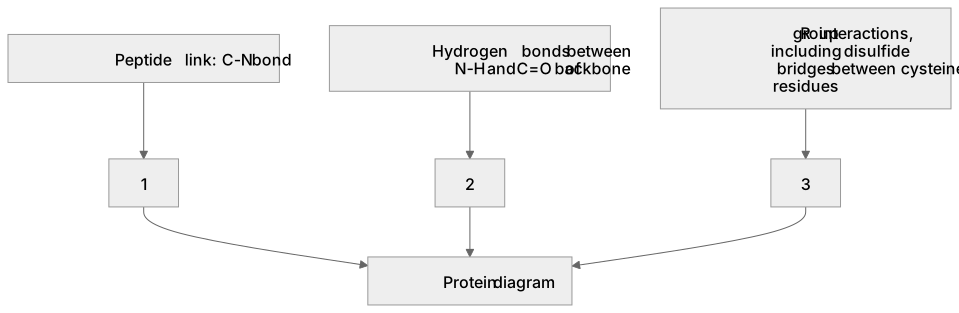
1Box 1
2Box 2
3Box 3
There is more to this lesson
The full lesson goes on to check your understanding and help you earn the marks. Create a free account to carry on, with your progress saved.
A week of Premium from your first lesson · Then the free plan continues · No card, no charge
Test your understanding of Proteins (A-level only): Students should be able to: draw the structure of a peptide formed from up to three amino acids draw the structure of the amino acids formed by hydrolysis of a peptide identify primary, secondary and tertiary structures in diagrams explain how these structures are maintained by hydrogen bonding and S–S bonds calculate Rf values from a chromatogram.
Active recall beats re-reading. Take an instant quiz now to test what you’ve learned and lock it into long-term memory.
A week of Premium from your first lesson · Then the free plan continues · No card, no charge