Study Notes
A-level Chemistry: Rate Equations and the Arrhenius Equation
Specification focus — AQA 7405, 3.1.9. This is A-level only content. In an examination, marks are awarded for using experimental data accurately, applying the correct rate relationship, and communicating a conclusion with units.
Overview
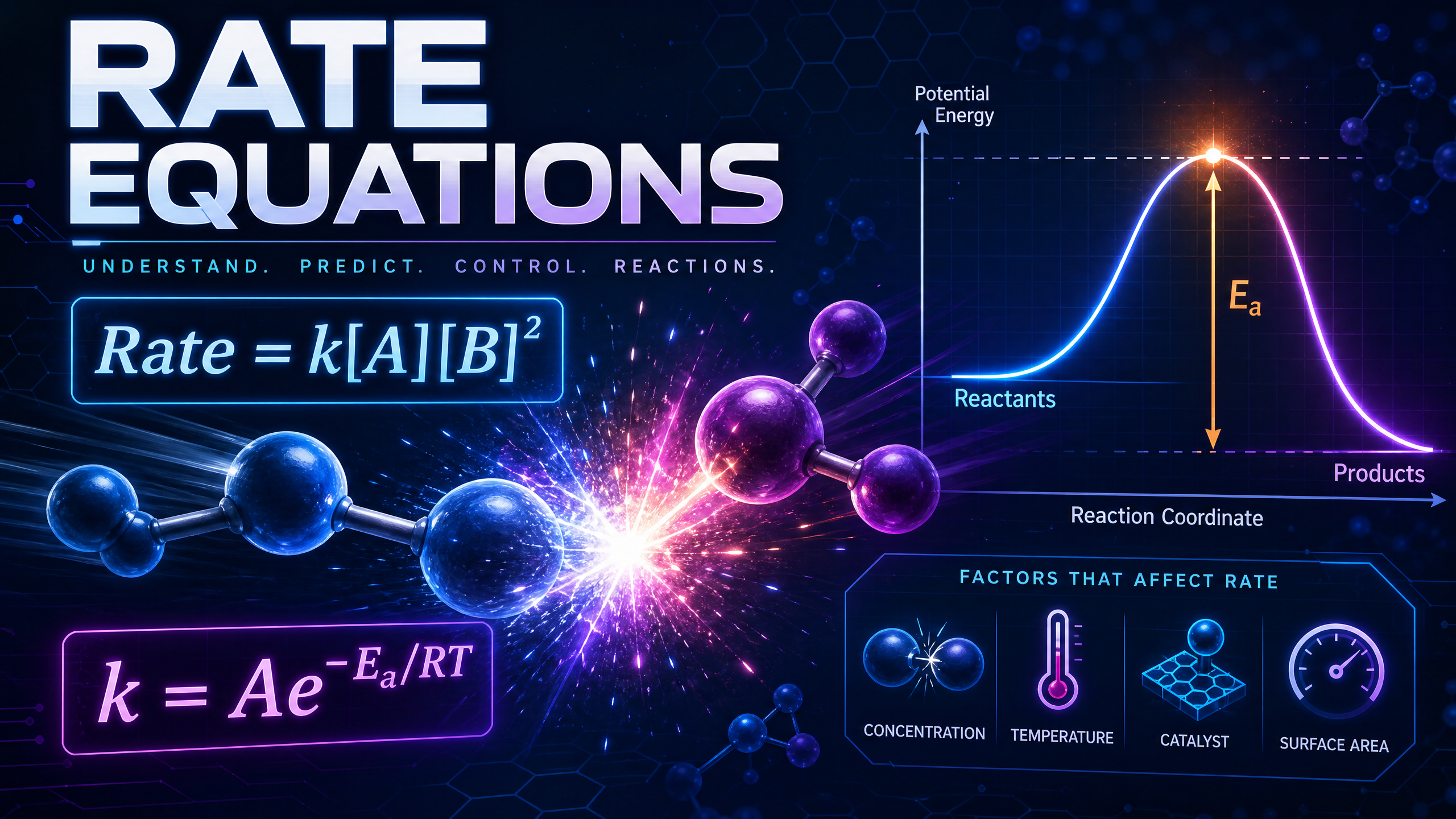
Rate equations turn collision theory into a usable mathematical model. A rate equation shows how a reaction rate depends on reactant concentrations and therefore gives evidence about a mechanism that may proceed in several steps. The core form is Rate = k[A]^m[B]^n, where the powers m and n are experimentally determined orders and k is the rate constant. AQA limits orders in this topic to 0, 1 or 2.[1]
Do not confuse a rate equation with a balanced symbol equation or a Kc expression. A balanced equation shows overall stoichiometry; a rate equation is found from data. A Kc expression includes equilibrium concentrations and may contain products; a rate equation for this course contains the relevant reactant concentrations. Candidates who state that an order was “read from the balanced equation” receive no credit.
1. The rate equation: orders and their meaning
For a reaction involving A and B:
| Relationship | Meaning for the rate | If concentration is doubled |
|---|---|---|
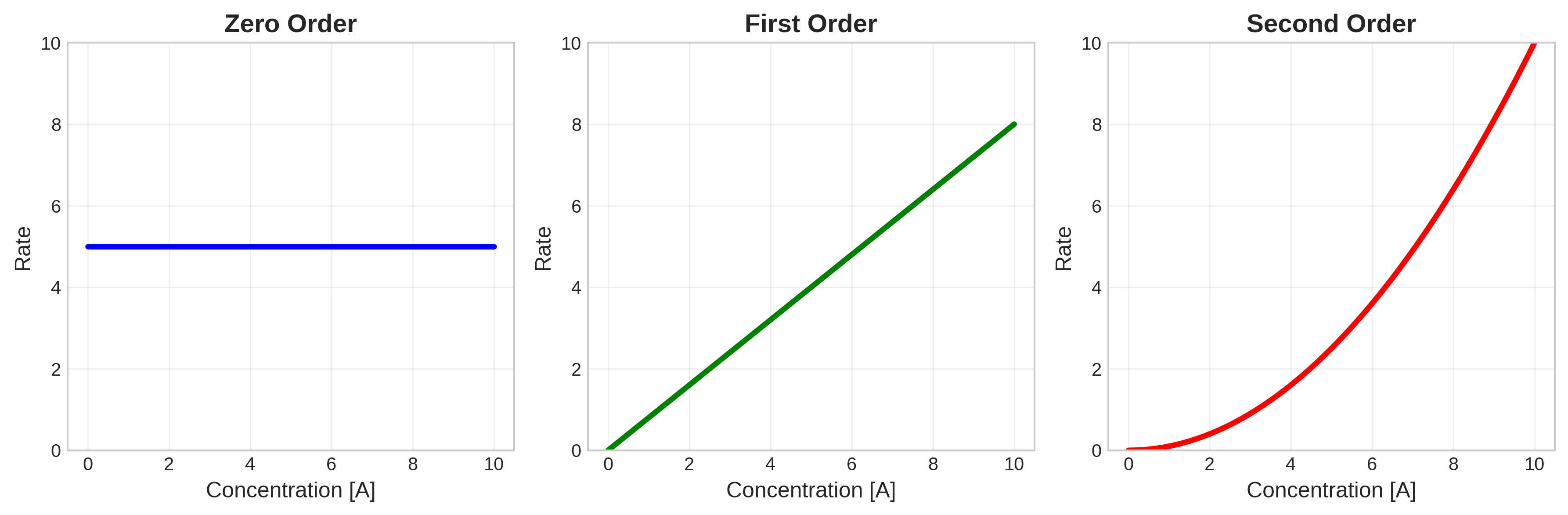
| Rate = k[A]^0 | Zero order in A: rate is independent of [A] | Rate ×1 |
| Rate = k[A]^1 | First order in A: rate is directly proportional to [A] | Rate ×2 |
| Rate = k[A]^2 | Second order in A: rate is proportional to [A]² | Rate ×4 |
A reliable method is factor → factor → power. Compare two experiments where only one concentration changes. Calculate the concentration factor, calculate the rate factor, and select the power that produces it. For example, if [A] doubles and the initial rate becomes four times greater, A is second order because 2² = 4. The memory hook is “Square the Second.”
Worked mini-example: deducing an order from initial rates
| Experiment | [A] / mol dm⁻³ | [B] / mol dm⁻³ | Initial rate / mol dm⁻³ s⁻¹ |
|---|---|---|---|
| 1 | 0.10 | 0.20 | 1.50 × 10⁻³ |
| 2 | 0.20 | 0.20 | 6.00 × 10⁻³ |
Only [A] changes. It doubles (×2), while the rate rises from 1.50 × 10⁻³ to 6.00 × 10⁻³ (×4). Therefore, rate ∝ [A]², so the reaction is second order with respect to A. In a 2-mark question, one mark is typically awarded for the numerical comparison and one for the correct order. Simply writing “second order” without evidence may lose the explanation mark.
2. Deriving and using a complete rate equation
Repeat the comparison for B using a pair of experiments in which [A] is constant. Then assemble the equation. If A is second order and B is first order, write:
**Rate = k[A]²[B]**The overall order is the sum of the separate orders: 2 + 1 = 3. This is useful when deriving the units of k, but it does not mean that three particles necessarily collide in a single overall reaction. Use careful mechanism wording: an elementary proposed slow step must be consistent with the experimentally determined orders. The slowest step is the rate-determining (or rate-limiting) step.
Examiner wording: “The order with respect to a reactant provides information about the rate-determining step.” Avoid the absolute claim that the overall balanced equation directly gives the mechanism.
Calculating k and its units
Rearrange before substituting. For Rate = k[A]²[B],
**k = Rate / ([A]²[B])**For a rate measured in mol dm⁻³ s⁻¹, the unit calculation is:
(mol dm⁻³ s⁻¹) / ((mol dm⁻³)² × (mol dm⁻³)) = dm⁶ mol⁻² s⁻¹.
Write units with the final answer. They are often a separate mark. Remember: “Overall order controls the units of k.”
3. Rate constant, temperature and activation energy
At a fixed temperature, k is constant for a particular reaction. When temperature increases, k increases because a greater proportion of particles have energy equal to or greater than the activation energy, so a greater fraction of collisions is successful. For a 2-mark qualitative explanation, candidates should mention both more particles with E ≥ Eₐ and more successful collisions.
The Arrhenius equation is:
**k = Ae^(−Eₐ/RT)**Here, A is the Arrhenius constant, Eₐ is activation energy in J mol⁻¹, R is 8.31 J K⁻¹ mol⁻¹, and T is temperature in K. The non-negotiable conversion is kJ mol⁻¹ → J mol⁻¹: multiply by 1000 before substitution. Memory hook: **“Eₐ must be J.”**Rearranging produces a straight-line relationship:
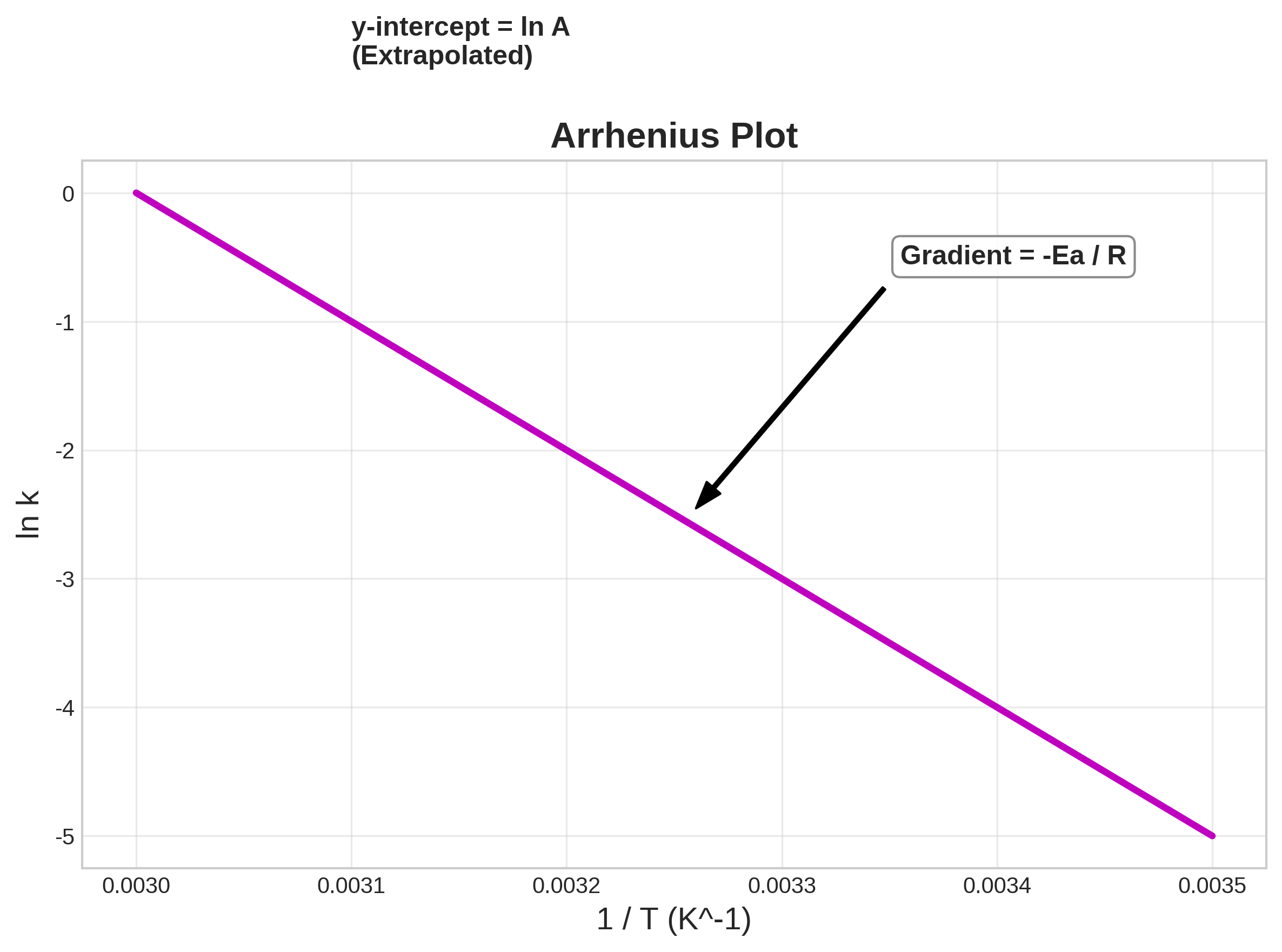
ln k = (−Eₐ/R)(1/T) + ln AThis matches y = mx + c. When plotting ln k against 1/T, the gradient is −Eₐ/R and the y-intercept is ln A. A negative gradient is expected because 1/T falls as temperature rises while k rises.
4. Formula and conversion checklist
| Formula or relationship | Status for AQA 3.1.9 | Marks-aware use |
|---|---|---|
| Rate = k[A]^m[B]^n | Given on formula sheet (when required) | Determine m and n from data; do not infer them from coefficients. |
| k = Ae^(−Eₐ/RT) | Given on formula sheet (when required) | Use T in K and Eₐ in J mol⁻¹. |
| ln k = (−Eₐ/R)(1/T) + ln A | Given on formula sheet (when required) | Identify gradient as −Eₐ/R. |
| rate = change in concentration / change in time | Must memorise | Use a tangent gradient for an instantaneous rate. |
| Common conversion | Correct operation | Frequent error |
|---|---|---|
| °C to K | Add 273 | Using °C directly in 1/T or Arrhenius calculations |
| kJ mol⁻¹ to J mol⁻¹ | Multiply by 1000 | Dividing by 1000 before calculation |
| Initial rate from a fixed endpoint time | Rate ∝ 1/t | Calling the time itself the rate |
5. Required Practical 7: measuring reaction rate
AQA Required Practical 7 requires measuring rate by an initial-rate method and a continuous-monitoring method.[2] Your centre may use a different approved reaction system, so learn the principles rather than a single recipe.
| Requirement | Initial-rate approach | Continuous-monitoring approach |
|---|---|---|
| Suitable apparatus | Conical flask, pipette/syringe, volumetric glassware, stopwatch, thermometer, suitable clock-reaction reagents and starch indicator where used | Conical flask, gas syringe or colorimeter and cuvettes, stopwatch, clamp stand, thermometer |
| Core method | Vary one initial concentration, keep total volume, temperature and other concentrations constant; record time to a fixed visible endpoint; use 1/t as a measure of initial rate | Record gas volume, absorbance or concentration at regular times; plot a concentration–time graph; draw a tangent to obtain the rate at a chosen time |
| Expected result | A rate–concentration pattern showing a zero-, first- or second-order relationship | A curve that becomes less steep as reactants are used; a straight line for a zero-order concentration–time relationship |
| Key controls | Constant temperature, total volume, mixing method, endpoint and timing method | Same temperature, same apparatus seal/optical path, regular timing, no gas leaks or bubbles in cuvette |
For an initial-rate method, candidates should state what is changed, what is controlled, what is measured, and how rate is calculated. “Repeat the experiment” earns limited credit unless the answer explains that repeats improve reliability and a mean can be calculated. For continuous monitoring, the word tangent is essential when asked for the rate at one instant; a chord gives an average rate over an interval.
Common errors are starting the timer late, changing total volume while changing concentration, allowing temperature to drift, reading a gas syringe at an angle, choosing an inconsistent visual endpoint, or using an absorbance range outside the colorimeter’s reliable range. Examiners may test these through a method-evaluation question, a graph interpretation task, or a request to explain why only one variable must change.
6. Graph and data skills
A concentration–time graph needs named axes and units. The gradient of a tangent is Δconcentration/Δtime, normally negative for reactant concentration. State the rate as a positive magnitude unless the question specifically asks for the gradient. For a zero-order reaction, [reactant] decreases linearly, so the magnitude of the gradient equals k.
On an Arrhenius graph, plot ln k on the y-axis and 1/T in K⁻¹ on the x-axis. Use a large triangle across the best-fit line when calculating gradient; do not use adjacent raw points unless instructed. Preserve the negative sign in the gradient, then use Eₐ = −gradient × R. Convert the final answer to kJ mol⁻¹ if requested.
7. Exam technique: command words and timing
Allow about one minute per mark. For a calculation, show the formula, the substitution, an unrounded intermediate value where helpful, and a final answer with units and appropriate significant figures. Method marks can be credited even if the final arithmetic is wrong, provided the working is clear.
| Command word | What earns credit in this topic |
|---|---|
| State / Give | A concise fact, such as “second order”. No explanation is needed. |
| Calculate | Formula, substitution, accurate arithmetic, units and conversion. |
| Deduce | Use the data or graph supplied; show the factor comparison. |
| Explain | Link cause to effect, for example more particles with E ≥ Eₐ leads to more successful collisions. |
| Evaluate | Identify a specific limitation and a realistic improvement, such as a thermostatically controlled water bath to reduce temperature variation. |
8. Synoptic links and retrieval practice
This topic connects directly to 3.1.5 Kinetics, because collision theory explains why temperature raises the rate constant. It connects to 3.1.8 Thermodynamics, where activation energy appears on enthalpy-profile diagrams. It also connects to 3.3.3 Halogenoalkanes: kinetic evidence can distinguish a unimolecular pathway from a bimolecular one. Finally, contrast it with 3.1.6 Kc: kinetics describes the speed of change, whereas Kc describes the equilibrium composition at a fixed temperature.
Cover and recall: Cover the answers and say: (1) What factor does the rate change by when a second-order concentration is tripled? (2) What are the units of k for a first-order reaction? (3) What does the gradient represent on a ln k against 1/T plot? (4) Why must Eₐ be in joules? (5) What graph construction is required for an instantaneous rate?
Elaborate: Why can a rate equation not be obtained from the overall symbol equation? What would happen to the Arrhenius plot if a catalyst lowered Eₐ? How could a systematic gas leak alter the apparent rate–concentration relationship?
References
Visual Resources
2 diagrams and illustrations
Interactive Diagrams
2 interactive diagrams to visualise key concepts
Conceptual Flow Outline
Flowchart for deducing reaction orders from initial rates data.
Conceptual Flow Outline
Process for finding the initial rate from continuous monitoring data.
Worked Examples
3 detailed examples with solutions and examiner commentary
Practice Questions
Test your understanding — click to reveal model answers
A reaction between A and B is first order with respect to A and second order with respect to B. Write the rate equation for this reaction.
Hint: Use the general form Rate = k[A]^m[B]^n.
Using the rate equation Rate = k[A][B]^2, deduce the units of the rate constant k.
Hint: Substitute the units of rate and concentration into the rearranged equation.
A student plots a graph of ln k against 1/T for a reaction. The gradient of the line is -8500 K. Calculate the activation energy, Ea, in kJ mol^-1. (R = 8.31 J K^-1 mol^-1)
Hint: Remember that the gradient equals -Ea/R.
The rate equation for a reaction is Rate = k[X]^2[Y]. The mechanism occurs in three steps. Suggest which molecules collide in the rate-determining step.
Hint: The orders in the rate equation tell you exactly how many of each molecule are involved in the RDS.
Explain qualitatively why increasing the temperature increases the value of the rate constant, k.
Hint: Think about collision theory and the Boltzmann distribution.