Study Notes

Overview
Scope alert. The supplied code 3.2.5 is the AQA A-level Chemistry transition-metals section, not a standard GCSE Chemistry topic. There are no Foundation/Higher tiers here: this is un-tiered A-level material. The GCSE bridge is useful—electron configuration, ionic charge, covalent bonding, redox and catalysts—but candidates need the more precise A-level language below. AQA identifies complex formation, coloured ions, variable oxidation states and catalytic activity as characteristic transition-metal properties. 1
The 3d series is where chemistry becomes visibly dramatic. A small central metal ion can bind different ligands, change its co-ordination number and geometry, absorb a different wavelength of light, and therefore appear a different colour. The same flexibility lets transition-metal compounds provide lower-energy reaction pathways in industrial processes. Examiners commonly use structured questions: a one-mark definition, a balanced complex-ion equation, a four-mark explanation of colour, a six-mark catalytic cycle, or data from a colorimeter. The winning habit is to state the chemical idea first, apply it to the species given, and then make the cause-and-effect link explicit.
| What candidates must do | Typical command word | What credit is given for |
|---|---|---|
| Recall a precise definition | Define / State | Exact key term, for example “incomplete d sub-level”. |
| Use a model in context | Explain / Suggest | A linked chain, not isolated facts. |
| Manipulate chemical information | Write / Calculate | Balanced charges, correct state symbols, visible working and units. |
| Reason from evidence | Compare / Evaluate | Similarity and difference, then a supported conclusion. |
Key Concepts
1. What counts as a transition metal?
A transition metal is an element that forms at least one stable ion with an incomplete d sub-level. Do not write merely “a d-block element”; that loses the defining point. Titanium to copper meet the definition. Scandium and zinc sit in the d-block, but are normally excluded: Sc³⁺ is 3d⁰ and Zn²⁺ is 3d¹⁰, so neither ion has an incomplete d sub-level. When forming positive ions, remove 4s electrons before 3d electrons. For example, Fe is [Ar] 4s²3d⁶, while Fe²⁺ is [Ar] 3d⁶.
The incomplete d sub-level matters because its electrons can occupy closely spaced energy levels and because the metal ion can form strong attractions to ligand lone pairs. It underpins all four signature properties: complex formation, colour, variable oxidation state and catalytic activity. 1
2. Ligands, complexes and co-ordinate bonds
A ligand is an ion or molecule that donates a lone pair of electrons to a transition-metal atom or ion, creating a co-ordinate bond. A complex is the central metal atom or ion surrounded by ligands. The co-ordination number is the number of co-ordinate bonds, not necessarily the number of ligand particles. Thus EDTA⁴⁻ is one ligand but makes six co-ordinate bonds.
A monodentate ligand has one donor atom: H₂O, NH₃ and Cl⁻ are the key examples. Ethane-1,2-diamine and C₂O₄²⁻ are bidentate, and EDTA⁴⁻ is multidentate. Use square brackets around a complex ion and check the overall charge before moving on. In [Cu(H₂O)₆]²⁺, six water molecules each donate a lone pair, so the co-ordination number is six.
Substitution happens when incoming ligands replace ligands already attached to the metal. Water and ammonia are similar in size and often exchange without changing co-ordination number; for example, [Cu(NH₃)₄(H₂O)₂]²⁺ is a valid partially substituted octahedral complex. Chloride is larger, so replacing water with Cl⁻ can reduce the co-ordination number from six to four. The key comparison is therefore ligand size → possible change in co-ordination number → change in shape and colour.
A useful equation is:
[
[Cu(H_2O)_6]^{2+}(aq) + 4NH_3(aq) \rightleftharpoons [Cu(NH_3)_4(H_2O)_2]^{2+}(aq) + 4H_2O(l)
]
The left-hand complex is pale blue; the ammonia complex is deep blue. Candidates should preserve the 2+ charge and balance the four displaced water ligands.
3. Shapes and stereoisomerism
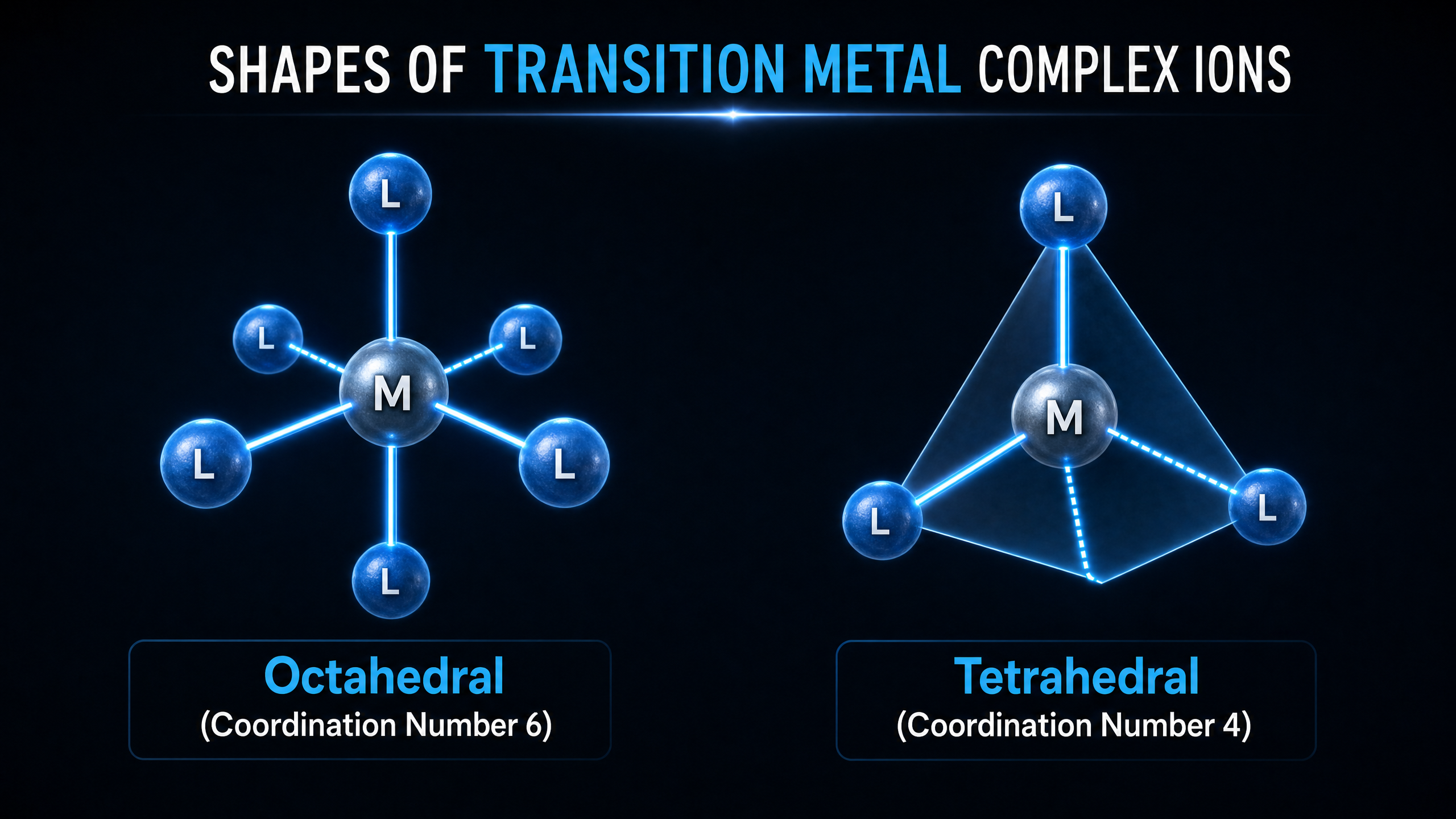
Small ligands such as H₂O and NH₃ commonly form octahedral complexes with co-ordination number six. Larger chloride ligands commonly form tetrahedral complexes with co-ordination number four. Some co-ordination-number-four complexes are square planar rather than tetrahedral; cisplatin, cis-[PtCl₂(NH₃)₂], is square planar. 1
Examiners can make this more demanding by testing isomerism. In a square-planar or octahedral complex, two identical ligands may be adjacent (cis) or opposite (trans). In cisplatin the two chloride ligands are adjacent; the cis form has the medical application. Octahedral complexes with bidentate ligands may show optical isomerism because the mirror images cannot be superimposed.
4. The chelate effect: entropy earns the mark
When a bidentate or multidentate ligand replaces monodentate ligands, the result is a chelate complex. The chelate effect means this replacement is often thermodynamically favourable. The examiner-safe explanation starts by counting particles.
For example:
[
[Cu(H_2O)_6]^{2+}(aq) + EDTA^{4-}(aq) \rightleftharpoons [Cu(EDTA)]^{2-}(aq) + 6H_2O(l)
]
On the left there are two solute particles; on the right there is one complex plus six released water molecules. The number of particles increases, so disorder increases and ΔS is positive. In (\Delta G = \Delta H - T\Delta S), a positive entropy term makes ΔG more negative. For a full explanation, add that feasibility depends on the balance of enthalpy and entropy, not entropy alone. AQA specifically requires this balance.1
5. Why complexes are coloured
Ligands split the d orbitals into two energy levels. When white light reaches a complex, a d electron absorbs a photon of exactly the right energy and moves from the lower to the higher d level. The observed colour is the complementary light that is transmitted or reflected, not the wavelength absorbed. This is absorption spectroscopy, not electron emission from a flame test.
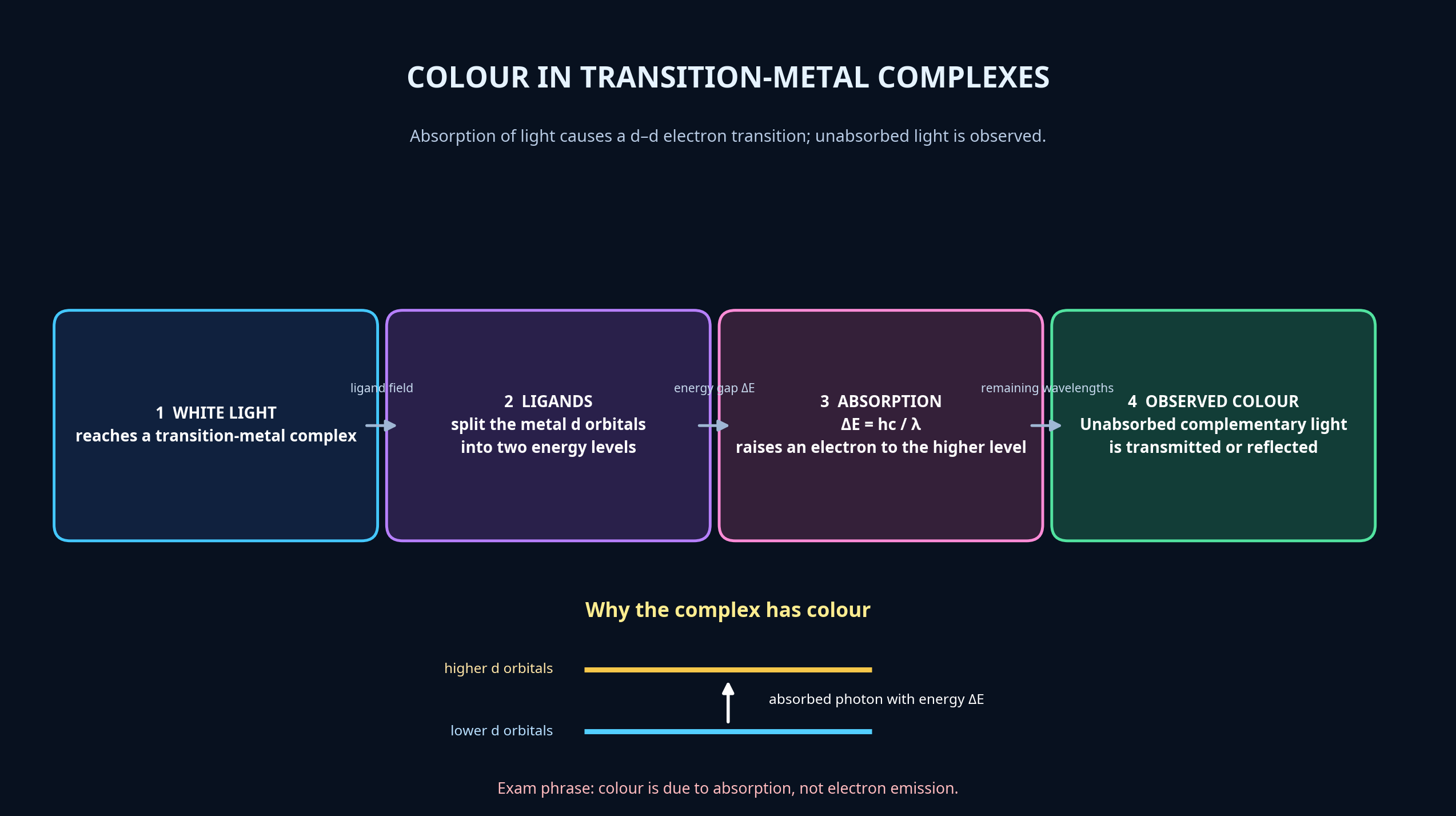
The energy relationship is (\Delta E = h
u = hc/\lambda). A change in ligand, oxidation state or co-ordination number changes ΔE; a new energy gap means a different wavelength is absorbed and therefore a different colour is seen. A fully empty d sub-level, as in Sc³⁺, or a fully filled one, as in Zn²⁺, cannot provide the required d–d promotion, which explains why their compounds are generally colourless/white.1
6. Variable oxidation states and redox
Transition elements often show variable oxidation states because the 4s and 3d electrons have similar energies. This makes electron transfer chemically accessible. Vanadium chemistry is a standard example: reducing vanadate(V) in acid gives species in oxidation states IV, III and II. The oxidation state should be made explicit in names and explanations: “copper(II)”, not simply “copper”.
Variable oxidation states also explain catalytic cycles. The catalyst is changed in one step, then regenerated in another. Because it is regenerated, it is not used up overall. Do not confuse this with a catalyst merely “speeding up” a reaction: the extra marks come from showing the alternative pathway or the intermediate/cycle.
7. Heterogeneous and homogeneous catalysts
A heterogeneous catalyst is in a different phase from the reactants and reacts at surface active sites. Solid V₂O₅ in the Contact process and solid Fe in the Haber process are required examples. A support medium increases surface area and reduces catalyst cost; impurities can poison the catalyst by blocking active sites. 1
For the Contact process, write the cycle:
[
V_2O_5(s) + SO_2(g) \rightarrow V_2O_4(s) + SO_3(g)
]
[
V_2O_4(s) + \tfrac{1}{2}O_2(g) \rightarrow V_2O_5(s)
]
A homogeneous catalyst is in the same phase as reactants and acts through an intermediate species. For Fe²⁺ catalysing iodide with peroxodisulfate:
[
2Fe^{2+}(aq) + S_2O_8^{2-}(aq) \rightarrow 2Fe^{3+}(aq) + 2SO_4^{2-}(aq)
]
[
2Fe^{3+}(aq) + 2I^-(aq) \rightarrow 2Fe^{2+}(aq) + I_2(aq)
]
The Fe²⁺ is regenerated. This exact regeneration point is usually worth a mark.
Mathematical and Scientific Relationships
| Relationship | Status | What it means in an answer |
|---|---|---|
| (\Delta E = h | ||
| u = hc/\lambda) | Must memorise and use. Values for h and c should be supplied in the question if needed; do not assume a standard chemistry data booklet supplies them. 2 | Calculate an orbital energy gap or state that a changed ΔE produces a changed absorbed wavelength. |
| (c = \lambda | ||
| u) | Must memorise and use. | Link wavelength and frequency before using (\Delta E = h |
| u). | ||
| (\Delta G = \Delta H - T\Delta S) | Must memorise and use. | Explain why a positive ΔS can make chelation feasible. Keep temperature in K and compatible energy units. |
Unit conversion that loses easy marks: (1,nm =1 \times 10^{-9},m). Thus 540 nm is (5.40 \times 10^{-7},m), not 540 m. If you calculate photon energy, retain J per photon unless the question asks for molar energy. Show the conversion as a separate first line so credit can be given even if later arithmetic slips.
Required Practical and Data Skills
Specification boundary: AQA places aqueous-ion identification in the linked 3.2.6 section as Required Practical 11, rather than within 3.2.5 itself. It is included here because it is essential synoptic enrichment and the supplied brief asked for it. 1
Aim: identify Fe²⁺, Cu²⁺, Fe³⁺ and Al³⁺ in aqueous solution by test-tube reactions with OH⁻, NH₃ and CO₃²⁻. In solution these are treated as hexaaqua ions such as [Cu(H₂O)₆]²⁺. A 3+ ion has a greater charge/size ratio than a 2+ ion, polarises O–H bonds in coordinated water more strongly, and therefore releases H⁺ more readily; [M(H₂O)₆]³⁺ is more acidic. 1
| Apparatus and reagents | Method | Expected observations |
|---|---|---|
| Spotting tile or labelled test tubes; dropping pipettes; aqueous salts of Fe²⁺, Cu²⁺, Fe³⁺ and Al³⁺; dilute NaOH; dilute NH₃; Na₂CO₃; distilled water; goggles. | Put about 1 cm³ of each unknown in three labelled tubes. Add each reagent dropwise, record the first change, then add excess and record whether a precipitate dissolves. Use clean pipettes to avoid contamination. | Cu²⁺: pale blue precipitate with OH⁻/NH₃; in excess NH₃ a deep-blue complex forms. Fe²⁺: green hydroxide precipitate, which browns on standing. Fe³⁺: brown hydroxide precipitate. Al³⁺: white precipitate with OH⁻ that dissolves in excess OH⁻ (amphoteric). Carbonate can give hydroxide precipitates and CO₂ with acidic aqua ions. |
Common errors are adding excess reagent before recording the initial precipitate, confusing adsorb with absorb, and using a contaminated dropper. Examiners may present an observations table, ask candidates to identify an unknown, request an ionic equation, or ask why Fe³⁺ aqua ions are more acidic than Fe²⁺ aqua ions.
For colorimetry, make a calibration curve by measuring absorbance for standards of known concentration, plot concentration on the x-axis and absorbance on the y-axis, draw a best-fit line, and interpolate the unknown concentration. A blank of distilled water sets the zero. The filter should be complementary to the solution colour so that the selected wavelength is strongly absorbed. Do not extrapolate beyond the standard range without stating that it is less reliable.
Practical Applications
Haemoglobin contains an Fe(II) complex with a multidentate ligand. O₂ coordinates reversibly to Fe(II), allowing transport in blood. Carbon monoxide is dangerous because it replaces the coordinated oxygen. 1 Cisplatin is the cis square-planar platinum complex used in cancer treatment; this is an exam-ready application of complex geometry and cis–trans isomerism. Industrially, V₂O₅ supports SO₃ production in the Contact process, while Fe provides active sites in the Haber process.
References
Visual Resources
2 diagrams and illustrations
Interactive Diagrams
2 interactive diagrams to visualise key concepts
Conceptual Flow Outline
Ligand size can influence co-ordination number, geometry and colour during substitution.
Conceptual Flow Outline
The V2O5 / V2O4 catalytic cycle in the Contact process.
Worked Examples
4 detailed examples with solutions and examiner commentary
Practice Questions
Test your understanding — click to reveal model answers
State the co-ordination number and shape of [Ag(NH3)2]+. (2 marks)
Hint: Count co-ordinate bonds, then remember the special silver complex in Tollens’ reagent.
Write an equation for the formation of [Cu(NH3)4(H2O)2]2+ from [Cu(H2O)6]2+ and ammonia. (2 marks)
Hint: Four water ligands are displaced, but two remain attached.
Explain why [Fe(H2O)6]3+ is more acidic than [Fe(H2O)6]2+. (3 marks)
Hint: Use the phrase “charge/size ratio” before explaining what happens to an O–H bond.
A complex absorbs 540 nm light. Calculate ΔE for one photon. Use h = 6.63 × 10⁻³⁴ J s and c = 3.00 × 10⁸ m s−1. (3 marks)
Hint: Convert 540 nm to 5.40 × 10⁻⁷ m before substituting.
Compare homogeneous and heterogeneous catalysis using one named transition-metal example for each. (4 marks)
Hint: Make one clear phase comparison, then state the different mechanism and give two examples.