AQA · A-Level · Chemistry
Course version: 7405 · Version from Sept 2016
The reaction of chlorine with water to form chloride ions and oxygen.
Full specification wording
Uses of chlorine and chlorate(I): The reaction of chlorine with water to form chloride ions and oxygen.
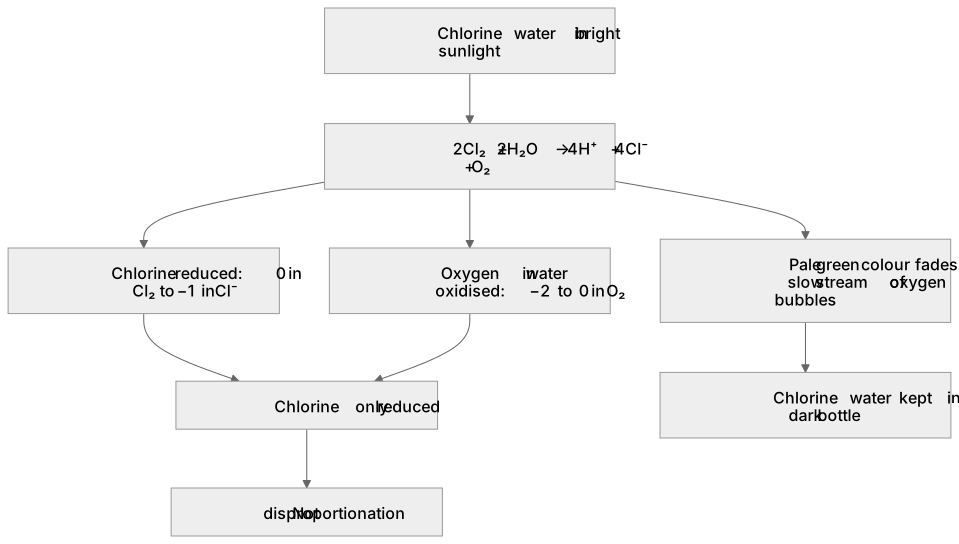
In bright sunlight chlorine water follows a second, slower route: 2Cl₂ + 2H₂O → 4H⁺ + 4Cl⁻ + O₂.
Checked against the AQA 7405 specification (opens in a new tab) on .
- Point 2 of 6
- 2 key terms
Study notes
From the checked teaching notes for this specification point.
The idea
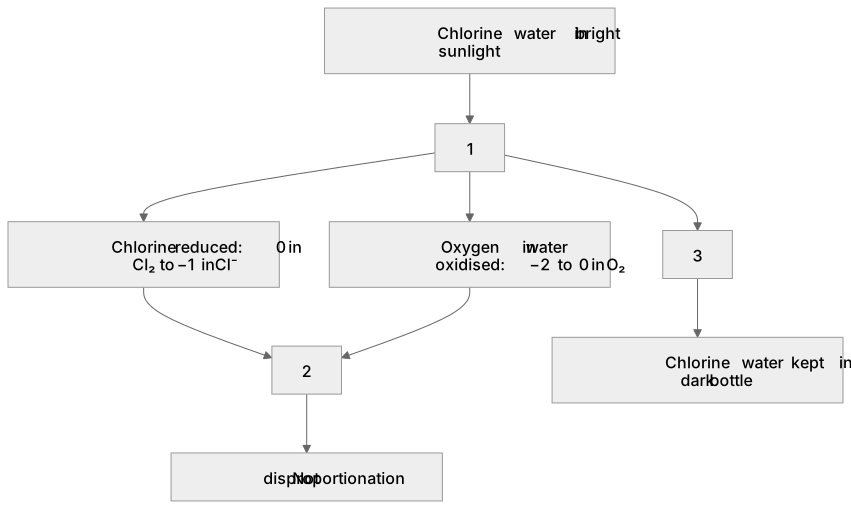
In bright sunlight chlorine water follows a second, slower route: 2Cl₂ + 2H₂O → 4H⁺ + 4Cl⁻ + O₂. Left on a sunny windowsill, the pale green colour of chlorine water fades and a slow stream of oxygen bubbles appears, which is why chlorine water is kept in a dark bottle and why swimming pools lose chlorine fastest on bright days. The redox bookkeeping differs from the chlorate(I) reaction. Here chlorine is only reduced, from 0 in Cl₂ to −1 in Cl⁻, and the species oxidised is the oxygen in water, going from −2 to 0 in O₂. Because chlorine ends in a single oxidation state, this reaction is not disproportionation, even though the two reactants are the same as before.
What earns the marks
- The balanced equation 2Cl₂ + 2H₂O → 4H⁺ + 4Cl⁻ + O₂.
- Stating that sunlight or ultraviolet light is needed.
- Identifying chlorine as reduced from 0 to −1.
- Identifying the oxygen in water as oxidised from −2 to 0.
- Stating that this reaction is not disproportionation, unlike the one forming chlorate(I).
Common mistakes and how to put them right
Calling this reaction disproportionation, when chlorine is only reduced.
Giving the oxidation state of oxygen in water as 0.
Balancing with a single Cl₂, which leaves oxygen unbalanced.
Assuming the reaction proceeds at the same rate in the dark.
Confusing this reaction with the chlorate(I) route and quoting the wrong products.
Exam tips
- Check the conditions in the stem: sunlight points to the oxygen route, ordinary conditions to the chlorate(I) route.
- Assign oxidation states to every element before deciding whether disproportionation has happened.
Try the lesson
The start of the Uses of chlorine and chlorate(I): The reaction of chlorine with water to form chloride ions and oxygen. lesson, made from checked teaching notes for this specification point.
Have a go first
Which equation represents the reaction of chlorine with water in the presence of sunlight?
Listen
In bright sunlight chlorine water follows a second, slower route: 2Cl₂ + 2H₂O → 4H⁺ + 4Cl⁻ + O₂. Left on a sunny windowsill, the pale green colour of chlorine water fades and a slow stream of oxygen bubbles appears, which is why chlorine water is kept in a dark bottle and why swimming pools lose chlorine fastest on bright days. The redox bookkeeping differs from the chlorate(I) reaction. Here chlorine is only reduced, from 0 in Cl₂ to −1 in Cl⁻, and the species oxidised is the oxygen in water, going from −2 to 0 in O₂. Because chlorine ends in a single oxidation state, this reaction is not disproportionation, even though the two reactants are the same as before. A strong answer earns marks for these points. the balanced equation 2Cl₂ + 2H₂O → 4H⁺ + 4Cl⁻ + O₂. stating that sunlight or ultraviolet light is needed. identifying chlorine as reduced from 0 to −1. identifying the oxygen in water as oxidised from −2 to 0. Exam tip: Check the conditions in the stem: sunlight points to the oxygen route, ordinary conditions to the chlorate(I) route.
See it
Key words
Say what each word means before you turn the card.
oxidation of water
Try answering aloud or in your head before turning the card.
not disproportionation
Try answering aloud or in your head before turning the card.
See every definition
- oxidation of water
- The oxygen in water is oxidised from −2 to 0 in O₂.
- not disproportionation
- Chlorine is only reduced, from 0 in Cl₂ to −1 in Cl⁻, so it ends in a single oxidation state.
Label the diagram
Some boxes have lost their names. Pick the right name for each number.
1Box 1
2Box 2
3Box 3
There is more to this lesson
The full lesson goes on to check your understanding and help you earn the marks. Create a free account to carry on, with your progress saved.
A week of Premium from your first lesson · Then the free plan continues · No card, no charge
Test your understanding of Uses of chlorine and chlorate(I): The reaction of chlorine with water to form chloride ions and oxygen.
Active recall beats re-reading. Take an instant quiz now to test what you’ve learned and lock it into long-term memory.
A week of Premium from your first lesson · Then the free plan continues · No card, no charge