AQA · GCSE · Chemistry
Course version: 8462 · Version from Sept 2018
For example: In addition polymers the repeating unit has the same atoms as…
Full specification wording
Addition polymerisation: For example: In addition polymers the repeating unit has the same atoms as the monomer because no other molecule is formed in the reaction.
In addition polymerisation, the repeating unit of the polymer contains exactly the same atoms as the monomer.
Checked against the AQA 8462 specification (opens in a new tab) on .
- Point 3 of 4
- 4 key terms
Study notes
From the checked teaching notes for this specification point.
The idea
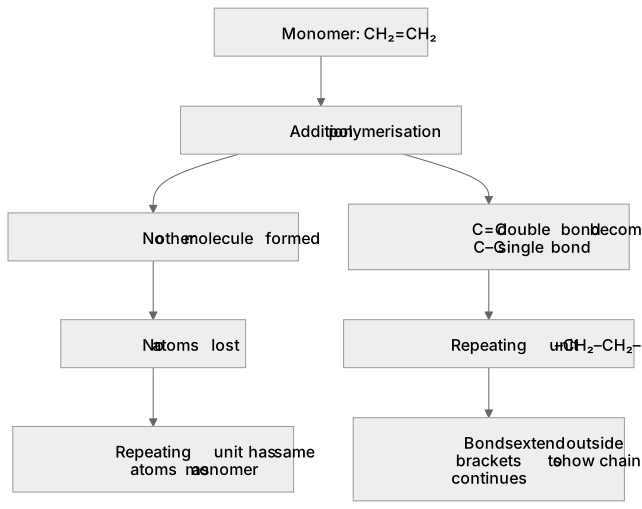
In addition polymerisation, the repeating unit of the polymer contains exactly the same atoms as the monomer. This is because no small molecule is eliminated during the reaction; all the atoms of each monomer become part of the polymer chain. For example, the monomer ethene, CH₂=CH₂, has two carbon atoms and four hydrogen atoms. Its polymer, poly(ethene), has a repeating unit –CH₂–CH₂– that also contains two carbon atoms and four hydrogen atoms. The only change is that the C=C double bond becomes a C–C single bond, and each carbon forms bonds to neighbouring repeating units. When drawing the repeating unit, show the two carbon atoms with single bonds and place the bonds that connect to the rest of the chain outside the brackets.
What earns the marks
- The repeating unit of an addition polymer has the same atoms as the monomer.
- No other molecule is formed during addition polymerisation, so no atoms are lost.
- The double bond in the monomer becomes a single bond in the repeating unit.
- The repeating unit is shown with bonds extending from the carbon atoms to indicate continuation of the chain.
- For ethene, the repeating unit is –CH₂–CH₂–, which contains the same atoms as CH₂=CH₂.
Common mistakes and how to put them right
Drawing the repeating unit with a double bond.
Put it right by showing only single bonds between carbon atoms.
Omitting the bonds that connect the repeating unit to the rest of the polymer chain.
Put it right by adding single bonds extending outside the brackets.
Including extra atoms such as H₂O in the repeating unit.
Put it right by using only the atoms present in the monomer.
Exam tips
- When drawing a repeating unit, always place the extension bonds through the brackets to show that the unit repeats.
- Count the atoms in the monomer and in your repeating unit to check they are identical.
- Remember that addition polymers are named by adding 'poly' before the monomer name, for example poly(ethene).
Try the lesson
The start of the Addition polymerisation: For example: In addition polymers the repeating unit has the same atoms as the monomer because no other molecule is formed in the reaction. lesson, made from checked teaching notes for this specification point.
Have a go first
In an addition polymer, how do the atoms in the repeating unit compare with the atoms in the monomer?
Listen
In addition polymerisation, the repeating unit of the polymer contains exactly the same atoms as the monomer. This is because no small molecule is eliminated during the reaction; all the atoms of each monomer become part of the polymer chain. For example, the monomer ethene, CH₂=CH₂, has two carbon atoms and four hydrogen atoms. Its polymer, poly(ethene), has a repeating unit –CH₂–CH₂– that also contains two carbon atoms and four hydrogen atoms. The only change is that the C=C double bond becomes a C–C single bond, and each carbon forms bonds to neighbouring repeating units. When drawing the repeating unit, show the two carbon atoms with single bonds and place the bonds that connect to the rest of the chain outside the brackets. A strong answer earns marks for these points. The repeating unit of an addition polymer has the same atoms as the monomer. No other molecule is formed during addition polymerisation, so no atoms are lost. The double bond in the monomer becomes a single bond in the repeating unit. The repeating unit is shown with bonds extending from the carbon atoms to indicate continuation of the chain. A common slip: Drawing the repeating unit with a double bond. Instead, showing only single bonds between carbon atoms. Exam tip: When drawing a repeating unit, always place the extension bonds through the brackets to show that the unit repeats.
See it
Key words
Say what each word means before you turn the card.
Addition polymerisation
Try answering aloud or in your head before turning the card.
Repeating unit
Try answering aloud or in your head before turning the card.
Monomer
Try answering aloud or in your head before turning the card.
Poly(ethene)
Try answering aloud or in your head before turning the card.
See every definition
- Addition polymerisation
- A reaction in which no other molecule is formed, so the repeating unit of the polymer has the same atoms as the monomer.
- Repeating unit
- The part of the polymer shown with bonds extending from the carbon atoms to indicate continuation of the chain, containing the same atoms as the monomer.
- Monomer
- The molecule whose atoms all become part of the polymer chain, with its double bond becoming a single bond in the repeating unit.
- Poly(ethene)
- The polymer of ethene, named by adding 'poly' before the monomer name, whose repeating unit is –CH₂–CH₂–.
Label the diagram
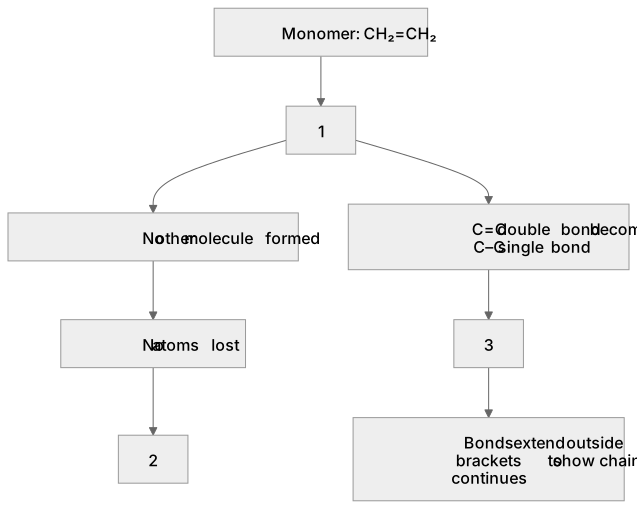
Some boxes have lost their names. Pick the right name for each number.
1Box 1
2Box 2
3Box 3
There is more to this lesson
The full lesson goes on to check your understanding and help you earn the marks. Create a free account to carry on, with your progress saved.
A week of Premium from your first lesson · Then the free plan continues · No card, no charge
Test your understanding of Addition polymerisation: For example: In addition polymers the repeating unit has the same atoms as the monomer because no other molecule is formed in the reaction.
Active recall beats re-reading. Take an instant quiz now to test what you’ve learned and lock it into long-term memory.
A week of Premium from your first lesson · Then the free plan continues · No card, no charge