AQA · GCSE · Chemistry
Course version: 8462 · Version from Sept 2018
The Earth’s resources of metal ores are limited.
Full specification wording
Alternative methods of extracting metals (HT only): The Earth’s resources of metal ores are limited.
Metal ores are naturally occurring rocks that contain enough of a metal compound to make extraction worthwhile.
Checked against the AQA 8462 specification (opens in a new tab) on .
- Point 1 of 8
- 3 key terms
Study notes
From the checked teaching notes for this specification point.
The idea
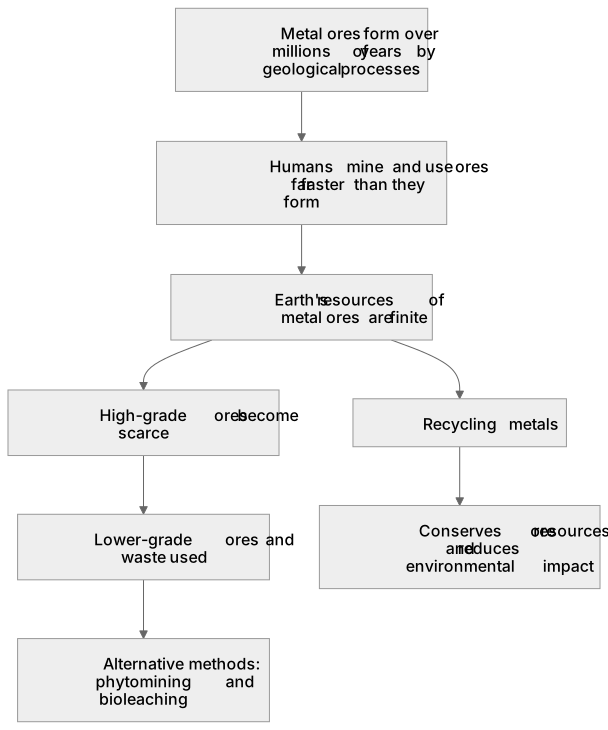
Metal ores are naturally occurring rocks that contain enough of a metal compound to make extraction worthwhile. They formed over millions of years by geological processes, and the rate at which humans mine and use them is far faster than the rate at which they form. This means the Earth’s resources of metal ores are finite and will eventually run out if extraction continues at current rates. As high-grade ores become scarce, extracting metals from lower-grade ores or from waste becomes more important, but these alternative methods often need more energy or more complex chemical processes. Recycling metals also helps conserve ore resources and reduces the environmental impact of mining.
What earns the marks
- Metal ores are finite resources because they form over geological timescales but are extracted and used much faster than they are replaced.
- The limited supply means that high-grade ores are being depleted, so lower-grade ores and alternative sources may need to be used in the future.
- Alternative extraction methods, such as phytomining and bioleaching, can obtain metals from low-grade ores or waste, but they may be slower or need different conditions.
- Recycling metals conserves ore resources, reduces the need for mining and lowers the energy demand and environmental impact of extraction.
- The limited nature of metal ores affects economic and environmental decisions about which extraction methods and materials are used.
Common mistakes and how to put them right
Thinking metal ores are renewable because new ore might form.
Put it right: Ore formation takes millions of years, so ores are finite on human timescales.
Assuming all metal ores are equally easy to extract.
Put it right: High-grade ores are easier and cheaper to process, while low-grade ores need alternative methods.
Confusing the limited supply of ores with the total amount of metal in the Earth.
Put it right: The issue is the availability of concentrated, extractable ore, not the total quantity of metal atoms.
Exam tips
- Use the word finite when describing metal ores, and link it to the idea that they will eventually run out.
- When discussing alternative methods, explain how they help address the limited supply of high-grade ores.
- Include recycling as a way to conserve metal ores and reduce environmental impact.
Try the lesson
The start of the Alternative methods of extracting metals (HT only): The Earth’s resources of metal ores are limited. lesson, made from checked teaching notes for this specification point.
Have a go first
Why are alternative extraction methods, such as phytomining and bioleaching, being developed to extract metals from low-grade ores?
Listen
Metal ores are naturally occurring rocks that contain enough of a metal compound to make extraction worthwhile. They formed over millions of years by geological processes, and the rate at which humans mine and use them is far faster than the rate at which they form. This means the Earth’s resources of metal ores are finite and will eventually run out if extraction continues at current rates. As high-grade ores become scarce, extracting metals from lower-grade ores or from waste becomes more important, but these alternative methods often need more energy or more complex chemical processes. Recycling metals also helps conserve ore resources and reduces the environmental impact of mining. A strong answer earns marks for these points. Metal ores are finite resources because they form over geological timescales but are extracted and used much faster than they are replaced. The limited supply means that high-grade ores are being depleted, so lower-grade ores and alternative sources may need to be used in the future. Alternative extraction methods, such as phytomining and bioleaching, can obtain metals from low-grade ores or waste, but they may be slower or need different conditions. Recycling metals conserves ore resources, reduces the need for mining and lowers the energy demand and environmental impact of extraction. A common slip: Thinking metal ores are renewable because new ore might form. Instead, ore formation takes millions of years, so ores are finite on human timescales. Exam tip: Use the word finite when describing metal ores, and link it to the idea that they will eventually run out.
See it
Key words
Say what each word means before you turn the card.
Finite resources
Try answering aloud or in your head before turning the card.
Alternative metal extraction
Try answering aloud or in your head before turning the card.
Recycling and resource conservation
Try answering aloud or in your head before turning the card.
See every definition
- Finite resources
- Resources that will eventually run out if extraction continues at current rates, because they form over geological timescales but are extracted and used much faster than they are replaced.
- Alternative metal extraction
- Methods that can obtain metals from low-grade ores or waste, but which may be slower or need different conditions.
- Recycling and resource conservation
- Recycling metals conserves ore resources, reduces the need for mining and lowers the energy demand and environmental impact of extraction.
Label the diagram
Some boxes have lost their names. Pick the right name for each number.
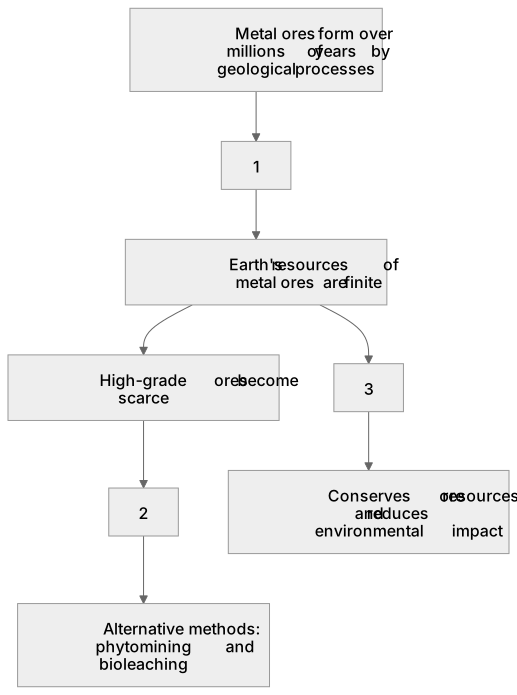
1Box 1
2Box 2
3Box 3
There is more to this lesson
The full lesson goes on to check your understanding and help you earn the marks. Create a free account to carry on, with your progress saved.
A week of Premium from your first lesson · Then the free plan continues · No card, no charge
Test your understanding of Alternative methods of extracting metals (HT only): The Earth’s resources of metal ores are limited.
Active recall beats re-reading. Take an instant quiz now to test what you’ve learned and lock it into long-term memory.
A week of Premium from your first lesson · Then the free plan continues · No card, no charge