AQA · GCSE · Chemistry
Course version: 8462 · Version from Sept 2018
Amino acids react by condensation polymerisation to produce polypeptides.
Full specification wording
Amino acids (HT only): Amino acids react by condensation polymerisation to produce polypeptides.
Amino acids are small molecules that each contain an amine group and a carboxylic acid group.
Checked against the AQA 8462 specification (opens in a new tab) on .
- Point 2 of 2
Study notes
From the checked teaching notes for this specification point.
The idea
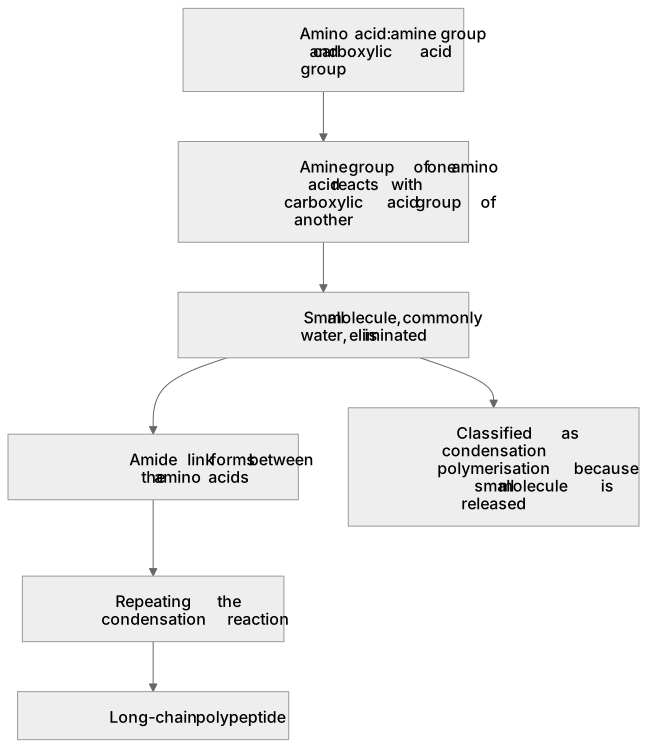
Amino acids are small molecules that each contain an amine group and a carboxylic acid group. In condensation polymerisation, the amine group of one amino acid reacts with the carboxylic acid group of another, releasing a small molecule such as water and forming an amide link. Repeating this process builds a long chain called a polypeptide. Because each amino acid can join to two neighbours, the polymer grows in two directions. For example, glycine joining with alanine releases water and forms a dipeptide; further additions extend the chain. The polypeptide backbone is a repeating sequence of amide links, and the side groups vary according to which amino acids were used. This is a higher-tier topic, so you should be able to identify the link formed and explain why the reaction is a condensation polymerisation.
What earns the marks
- Amino acids contain both an amine group and a carboxylic acid group.
- The amine group of one amino acid reacts with the carboxylic acid group of another.
- A small molecule, commonly water, is eliminated during each linking step.
- The new bond formed between the amino acids is an amide link.
- Repeating the condensation reaction produces a long-chain polypeptide.
- The reaction is classified as condensation polymerisation because a small molecule is released as the polymer forms.
Common mistakes and how to put them right
Thinking that amino acids join without releasing anything.
Put it right: Condensation polymerisation releases a small molecule such as water at each link.
Confusing the amide link with an ester link.
Put it right: Amine plus carboxylic acid forms an amide link.
Believing that only one type of amino acid can be used.
Put it right: Different amino acids can be combined, giving different side groups along the chain.
Exam tips
- Name the two functional groups present in an amino acid before describing the reaction.
- State clearly that a small molecule is eliminated, and identify it as water in the common case.
- Use the term amide link when describing the bond formed between amino acid units.
- Link the release of the small molecule to the definition of condensation polymerisation.
Try the lesson
The start of the Amino acids (HT only): Amino acids react by condensation polymerisation to produce polypeptides. lesson, made from checked teaching notes for this specification point.
Have a go first
Which small molecule is eliminated when amino acids join together by condensation polymerisation to form a polypeptide?
Listen
Amino acids are small molecules that each contain an amine group and a carboxylic acid group. In condensation polymerisation, the amine group of one amino acid reacts with the carboxylic acid group of another, releasing a small molecule such as water and forming an amide link. Repeating this process builds a long chain called a polypeptide. Because each amino acid can join to two neighbours, the polymer grows in two directions. For example, glycine joining with alanine releases water and forms a dipeptide; further additions extend the chain. The polypeptide backbone is a repeating sequence of amide links, and the side groups vary according to which amino acids were used. This is a higher-tier topic, so you should be able to identify the link formed and explain why the reaction is a condensation polymerisation. A strong answer earns marks for these points. Amino acids contain both an amine group and a carboxylic acid group. The amine group of one amino acid reacts with the carboxylic acid group of another. A small molecule, commonly water, is eliminated during each linking step. The new bond formed between the amino acids is an amide link. A common slip: Thinking that amino acids join without releasing anything: the error is omitting the small molecule. Instead, condensation polymerisation releases a small molecule such as water at each link. Exam tip: Name the two functional groups present in an amino acid before describing the reaction.
See it
Label the diagram
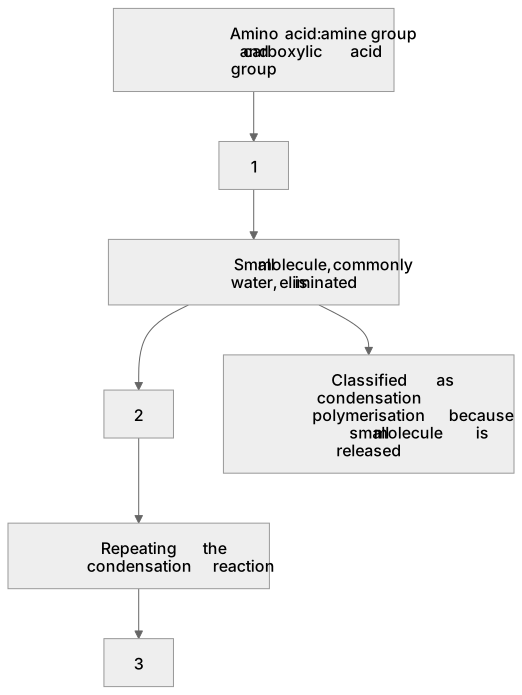
Some boxes have lost their names. Pick the right name for each number.
1Box 1
2Box 2
3Box 3
There is more to this lesson
The full lesson goes on to check your understanding and help you earn the marks. Create a free account to carry on, with your progress saved.
A week of Premium from your first lesson · Then the free plan continues · No card, no charge
Test your understanding of Amino acids (HT only): Amino acids react by condensation polymerisation to produce polypeptides.
Active recall beats re-reading. Take an instant quiz now to test what you’ve learned and lock it into long-term memory.
A week of Premium from your first lesson · Then the free plan continues · No card, no charge