AQA · GCSE · Chemistry
Course version: 8462 · Version from Sept 2018
The masses of reactants and products can be calculated from balanced…
Full specification wording
Amounts of substances in equations (HT only): The masses of reactants and products can be calculated from balanced symbol equations.
A balanced symbol equation shows the ratio in which particles react, and that same ratio applies to amounts in moles.
Checked against the AQA 8462 specification (opens in a new tab) on .
- Point 1 of 2
- 4 key terms
Study notes
From the checked teaching notes for this specification point.
The idea
A balanced symbol equation shows the ratio in which particles react, and that same ratio applies to amounts in moles. Because mass depends on Mr, the mass ratio is not simply the balancing numbers. The method is: write the balanced equation; convert the known mass to moles using n = m ÷ Mr; use the balancing numbers to find moles of the required substance; convert those moles to mass using m = n × Mr. For example, 2Mg + O₂ → 2MgO shows 2 mol Mg react with 1 mol O₂ to form 2 mol MgO. If 4.8 g Mg reacts, n(Mg) = 4.8 ÷ 24 = 0.2 mol, so n(MgO) = 0.2 mol and m(MgO) = 0.2 × 40 = 8.0 g. The equation must be balanced before any ratio is used.
What earns the marks
- Write or select the correctly balanced symbol equation and identify the known and required substances.
- Convert the known mass to moles using the correct Mr for that substance.
- Use the balancing numbers as a mole ratio to find the amount of the required substance.
- Convert the required amount to mass using its own Mr, not the Mr of the known substance.
- Present a clear sequence of steps with units so the reasoning can be followed.
Common mistakes and how to put them right
Using the mass ratio directly from the balancing numbers.
Put it right by converting to moles first, then applying the ratio, then converting back to mass.
Using the wrong Mr for the required product or reactant.
Put it right by calculating Mr separately for each substance in the equation.
Applying the ratio upside down.
Put it right by matching the substance you know to the substance you need in the equation.
Exam tips
- Annotate the equation with the moles of each substance before doing arithmetic.
- Keep the full calculator value until the final step, then round to a sensible number of significant figures.
- Check that the total mass of reactants equals the total mass of products as a final consistency check.
Try the lesson
The start of the Amounts of substances in equations (HT only): The masses of reactants and products can be calculated from balanced symbol equations. lesson, made from checked teaching notes for this specification point.
Have a go first
In the reaction N₂ + 3H₂ → 2NH₃, calculate the mass of ammonia produced when 28 g of nitrogen reacts completely with hydrogen. (Mr: N₂ = 28, NH₃ = 17)
Listen
A balanced symbol equation shows the ratio in which particles react, and that same ratio applies to amounts in moles. Because mass depends on Mr, the mass ratio is not simply the balancing numbers. The method is: write the balanced equation; convert the known mass to moles using n = m ÷ Mr; use the balancing numbers to find moles of the required substance; convert those moles to mass using m = n × Mr. For example, 2Mg + O₂ → 2MgO shows 2 mol Mg react with 1 mol O₂ to form 2 mol MgO. If 4.8 g Mg reacts, n(Mg) = 4.8 ÷ 24 = 0.2 mol, so n(MgO) = 0.2 mol and m(MgO) = 0.2 × 40 = 8.0 g. The equation must be balanced before any ratio is used. A strong answer earns marks for these points. Write or select the correctly balanced symbol equation and identify the known and required substances. Convert the known mass to moles using the correct Mr for that substance. Use the balancing numbers as a mole ratio to find the amount of the required substance. Convert the required amount to mass using its own Mr, not the Mr of the known substance. A common slip: Using the mass ratio directly from the balancing numbers. Instead, converting to moles first, then applying the ratio, then converting back to mass. Exam tip: Annotate the equation with the moles of each substance before doing arithmetic.
See it
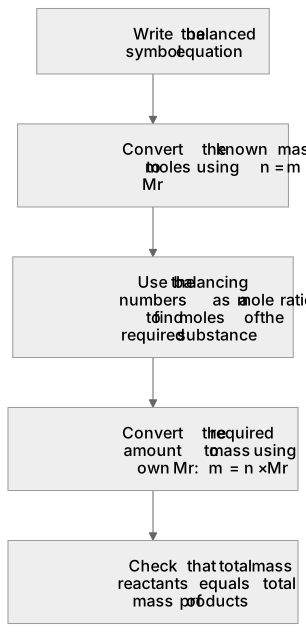
Put it in order
Put these steps in the order they happen.
- 1. Convert the known mass to moles using n = m ÷ Mr
- 2. Use the balancing numbers as a mole ratio to find moles of the required substance
- 3. Write the balanced symbol equation
- 4. Check that total mass of reactants equals total mass of products
- 5. Convert the required amount to mass using its own Mr: m = n × Mr
Key words
Say what each word means before you turn the card.
Balanced equations as mole ratios
Try answering aloud or in your head before turning the card.
Stoichiometric calculations
Try answering aloud or in your head before turning the card.
Converting between mass and amount
Try answering aloud or in your head before turning the card.
Conservation of mass
Try answering aloud or in your head before turning the card.
See every definition
- Balanced equations as mole ratios
- A balanced symbol equation shows the ratio in which particles react, and that same ratio applies to amounts in moles.
- Stoichiometric calculations
- The masses of reactants and products can be calculated from balanced symbol equations, converting the known mass to moles, using the balancing numbers, then converting to mass.
- Converting between mass and amount
- Moles are found from mass using n = m ÷ Mr, and mass is found from moles using m = n × Mr.
- Conservation of mass
- A final consistency check is that the total mass of reactants equals the total mass of products.
Label the diagram
Some boxes have lost their names. Pick the right name for each number.
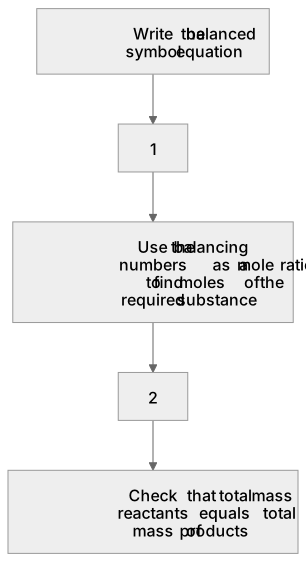
1Box 1
2Box 2
There is more to this lesson
The full lesson goes on to check your understanding and help you earn the marks. Create a free account to carry on, with your progress saved.
A week of Premium from your first lesson · Then the free plan continues · No card, no charge
Test your understanding of Amounts of substances in equations (HT only): The masses of reactants and products can be calculated from balanced symbol equations.
Active recall beats re-reading. Take an instant quiz now to test what you’ve learned and lock it into long-term memory.
A week of Premium from your first lesson · Then the free plan continues · No card, no charge