AQA · GCSE · Chemistry
Course version: 8462 · Version from Sept 2018
Solid particles and unburned hydrocarbons may also be released that form…
Full specification wording
Atmospheric pollutants from fuels: Solid particles and unburned hydrocarbons may also be released that form particulates in the atmosphere.
Combustion does not always convert every fuel molecule into simple gases.
Checked against the AQA 8462 specification (opens in a new tab) on .
- Point 4 of 5
- 3 key terms
Study notes
From the checked teaching notes for this specification point.
The idea
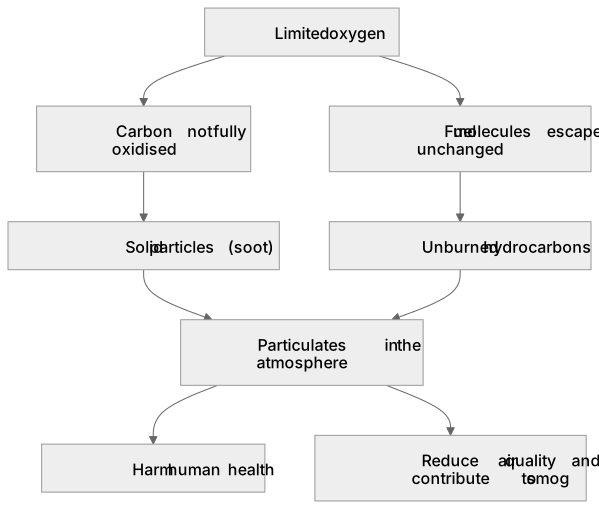
Combustion does not always convert every fuel molecule into simple gases. When oxygen is limited, some carbon is not fully oxidised and is released as solid particles, often called soot. Some fuel molecules may escape without burning at all, and these unburned hydrocarbons are also released. In the atmosphere, solid particles and unburned hydrocarbons can join together to form particulates, which are tiny solid or liquid particles suspended in the air. For example, diesel engines can emit black soot and unburned fuel droplets. Particulates can reduce air quality, cause breathing problems and contribute to smog. They also affect climate by absorbing or scattering sunlight.
What earns the marks
- Solid particles, often carbon soot, form when carbon in a fuel is not fully burned.
- Unburned hydrocarbons are fuel molecules that escape combustion unchanged.
- Solid particles and unburned hydrocarbons can form particulates in the atmosphere.
- Particulates are tiny solid or liquid particles suspended in the air.
- Particulates can harm human health, reduce air quality and contribute to smog.
- Incomplete combustion increases the release of solid particles and unburned hydrocarbons.
Common mistakes and how to put them right
Calling particulates a gas.
Put it right: Particulates are tiny solid or liquid particles suspended in the atmosphere.
Thinking that unburned hydrocarbons are the same as carbon dioxide.
Put it right: Unburned hydrocarbons are fuel molecules that did not react, while carbon dioxide is a fully oxidised product.
Assuming that all carbon in a fuel becomes carbon dioxide.
Put it right: With limited oxygen, some carbon forms solid particles instead.
Exam tips
- Use the term unburned hydrocarbons for fuel molecules that escape combustion, and particulates for the tiny particles they help to form.
- Link particulates to health and environmental effects such as breathing problems and smog, because questions often ask for consequences as well as formation.
- When explaining soot formation, mention a limited supply of oxygen, since that is the condition that prevents complete oxidation of carbon.
Try the lesson
The start of the Atmospheric pollutants from fuels: Solid particles and unburned hydrocarbons may also be released that form particulates in the atmosphere. lesson, made from checked teaching notes for this specification point.
Have a go first
What name is given to the tiny solid particles and unburned hydrocarbons that are released into the atmosphere when some fuels burn?
Listen
Combustion does not always convert every fuel molecule into simple gases. When oxygen is limited, some carbon is not fully oxidised and is released as solid particles, often called soot. Some fuel molecules may escape without burning at all, and these unburned hydrocarbons are also released. In the atmosphere, solid particles and unburned hydrocarbons can join together to form particulates, which are tiny solid or liquid particles suspended in the air. For example, diesel engines can emit black soot and unburned fuel droplets. Particulates can reduce air quality, cause breathing problems and contribute to smog. They also affect climate by absorbing or scattering sunlight. A strong answer earns marks for these points. Solid particles, often carbon soot, form when carbon in a fuel is not fully burned. Unburned hydrocarbons are fuel molecules that escape combustion unchanged. Solid particles and unburned hydrocarbons can form particulates in the atmosphere. Particulates are tiny solid or liquid particles suspended in the air. A common slip: Calling particulates a gas. Instead, particulates are tiny solid or liquid particles suspended in the atmosphere. Exam tip: Use the term unburned hydrocarbons for fuel molecules that escape combustion, and particulates for the tiny particles they help to form.
See it
Key words
Say what each word means before you turn the card.
Incomplete combustion
Try answering aloud or in your head before turning the card.
Particulates
Try answering aloud or in your head before turning the card.
Unburned hydrocarbons
Try answering aloud or in your head before turning the card.
See every definition
- Incomplete combustion
- Combustion in which some carbon in a fuel is not fully burned, increasing the release of solid particles and unburned hydrocarbons.
- Particulates
- Tiny solid or liquid particles suspended in the air, which solid particles and unburned hydrocarbons can join together to form in the atmosphere.
- Unburned hydrocarbons
- Fuel molecules that escape combustion unchanged.
Label the diagram
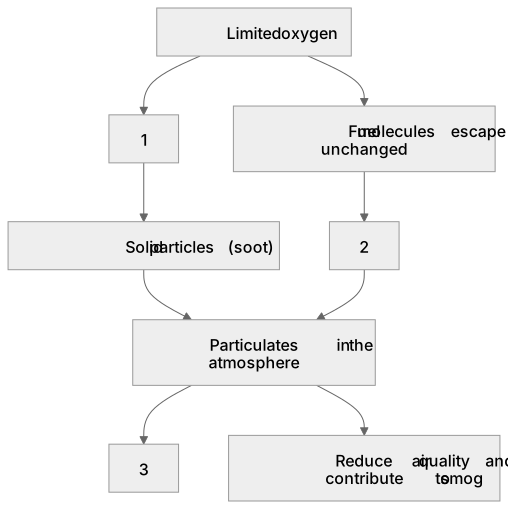
Some boxes have lost their names. Pick the right name for each number.
1Box 1
2Box 2
3Box 3
There is more to this lesson
The full lesson goes on to check your understanding and help you earn the marks. Create a free account to carry on, with your progress saved.
A week of Premium from your first lesson · Then the free plan continues · No card, no charge
Test your understanding of Atmospheric pollutants from fuels: Solid particles and unburned hydrocarbons may also be released that form particulates in the atmosphere.
Active recall beats re-reading. Take an instant quiz now to test what you’ve learned and lock it into long-term memory.
A week of Premium from your first lesson · Then the free plan continues · No card, no charge