AQA · GCSE · Chemistry
Course version: 8462 · Version from Sept 2018
Students should be able to explain how the concentration of a solution in…
Full specification wording
Atom economy: Students should be able to explain how the concentration of a solution in mol/dm is related to the mass of the solute and the volume of the solution.
Concentration in mol/dm³ links solute mass to solution volume.
Checked against the AQA 8462 specification (opens in a new tab) on .
- Point 7 of 7
- 4 key terms
Study notes
From the checked teaching notes for this specification point.
The idea
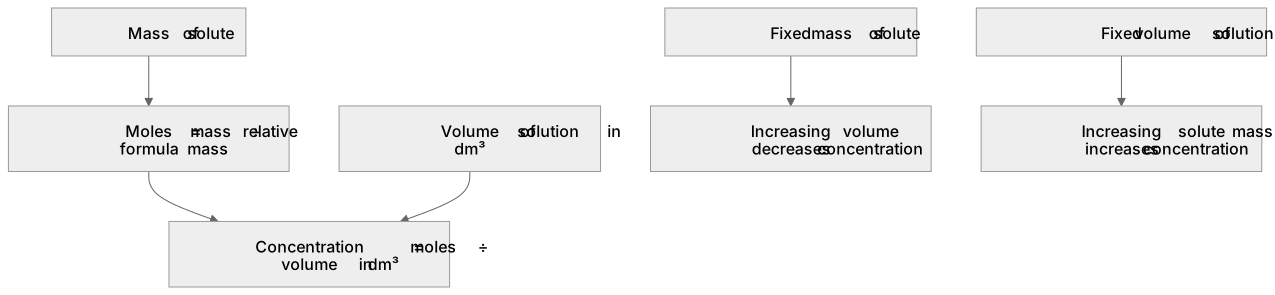
Concentration in mol/dm³ links solute mass to solution volume. Although the metadata lists this under atom economy, it directly addresses using concentrations of solutions in mol/dm³. To explain the relationship, first convert solute mass into moles using: moles = mass ÷ relative formula mass. Next, divide the moles by the volume in dm³ to find concentration. For a fixed solute mass, increasing the solution volume decreases concentration (dilution). Conversely, for a fixed volume, increasing solute mass increases concentration. For example, 4.0 g of NaOH (molar mass 40.0 g/mol) is 0.100 mol. Dissolved to make 500 cm³ (0.500 dm³) of solution, the concentration is 0.100 ÷ 0.500 = 0.200 mol/dm³.
What earns the marks
- State that concentration in mol/dm³ represents the number of moles of solute dissolved per cubic decimetre of solution.
- Explain the conversion of solute mass to moles using the formula: moles = mass ÷ relative formula mass.
- Describe how to calculate concentration using the formula: concentration = moles ÷ volume in dm³.
- Explain that for a fixed mass of solute, increasing the volume of the solution decreases the concentration.
- Explain that for a fixed volume of solution, increasing the mass of the solute increases the concentration.
Common mistakes and how to put them right
Forgetting to convert the volume from cm³ to dm³ before calculating.
Put it right by dividing the volume in cm³ by 1000.
Treating concentration as mass per volume without converting mass to moles.
Put it right by dividing the mass by the relative formula mass first to find moles.
Believing that adding more solvent increases the concentration.
Put it right by explaining that adding solvent increases the total volume, which decreases the concentration.
Exam tips
- Always check the units given in the question; if volume is in cm³, convert it to dm³ immediately before using it in the concentration formula.
- Use the step-by-step chain: mass to moles to concentration, showing your working clearly for each stage to secure method marks.
Try the lesson
The start of the Atom economy: Students should be able to explain how the concentration of a solution in mol/dm is related to the mass of the solute and the volume of the solution. lesson, made from checked teaching notes for this specification point.
Have a go first
A solution is made by dissolving 4.0 g of sodium hydroxide (Mᵣ = 40) in water to make 500 cm³ of solution. What is the concentration in mol/dm³?
Listen
Concentration in mol/dm³ links solute mass to solution volume. Although the metadata lists this under atom economy, it directly addresses using concentrations of solutions in mol/dm³. To explain the relationship, first convert solute mass into moles using: moles = mass ÷ relative formula mass. Next, divide the moles by the volume in dm³ to find concentration. For a fixed solute mass, increasing the solution volume decreases concentration (dilution). Conversely, for a fixed volume, increasing solute mass increases concentration. For example, 4.0 g of NaOH (molar mass 40.0 g/mol) is 0.100 mol. Dissolved to make 500 cm³ (0.500 dm³) of solution, the concentration is 0.100 ÷ 0.500 = 0.200 mol/dm³. A strong answer earns marks for these points. State that concentration in mol/dm³ represents the number of moles of solute dissolved per cubic decimetre of solution. Explain the conversion of solute mass to moles using the formula: moles = mass ÷ relative formula mass. Describe how to calculate concentration using the formula: concentration = moles ÷ volume in dm³. Explain that for a fixed mass of solute, increasing the volume of the solution decreases the concentration. A common slip: Forgetting to convert the volume from cm³ to dm³ before calculating. Instead, dividing the volume in cm³ by 1000. Exam tip: Always check the units given in the question; if volume is in cm³, convert it to dm³ immediately before using it in the concentration formula.
See it
Key words
Say what each word means before you turn the card.
Concentration
Try answering aloud or in your head before turning the card.
Mole calculations
Try answering aloud or in your head before turning the card.
Mass and volume relationships
Try answering aloud or in your head before turning the card.
Dilution
Try answering aloud or in your head before turning the card.
See every definition
- Concentration
- The number of moles of solute dissolved per cubic decimetre of solution, found by dividing the moles by the volume in dm³.
- Mole calculations
- Converting solute mass into moles using moles = mass ÷ relative formula mass before finding concentration.
- Mass and volume relationships
- For a fixed mass of solute, increasing the volume of the solution decreases the concentration, while for a fixed volume, increasing the mass of the solute increases it.
- Dilution
- Adding more solvent increases the total volume, which decreases the concentration.
Label the diagram
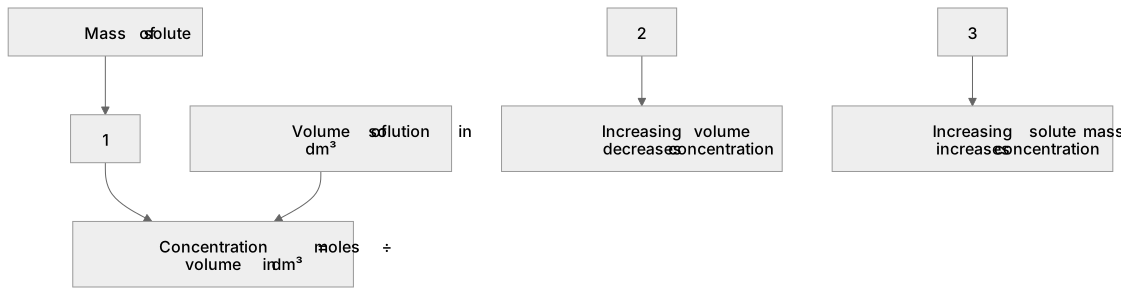
Some boxes have lost their names. Pick the right name for each number.
1Box 1
2Box 2
3Box 3
There is more to this lesson
The full lesson goes on to check your understanding and help you earn the marks. Create a free account to carry on, with your progress saved.
A week of Premium from your first lesson · Then the free plan continues · No card, no charge
Test your understanding of Atom economy: Students should be able to explain how the concentration of a solution in mol/dm is related to the mass of the solute and the volume of the solution.
Active recall beats re-reading. Take an instant quiz now to test what you’ve learned and lock it into long-term memory.
A week of Premium from your first lesson · Then the free plan continues · No card, no charge