AQA · GCSE · Chemistry
Course version: 8462 · Version from Sept 2018
The atom economy (atom utilisation) is a measure of the amount of starting…
Full specification wording
Atom economy: The atom economy (atom utilisation) is a measure of the amount of starting materials that end up as useful products.
Atom economy, also called atom utilisation, measures how much of the mass of the reactants becomes the desired product rather than waste or by-products.
Checked against the AQA 8462 specification (opens in a new tab) on .
- Point 1 of 7
- 4 key terms
Study notes
From the checked teaching notes for this specification point.
The idea
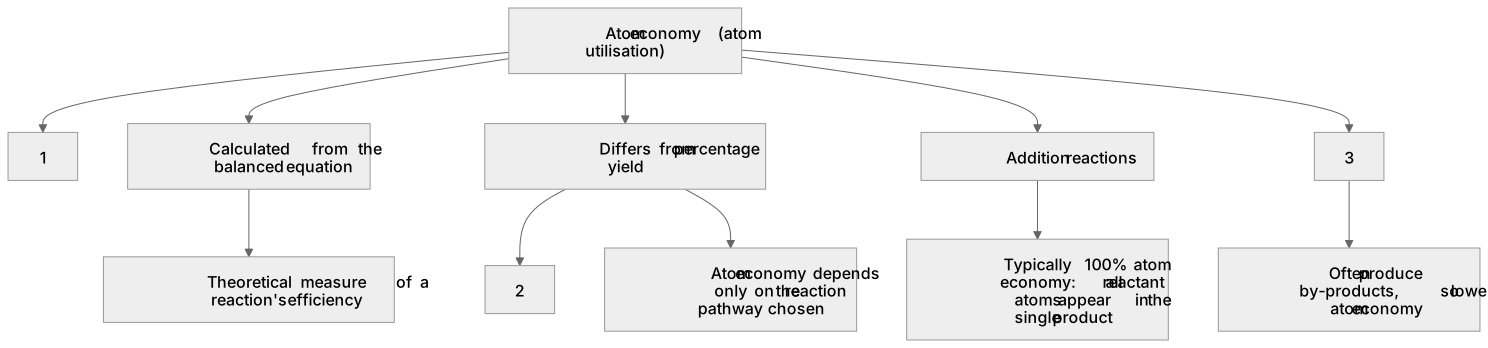
Atom economy, also called atom utilisation, measures how much of the mass of the reactants becomes the desired product rather than waste or by-products. It is calculated from the balanced equation, not from an experiment, so it is a theoretical measure of a reaction's efficiency. A reaction with high atom economy converts most reactant atoms into the useful product; addition reactions typically have 100% atom economy because all reactant atoms appear in the single product, while substitution and elimination reactions often produce by-products and therefore lower atom economy. For example, in an addition reaction such as ethene reacting with hydrogen to form ethane, all atoms become ethane, so the atom economy is 100%. Atom economy differs from percentage yield: yield depends on how much product is actually collected, whereas atom economy depends only on the reaction pathway chosen.
What earns the marks
- Define atom economy as the proportion of reactant mass that becomes the desired product, distinguishing it from percentage yield.
- Identify the desired product and all reactants from a balanced equation before any calculation.
- Explain that atom economy is a theoretical value determined by the equation and is independent of experimental losses.
- Compare two reaction pathways and state which has higher atom economy from the balanced equations, linking this to fewer unwanted by-products.
- Recognise that addition reactions generally have higher atom economy than substitution or elimination reactions because no atoms are wasted.
Common mistakes and how to put them right
Confusing atom economy with percentage yield.
Put it right by stating that atom economy comes from the equation while yield comes from measured amounts.
Including only some reactants in the denominator.
Put it right by summing the relative formula masses of all reactants shown in the balanced equation.
Assuming a high atom economy guarantees a high yield.
Put it right by explaining that a reaction can be efficient in theory but slow, incomplete or difficult to separate in practice.
Exam tips
- Write the balanced equation first and label the desired product clearly before calculating anything.
- Use the term atom utilisation if it appears in the question, showing you recognise it as a synonym for atom economy.
- When comparing pathways, quote the atom economy values or the by-products formed to justify your choice rather than asserting one is better.
Try the lesson
The start of the Atom economy: The atom economy (atom utilisation) is a measure of the amount of starting materials that end up as useful products. lesson, made from checked teaching notes for this specification point.
Have a go first
What does the atom economy of a reaction measure?
Listen
Atom economy, also called atom utilisation, measures how much of the mass of the reactants becomes the desired product rather than waste or by-products. It is calculated from the balanced equation, not from an experiment, so it is a theoretical measure of a reaction's efficiency. A reaction with high atom economy converts most reactant atoms into the useful product; addition reactions typically have 100% atom economy because all reactant atoms appear in the single product, while substitution and elimination reactions often produce by-products and therefore lower atom economy. For example, in an addition reaction such as ethene reacting with hydrogen to form ethane, all atoms become ethane, so the atom economy is 100%. Atom economy differs from percentage yield: yield depends on how much product is actually collected, whereas atom economy depends only on the reaction pathway chosen. A strong answer earns marks for these points. Define atom economy as the proportion of reactant mass that becomes the desired product, distinguishing it from percentage yield. Identify the desired product and all reactants from a balanced equation before any calculation. Explain that atom economy is a theoretical value determined by the equation and is independent of experimental losses. Compare two reaction pathways and state which has higher atom economy from the balanced equations, linking this to fewer unwanted by-products. A common slip: Confusing atom economy with percentage yield. Instead, stating that atom economy comes from the equation while yield comes from measured amounts. Exam tip: Write the balanced equation first and label the desired product clearly before calculating anything.
See it

Key words
Say what each word means before you turn the card.
Atom economy
Try answering aloud or in your head before turning the card.
Atom utilisation
Try answering aloud or in your head before turning the card.
Percentage yield
Try answering aloud or in your head before turning the card.
Addition reactions
Try answering aloud or in your head before turning the card.
See every definition
- Atom economy
- A measure of the amount of starting materials that end up as useful products, also called atom utilisation.
- Atom utilisation
- Another name for atom economy, the measure of the amount of starting materials that end up as useful products.
- Percentage yield
- A value that depends on how much product is actually collected, unlike atom economy which depends only on the reaction pathway chosen.
- Addition reactions
- Reactions that typically have 100% atom economy because all reactant atoms appear in the single product.
Label the diagram
Some boxes have lost their names. Pick the right name for each number.
1Box 1
2Box 2
3Box 3
There is more to this lesson
The full lesson goes on to check your understanding and help you earn the marks. Create a free account to carry on, with your progress saved.
A week of Premium from your first lesson · Then the free plan continues · No card, no charge
Test your understanding of Atom economy: The atom economy (atom utilisation) is a measure of the amount of starting materials that end up as useful products.
Active recall beats re-reading. Take an instant quiz now to test what you’ve learned and lock it into long-term memory.
A week of Premium from your first lesson · Then the free plan continues · No card, no charge