AQA · GCSE · Chemistry
Course version: 8462 · Version from Sept 2018
The percentage atom economy of a reaction is calculated using the balanced…
Full specification wording
Atom economy: The percentage atom economy of a reaction is calculated using the balanced equation for the reaction as follows: Relative f ormula mass o f desired product f rom equation × 100 Sum o f relative f ormula masses o f all reactants f rom equation Students should be able to: calculate the atom economy of a reaction to form a desired product from the balanced equation (HT only) explain why a particular reaction pathway is chosen to produce a specified product given appropriate data such as atom economy (if not calculated), yield, rate, equilibrium position and usefulness of by-products.
Percentage atom economy is calculated from the balanced equation using: percentage atom economy = (relative formula mass of desired product from equation ÷ sum of relative formula masses of all…
Checked against the AQA 8462 specification (opens in a new tab) on .
- Point 3 of 7
Study notes
From the checked teaching notes for this specification point.
The idea
Percentage atom economy is calculated from the balanced equation using: percentage atom economy = (relative formula mass of desired product from equation ÷ sum of relative formula masses of all reactants from equation) × 100. Multiply each species by its balancing number before adding. For example, for N₂ + 3H₂ → 2NH₃, the desired product mass is 2 × 17 = 34 and the reactant total is 28 + 6 = 34, giving 100%. Higher tier students calculate this value; all students may explain pathway choice using given data. A pathway is chosen by weighing atom economy against yield, rate, equilibrium position and whether by-products are useful, so the highest atom economy is not automatically selected.
What earns the marks
- Write the balanced equation and identify the desired product before calculating.
- Calculate the relative formula mass of the desired product and multiply by its balancing number.
- Sum the relative formula masses of all reactants, each multiplied by its balancing number, for the denominator.
- Substitute into percentage atom economy = (desired product mass ÷ total reactant mass) × 100 and evaluate the result.
- Explain pathway choice by comparing atom economy with yield, rate, equilibrium position and the usefulness of by-products, using the data provided.
Common mistakes and how to put them right
Ignoring balancing numbers when finding relative formula masses.
Put it right by multiplying each relative formula mass by its coefficient in the equation.
Placing the total reactant mass in the numerator.
Put it right by keeping the desired product mass on top and the reactant total underneath.
Choosing a pathway on atom economy alone.
Put it right by discussing yield, rate, equilibrium position and by-product usefulness as well.
Exam tips
- Show the relative formula mass of each species separately before combining them, so arithmetic errors are easy to spot and method marks can be awarded.
- Check that the numerator and denominator use the same units and that the final answer is a percentage.
- For pathway-choice questions, structure the answer around each piece of data given, stating whether it favours the pathway and why.
Try the lesson
The start of the Atom economy: The percentage atom economy of a reaction is calculated using the balanced equation for the reaction as follows: Relative f ormula mass o f desired product f rom equation × 100 Sum o f relative f ormula masses o f all reactants f rom equation Students should be able to: calculate the atom economy of a reaction to form a desired product from the balanced equation (HT only) explain why a particular reaction pathway is chosen to produce a specified product given appropriate data such as atom economy (if not calculated), yield, rate, equilibrium position and usefulness of by-products. lesson, made from checked teaching notes for this specification point.
Have a go first
Which expression gives the percentage atom economy of a reaction?
Listen
Percentage atom economy is calculated from the balanced equation using: percentage atom economy = (relative formula mass of desired product from equation ÷ sum of relative formula masses of all reactants from equation) × 100. Multiply each species by its balancing number before adding. For example, for N₂ + 3H₂ → 2NH₃, the desired product mass is 2 × 17 = 34 and the reactant total is 28 + 6 = 34, giving 100%. Higher tier students calculate this value; all students may explain pathway choice using given data. A pathway is chosen by weighing atom economy against yield, rate, equilibrium position and whether by-products are useful, so the highest atom economy is not automatically selected. A strong answer earns marks for these points. Write the balanced equation and identify the desired product before calculating. Calculate the relative formula mass of the desired product and multiply by its balancing number. Sum the relative formula masses of all reactants, each multiplied by its balancing number, for the denominator. Substitute into percentage atom economy = (desired product mass ÷ total reactant mass) × 100 and evaluate the result. A common slip: Ignoring balancing numbers when finding relative formula masses. Instead, multiplying each relative formula mass by its coefficient in the equation. Exam tip: Show the relative formula mass of each species separately before combining them, so arithmetic errors are easy to spot and method marks can be awarded.
See it
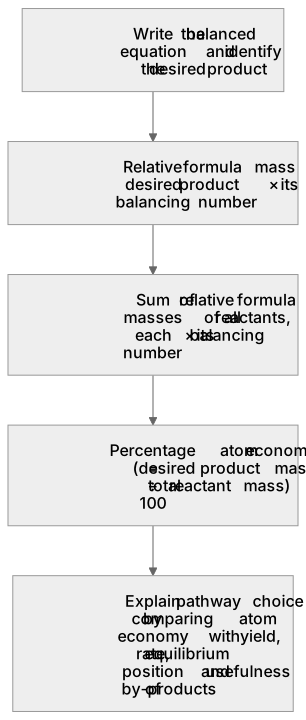
Put it in order
Put these steps in the order they happen.
- 1. Relative formula mass of desired product × its balancing number
- 2. Sum of relative formula masses of all reactants, each × its balancing number
- 3. Write the balanced equation and identify the desired product
- 4. Explain pathway choice by comparing atom economy with yield, rate, equilibrium position and usefulness of by-products
- 5. Percentage atom economy = (desired product mass ÷ total reactant mass) × 100
Label the diagram
Some boxes have lost their names. Pick the right name for each number.
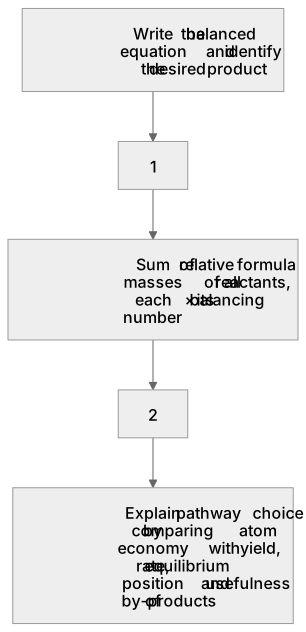
1Box 1
2Box 2
There is more to this lesson
The full lesson goes on to check your understanding and help you earn the marks. Create a free account to carry on, with your progress saved.
A week of Premium from your first lesson · Then the free plan continues · No card, no charge
Test your understanding of Atom economy: The percentage atom economy of a reaction is calculated using the balanced equation for the reaction as follows: Relative f ormula mass o f desired product f rom equation × 100 Sum o f relative f ormula masses o f all reactants f rom equation Students should be able to: calculate the atom economy of a reaction to form a desired product from the balanced equation (HT only) explain why a particular reaction pathway is chosen to produce a specified product given appropriate data such as atom economy (if not calculated), yield, rate, equilibrium position and usefulness of by-products.
Active recall beats re-reading. Take an instant quiz now to test what you’ve learned and lock it into long-term memory.
A week of Premium from your first lesson · Then the free plan continues · No card, no charge