AQA · GCSE · Chemistry
Course version: 8462 · Version from Sept 2018
Atoms of each element are represented by a chemical symbol, eg O…
Full specification wording
Atoms, elements and compounds: Atoms of each element are represented by a chemical symbol, eg O represents an atom of oxygen, Na represents an atom of sodium.
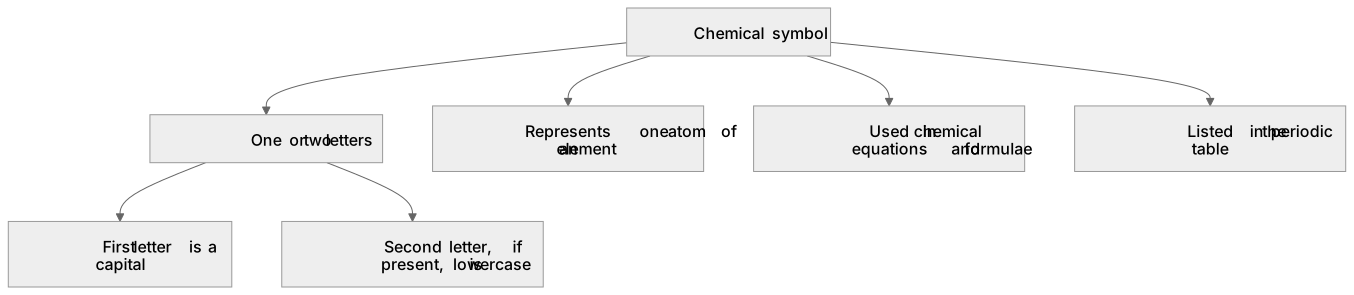
Each element has a unique chemical symbol, usually one or two letters.
Checked against the AQA 8462 specification (opens in a new tab) on .
- Point 2 of 10
- 3 key terms
Study notes
From the checked teaching notes for this specification point.
The idea
Each element has a unique chemical symbol, usually one or two letters. The first letter is always a capital, and the second letter, if present, is lowercase. For example, O is oxygen, Na is sodium, and Fe is iron. These symbols are internationally recognised and are used in chemical equations and formulae. The symbol represents one atom of that element. When you write a formula such as H₂O, the symbols tell you which elements are present and the subscripts tell you how many atoms of each. Understanding symbols is essential for writing and interpreting chemical equations, and for calculating relative formula masses. The periodic table lists all elements with their symbols, and you are expected to know the symbols for the first 20 elements and some common transition metals.
What earns the marks
- State that each element has its own unique chemical symbol.
- Write the correct symbol for common elements, using capital and lowercase letters appropriately.
- Interpret a chemical symbol as representing one atom of that element.
- Use symbols to write chemical formulae for compounds.
- Recognise that symbols are used internationally and are listed in the periodic table.
Common mistakes and how to put them right
Writing symbols with incorrect capitalisation, such as 'na' instead of 'Na' or 'CO' for cobalt instead of 'Co'.
Put it right: Use a capital first letter and lowercase second letter.
Confusing the symbol with the name, for example thinking 'Na' stands for nitrogen.
Put it right: Learn the symbols for common elements.
Assuming a symbol represents a molecule rather than an atom.
Put it right: A symbol represents one atom of the element.
Exam tips
- Learn the symbols and names of the first 20 elements and common transition metals like iron, copper and zinc.
- When writing formulae, ensure subscripts are used correctly to show the number of atoms.
- In equations, use symbols rather than names to show you understand chemical notation.
Try the lesson
The start of the Atoms, elements and compounds: Atoms of each element are represented by a chemical symbol, eg O represents an atom of oxygen, Na represents an atom of sodium. lesson, made from checked teaching notes for this specification point.
Have a go first
Which chemical symbol represents an atom of oxygen?
Listen
Each element has a unique chemical symbol, usually one or two letters. The first letter is always a capital, and the second letter, if present, is lowercase. For example, O is oxygen, Na is sodium, and Fe is iron. These symbols are internationally recognised and are used in chemical equations and formulae. The symbol represents one atom of that element. When you write a formula such as H₂O, the symbols tell you which elements are present and the subscripts tell you how many atoms of each. Understanding symbols is essential for writing and interpreting chemical equations, and for calculating relative formula masses. The periodic table lists all elements with their symbols, and you are expected to know the symbols for the first 20 elements and some common transition metals. A strong answer earns marks for these points. State that each element has its own unique chemical symbol. Write the correct symbol for common elements, using capital and lowercase letters appropriately. Interpret a chemical symbol as representing one atom of that element. Use symbols to write chemical formulae for compounds. A common slip: Writing symbols with incorrect capitalisation, such as 'na' instead of 'Na' or 'CO' for cobalt instead of 'Co'. Instead, use a capital first letter and lowercase second letter. Exam tip: Learn the symbols and names of the first 20 elements and common transition metals like iron, copper and zinc.
See it
Key words
Say what each word means before you turn the card.
Chemical symbol
Try answering aloud or in your head before turning the card.
Formula
Try answering aloud or in your head before turning the card.
Periodic table
Try answering aloud or in your head before turning the card.
See every definition
- Chemical symbol
- A representation of an atom of each element, usually one or two letters, where the first letter is always a capital and the second letter, if present, is lowercase.
- Formula
- A way of showing which elements are present and, through subscripts, how many atoms of each are present.
- Periodic table
- A list of all elements with their symbols.
Label the diagram
Some boxes have lost their names. Pick the right name for each number.
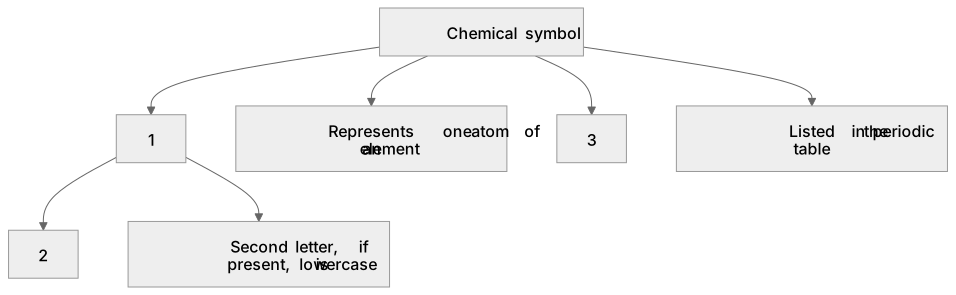
1Box 1
2Box 2
3Box 3
There is more to this lesson
The full lesson goes on to check your understanding and help you earn the marks. Create a free account to carry on, with your progress saved.
A week of Premium from your first lesson · Then the free plan continues · No card, no charge
Test your understanding of Atoms, elements and compounds: Atoms of each element are represented by a chemical symbol, eg O represents an atom of oxygen, Na represents an atom of sodium.
Active recall beats re-reading. Take an instant quiz now to test what you’ve learned and lock it into long-term memory.
A week of Premium from your first lesson · Then the free plan continues · No card, no charge