AQA · GCSE · Chemistry
Course version: 8462 · Version from Sept 2018
Chemical reactions always involve the formation of one or more new…
Full specification wording
Atoms, elements and compounds: Chemical reactions always involve the formation of one or more new substances, and often involve a detectable energy change.
A chemical reaction rearranges atoms to make one or more new substances with different properties from the reactants.
Checked against the AQA 8462 specification (opens in a new tab) on .
- Point 5 of 10
- 4 key terms
Study notes
From the checked teaching notes for this specification point.
The idea
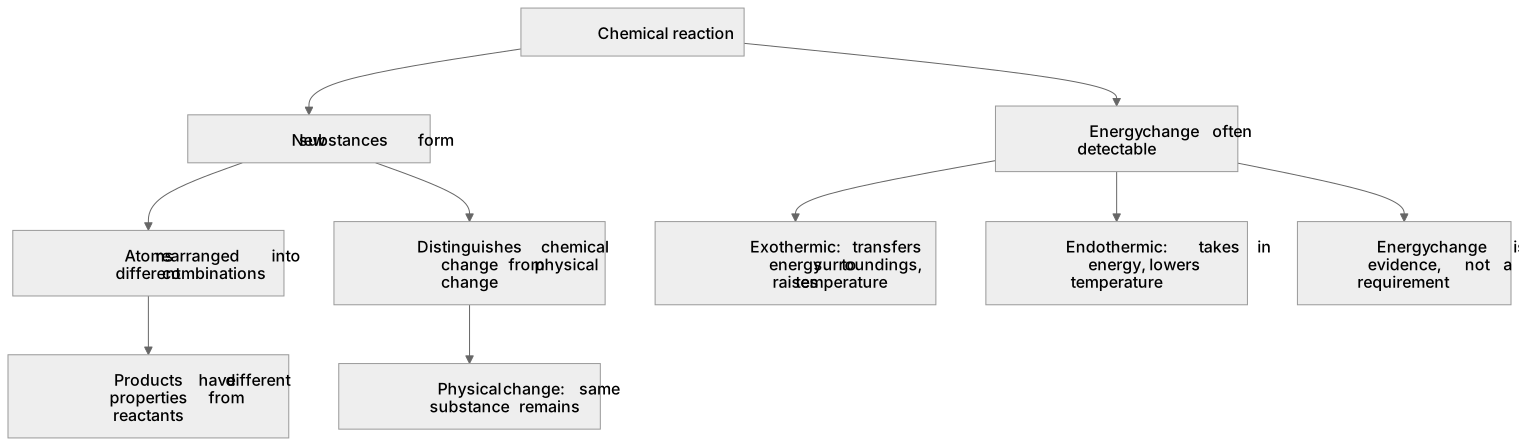
A chemical reaction rearranges atoms to make one or more new substances with different properties from the reactants. For example, burning magnesium in oxygen forms white magnesium oxide, a new compound. The statement has two clauses. First, new substances always form; this distinguishes chemical change from physical change such as melting ice, where the substance is still water. Second, an energy change is often detectable: the mixture may heat up (exothermic, such as combustion) or cool down (endothermic, such as thermal decomposition of calcium carbonate). Energy change is evidence, not a requirement, so some reactions show little temperature change. Detect new substances by observing colour, gas, precipitate or pH changes, and measure energy change with a thermometer.
What earns the marks
- New substances form because atoms in reactants are rearranged into different combinations; the products have different properties from the reactants.
- Chemical change differs from physical change: in a physical change the same substance remains, whereas in a chemical change new substances form.
- Energy change is often detectable as a temperature rise or fall, or as light or sound, but it is not present in every reaction.
- Exothermic reactions transfer energy to the surroundings and raise temperature; endothermic reactions take in energy and lower temperature.
- Evidence for a reaction can include a new colour, a gas evolved, a precipitate formed or a pH change, alongside any energy change.
Common mistakes and how to put them right
Treating any observable change as chemical.
Put it right: A change of state or dissolving is physical because no new substance forms.
Assuming every reaction must release heat.
Put it right: Some reactions absorb energy and cool the surroundings, and some show little temperature change.
Confusing the reactants with the products when describing new substances.
Put it right: Name the new substance formed, such as magnesium oxide from magnesium and oxygen.
Exam tips
- When asked to justify that a reaction occurred, name the new substance and give the observation that shows it, rather than saying only that bubbles appeared.
- For energy change questions, state the direction of temperature change and classify it as exothermic or endothermic.
- Use particle diagrams or word equations to show rearrangement of atoms, which explains why new substances form.
Try the lesson
The start of the Atoms, elements and compounds: Chemical reactions always involve the formation of one or more new substances, and often involve a detectable energy change. lesson, made from checked teaching notes for this specification point.
Have a go first
Which statement correctly describes the changes that occur during a chemical reaction?
Listen
A chemical reaction rearranges atoms to make one or more new substances with different properties from the reactants. For example, burning magnesium in oxygen forms white magnesium oxide, a new compound. The statement has two clauses. First, new substances always form; this distinguishes chemical change from physical change such as melting ice, where the substance is still water. Second, an energy change is often detectable: the mixture may heat up (exothermic, such as combustion) or cool down (endothermic, such as thermal decomposition of calcium carbonate). Energy change is evidence, not a requirement, so some reactions show little temperature change. Detect new substances by observing colour, gas, precipitate or pH changes, and measure energy change with a thermometer. A strong answer earns marks for these points. New substances form because atoms in reactants are rearranged into different combinations; the products have different properties from the reactants. Chemical change differs from physical change: in a physical change the same substance remains, whereas in a chemical change new substances form. Energy change is often detectable as a temperature rise or fall, or as light or sound, but it is not present in every reaction. Exothermic reactions transfer energy to the surroundings and raise temperature; endothermic reactions take in energy and lower temperature. A common slip: Treating any observable change as chemical. Instead, a change of state or dissolving is physical because no new substance forms. Exam tip: When asked to justify that a reaction occurred, name the new substance and give the observation that shows it, rather than saying only that bubbles appeared.
See it
Key words
Say what each word means before you turn the card.
Chemical change
Try answering aloud or in your head before turning the card.
Physical change
Try answering aloud or in your head before turning the card.
Exothermic
Try answering aloud or in your head before turning the card.
Endothermic
Try answering aloud or in your head before turning the card.
See every definition
- Chemical change
- A change in which one or more new substances form, with different properties from the reactants, because atoms are rearranged into different combinations.
- Physical change
- A change such as melting ice in which the same substance remains, so no new substance forms.
- Exothermic
- A reaction that transfers energy to the surroundings and raises the temperature, such as combustion.
- Endothermic
- A reaction that takes in energy and lowers the temperature, such as thermal decomposition of calcium carbonate.
Label the diagram
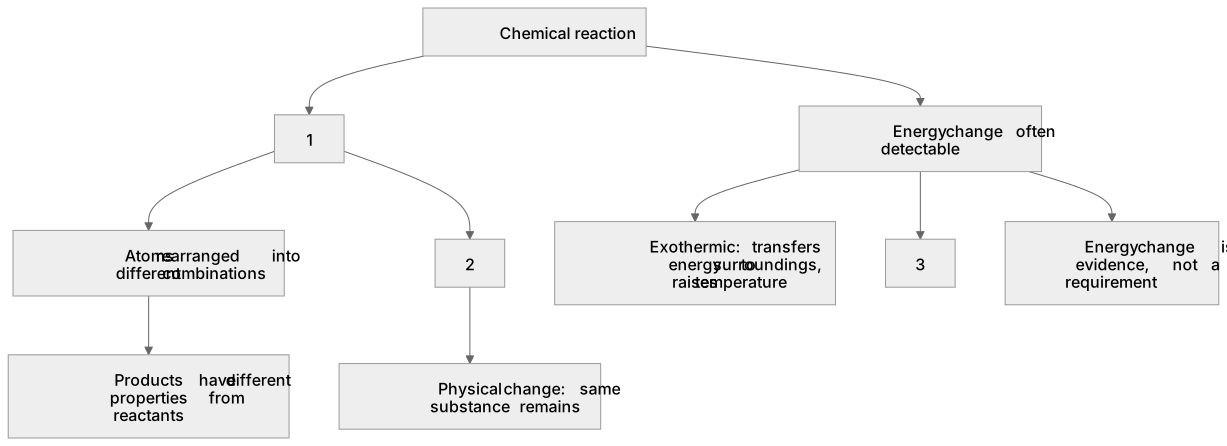
Some boxes have lost their names. Pick the right name for each number.
1Box 1
2Box 2
3Box 3
There is more to this lesson
The full lesson goes on to check your understanding and help you earn the marks. Create a free account to carry on, with your progress saved.
A week of Premium from your first lesson · Then the free plan continues · No card, no charge
Test your understanding of Atoms, elements and compounds: Chemical reactions always involve the formation of one or more new substances, and often involve a detectable energy change.
Active recall beats re-reading. Take an instant quiz now to test what you’ve learned and lock it into long-term memory.
A week of Premium from your first lesson · Then the free plan continues · No card, no charge