AQA · GCSE · Chemistry
Course version: 8462 · Version from Sept 2018
The units of rate of reaction may be given as g/s or cm /s.
Full specification wording
Calculating rates of reactions: The units of rate of reaction may be given as g/s or cm /s.
Rate of reaction measures how quickly a reactant is used up or a product is formed.
Checked against the AQA 8462 specification (opens in a new tab) on .
- Point 1 of 2
Study notes
From the checked teaching notes for this specification point.
The idea
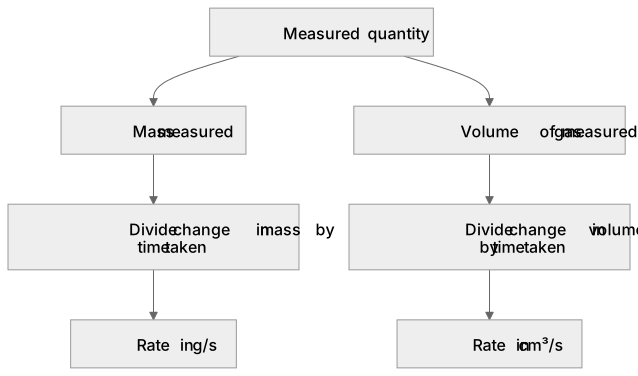
Rate of reaction measures how quickly a reactant is used up or a product is formed. When the quantity measured is a mass, the rate is calculated by dividing the change in mass by the time taken, giving units of grams per second, written g/s. When the quantity measured is a volume of gas, the rate is calculated by dividing the change in volume by the time taken, giving units of cubic centimetres per second, written cm³/s. The same principle applies to any measured quantity: divide the change by the time. For example, if 24 cm³ of gas is collected in 8 s, the average rate is 24 cm³ ÷ 8 s = 3 cm³/s. Choosing the right unit depends on what is measured during the experiment.
What earns the marks
- Rate of reaction is calculated by dividing the change in the measured quantity by the time taken.
- When mass is measured, the rate may be expressed in g/s.
- When volume of gas is measured, the rate may be expressed in cm³/s.
- The unit must match the quantity measured: mass gives g/s and volume gives cm³/s.
- A rate calculated over the whole reaction is an average rate, whereas the gradient of a graph at a point gives the rate at that moment.
Common mistakes and how to put them right
Writing the volume unit as cm/s instead of cm³/s.
Put it right by using the cubed unit for volume.
Dividing time by the change in quantity instead of dividing the change in quantity by time.
Put it right by putting the change in mass or volume on top.
Using g/s for a volume measurement or cm³/s for a mass measurement.
Put it right by matching the unit to the quantity measured.
Exam tips
- Always include the unit with a calculated rate, and check it matches the quantity measured.
- Show the division clearly, for example change in volume divided by time, before giving the final value.
- If a graph is provided, remember that the gradient gives the rate, and a steeper gradient means a faster reaction.
Try the lesson
The start of the Calculating rates of reactions: The units of rate of reaction may be given as g/s or cm /s. lesson, made from checked teaching notes for this specification point.
Have a go first
A student investigates the rate of reaction between marble chips and hydrochloric acid by measuring the volume of carbon dioxide gas produced over time. What is the correct unit for the rate of this reaction?
Listen
Rate of reaction measures how quickly a reactant is used up or a product is formed. When the quantity measured is a mass, the rate is calculated by dividing the change in mass by the time taken, giving units of grams per second, written g/s. When the quantity measured is a volume of gas, the rate is calculated by dividing the change in volume by the time taken, giving units of cubic centimetres per second, written cm³/s. The same principle applies to any measured quantity: divide the change by the time. For example, if 24 cm³ of gas is collected in 8 s, the average rate is 24 cm³ ÷ 8 s = 3 cm³/s. Choosing the right unit depends on what is measured during the experiment. A strong answer earns marks for these points. Rate of reaction is calculated by dividing the change in the measured quantity by the time taken. When mass is measured, the rate may be expressed in g/s. When volume of gas is measured, the rate may be expressed in cm³/s. The unit must match the quantity measured: mass gives g/s and volume gives cm³/s. A common slip: Writing the volume unit as cm/s instead of cm³/s. Instead, using the cubed unit for volume. Exam tip: Always include the unit with a calculated rate, and check it matches the quantity measured.
See it
Label the diagram
Some boxes have lost their names. Pick the right name for each number.
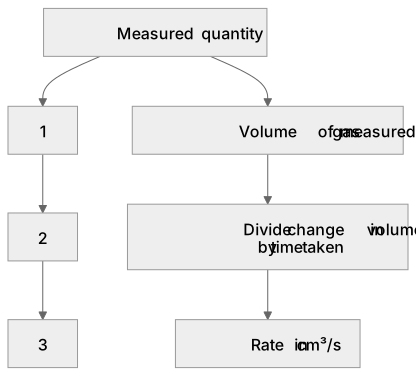
1Box 1
2Box 2
3Box 3
There is more to this lesson
The full lesson goes on to check your understanding and help you earn the marks. Create a free account to carry on, with your progress saved.
A week of Premium from your first lesson · Then the free plan continues · No card, no charge
Test your understanding of Calculating rates of reactions: The units of rate of reaction may be given as g/s or cm /s.
Active recall beats re-reading. Take an instant quiz now to test what you’ve learned and lock it into long-term memory.
A week of Premium from your first lesson · Then the free plan continues · No card, no charge