AQA · GCSE · Chemistry
Course version: 8462 · Version from Sept 2018
For example, low density (LD) and high density (HD) poly(ethene) are…
Full specification wording
Ceramics, polymers and composites: For example, low density (LD) and high density (HD) poly(ethene) are produced from ethene.
Ethene is the monomer used to make poly(ethene).
Checked against the AQA 8462 specification (opens in a new tab) on .
- Point 5 of 11
- 4 key terms
Study notes
From the checked teaching notes for this specification point.
The idea
Ethene is the monomer used to make poly(ethene). The same monomer can produce two different polymers depending on the conditions used. Low density poly(ethene), or LD poly(ethene), is made using very high pressure and a trace of oxygen as an initiator. This encourages branching. The branched chains cannot pack closely together, so the polymer is less dense, more flexible and has a lower softening temperature; it is used for bags and film. High density poly(ethene), or HD poly(ethene), is made using a catalyst, lower pressure and a slightly elevated temperature. This produces straighter chains. These straight chains pack closely, so the polymer is denser, stronger and more rigid; it is used for bottles and pipes. This shows that conditions control polymer properties.
What earns the marks
- Ethene is the monomer used to produce both LD and HD poly(ethene).
- LD poly(ethene) is made under high pressure with a trace of oxygen, resulting in branched chains.
- HD poly(ethene) is made using a catalyst at lower pressure, resulting in straighter chains.
- Branched chains pack less closely, so LD poly(ethene) is less dense and more flexible.
- Straight chains pack closely, so HD poly(ethene) is denser, stronger and more rigid.
- The two forms have different uses, such as bags and film for LD poly(ethene) and bottles and pipes for HD poly(ethene).
Common mistakes and how to put them right
Stating that LD and HD poly(ethene) are made from different monomers.
Put it right: The correct statement is that both are made from ethene.
Saying that HD poly(ethene) is made under higher pressure than LD poly(ethene).
Put it right: The correct comparison is that LD poly(ethene) uses the higher pressure.
Reversing the chain structures by saying LD poly(ethene) has straight chains.
Put it right: The correct description is that LD poly(ethene) has branched chains.
Exam tips
- Name ethene as the shared monomer before comparing the two products.
- Use the words branched and straight when comparing the chain structures.
- Link each form to a use, such as film for LD poly(ethene) and bottles for HD poly(ethene), to demonstrate understanding.
Try the lesson
The start of the Ceramics, polymers and composites: For example, low density (LD) and high density (HD) poly(ethene) are produced from ethene. lesson, made from checked teaching notes for this specification point.
Have a go first
Which monomer is used to produce both low density (LD) and high density (HD) poly(ethene)?
Listen
Ethene is the monomer used to make poly(ethene). The same monomer can produce two different polymers depending on the conditions used. Low density poly(ethene), or LD poly(ethene), is made using very high pressure and a trace of oxygen as an initiator. This encourages branching. The branched chains cannot pack closely together, so the polymer is less dense, more flexible and has a lower softening temperature; it is used for bags and film. High density poly(ethene), or HD poly(ethene), is made using a catalyst, lower pressure and a slightly elevated temperature. This produces straighter chains. These straight chains pack closely, so the polymer is denser, stronger and more rigid; it is used for bottles and pipes. This shows that conditions control polymer properties. A strong answer earns marks for these points. Ethene is the monomer used to produce both LD and HD poly(ethene). LD poly(ethene) is made under high pressure with a trace of oxygen, resulting in branched chains. HD poly(ethene) is made using a catalyst at lower pressure, resulting in straighter chains. Branched chains pack less closely, so LD poly(ethene) is less dense and more flexible. Exam tip: Name ethene as the shared monomer before comparing the two products.
See it
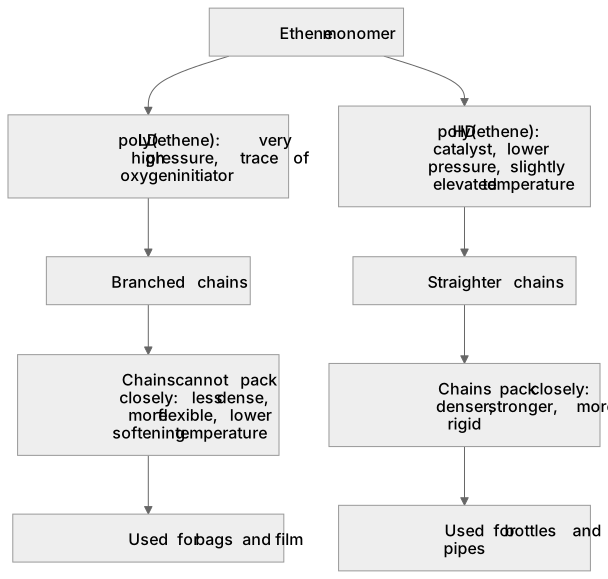
Key words
Say what each word means before you turn the card.
Monomers and polymerisation
Try answering aloud or in your head before turning the card.
Polymers
Try answering aloud or in your head before turning the card.
Structure-property relationships
Try answering aloud or in your head before turning the card.
Everyday materials
Try answering aloud or in your head before turning the card.
See every definition
- Monomers and polymerisation
- Ethene is the monomer used to make poly(ethene), and the same monomer can produce two different polymers depending on the conditions used.
- Polymers
- Poly(ethene) exists as low density and high density forms, each with different chain structures and properties.
- Structure-property relationships
- Branched chains cannot pack closely together, so the polymer is less dense and more flexible, while straight chains pack closely, so the polymer is denser, stronger and more rigid.
- Everyday materials
- Low density poly(ethene) is used for bags and film, and high density poly(ethene) is used for bottles and pipes.
Label the diagram
Some boxes have lost their names. Pick the right name for each number.
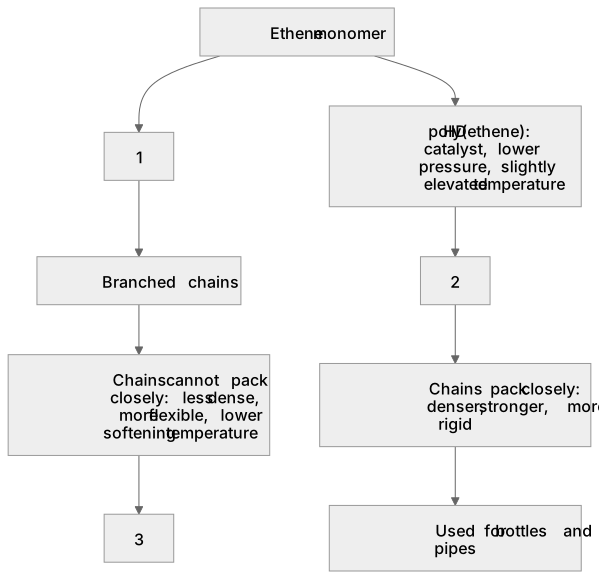
1Box 1
2Box 2
3Box 3
There is more to this lesson
The full lesson goes on to check your understanding and help you earn the marks. Create a free account to carry on, with your progress saved.
A week of Premium from your first lesson · Then the free plan continues · No card, no charge
Test your understanding of Ceramics, polymers and composites: For example, low density (LD) and high density (HD) poly(ethene) are produced from ethene.
Active recall beats re-reading. Take an instant quiz now to test what you’ve learned and lock it into long-term memory.
A week of Premium from your first lesson · Then the free plan continues · No card, no charge