AQA · GCSE · Chemistry
Course version: 8462 · Version from Sept 2018
Students should be able to, given appropriate information: compare…
Full specification wording
Ceramics, polymers and composites: Students should be able to, given appropriate information: compare quantitatively the physical properties of glass and clay ceramics, polymers, composites and metals explain how the properties of materials are related to their uses and select appropriate materials.
Given data such as density, melting point, tensile strength or electrical conductivity, compare materials numerically rather than by impression.
Checked against the AQA 8462 specification (opens in a new tab) on .
- Point 11 of 11
- 3 key terms
Study notes
From the checked teaching notes for this specification point.
The idea
Given data such as density, melting point, tensile strength or electrical conductivity, compare materials numerically rather than by impression. Read the table, identify the property being compared, and state which material has the higher or lower value, quoting the figures. Then link that property to a use: low density and high strength suit aircraft panels, high melting point suits furnace linings, electrical insulation suits cable sheathing, and malleability suits shaped metal components. Selecting a material means matching the demands of the job to the data, not choosing the cheapest or most familiar option.
For example: If a table shows a polymer with low density and a metal with high density, the polymer is preferable where mass must be kept low, provided its strength and melting point are adequate.
What earns the marks
- Reads values from supplied data and quotes them when comparing two materials.
- Uses comparative language such as higher, lower, greater or smaller, supported by the figures.
- Compares materials across more than one property, for example density and melting point, rather than a single value.
- Explains a use by referring to a specific property, such as using a ceramic with a high melting point for a furnace lining.
- Selects a material for a stated purpose and justifies the choice using the data provided.
- Recognises that a material may be suitable for one use but not another because different uses demand different properties.
Common mistakes and how to put them right
Comparing materials without quoting any figures.
Put it right: Cite the relevant values from the table.
Choosing a material because it is strong while ignoring another critical property such as melting point.
Put it right: Check all stated requirements.
Writing that a material is better without saying better for what.
Put it right: Name the property and the use it suits.
Exam tips
- Underline the property named in the question before reading the table, so you compare the right column.
- Quote at least one figure for each material you compare, then state the consequence for the use.
- If asked to select a material, name it and give a property-based reason, not a personal preference.
Try the lesson
The start of the Ceramics, polymers and composites: Students should be able to, given appropriate information: compare quantitatively the physical properties of glass and clay ceramics, polymers, composites and metals explain how the properties of materials are related to their uses and select appropriate materials. lesson, made from checked teaching notes for this specification point.
Have a go first
A manufacturer is selecting a material for a bicycle frame. Material A has a density of 1.8 g/cm³ and a relative strength of 150. Material B has a density of 7.9 g/cm³ and a relative strength of 50. Which statement correctly explains why Material A is the better choice for a lightweight, strong bicycle frame?
Listen
Given data such as density, melting point, tensile strength or electrical conductivity, compare materials numerically rather than by impression. Read the table, identify the property being compared, and state which material has the higher or lower value, quoting the figures. Then link that property to a use: low density and high strength suit aircraft panels, high melting point suits furnace linings, electrical insulation suits cable sheathing, and malleability suits shaped metal components. Selecting a material means matching the demands of the job to the data, not choosing the cheapest or most familiar option. For example, if a table shows a polymer with low density and a metal with high density, the polymer is preferable where mass must be kept low, provided its strength and melting point are adequate. A strong answer earns marks for these points. Reads values from supplied data and quotes them when comparing two materials. Uses comparative language such as higher, lower, greater or smaller, supported by the figures. Compares materials across more than one property, for example density and melting point, rather than a single value. Explains a use by referring to a specific property, such as using a ceramic with a high melting point for a furnace lining. A common slip: Comparing materials without quoting any figures. Instead, cite the relevant values from the table. Exam tip: Underline the property named in the question before reading the table, so you compare the right column.
See it
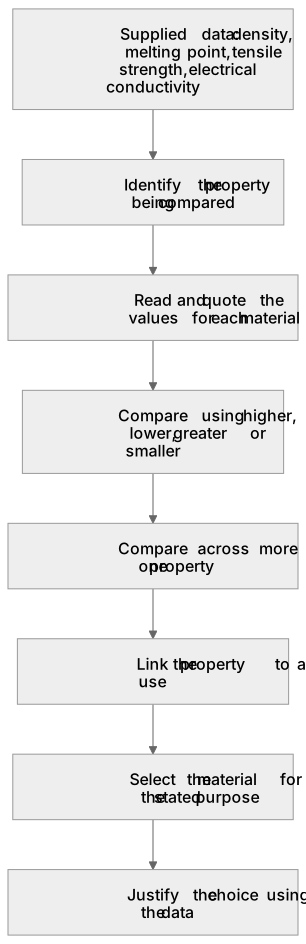
Put it in order
Put these steps in the order they happen.
- 1. Compare across more than one property
- 2. Justify the choice using the data
- 3. Link the property to a use
- 4. Supplied data: density, melting point, tensile strength, electrical conductivity
- 5. Identify the property being compared
- 6. Select the material for the stated purpose
- 7. Read and quote the values for each material
- 8. Compare using higher, lower, greater or smaller
Key words
Say what each word means before you turn the card.
Quantitative comparison of properties
Try answering aloud or in your head before turning the card.
Materials selection for uses
Try answering aloud or in your head before turning the card.
Data interpretation
Try answering aloud or in your head before turning the card.
See every definition
- Quantitative comparison of properties
- Comparing materials numerically rather than by impression, reading the table, identifying the property being compared and quoting the figures.
- Materials selection for uses
- Matching the demands of the job to the data rather than choosing the cheapest or most familiar option.
- Data interpretation
- Reading values from supplied data and using comparative language such as higher, lower, greater or smaller, supported by the figures.
Label the diagram
Some boxes have lost their names. Pick the right name for each number.
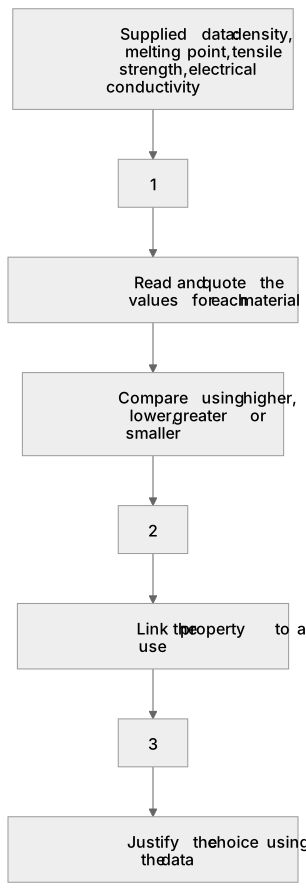
1Box 1
2Box 2
3Box 3
There is more to this lesson
The full lesson goes on to check your understanding and help you earn the marks. Create a free account to carry on, with your progress saved.
A week of Premium from your first lesson · Then the free plan continues · No card, no charge
Test your understanding of Ceramics, polymers and composites: Students should be able to, given appropriate information: compare quantitatively the physical properties of glass and clay ceramics, polymers, composites and metals explain how the properties of materials are related to their uses and select appropriate materials.
Active recall beats re-reading. Take an instant quiz now to test what you’ve learned and lock it into long-term memory.
A week of Premium from your first lesson · Then the free plan continues · No card, no charge