AQA · GCSE · Chemistry
Course version: 8462 · Version from Sept 2018
Thermosetting polymers do not melt when they are heated.
Full specification wording
Ceramics, polymers and composites: Thermosetting polymers do not melt when they are heated.
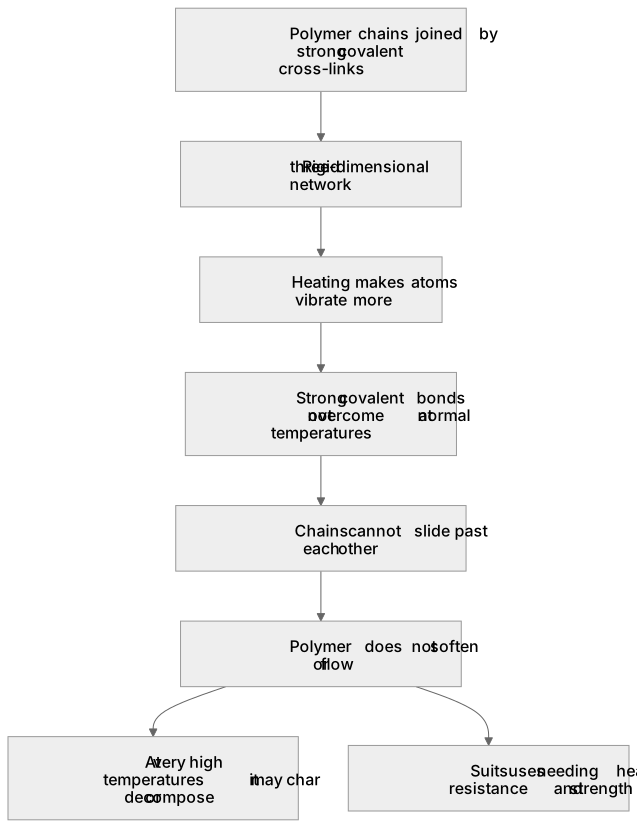
Thermosetting polymers have polymer chains that are joined to one another by strong covalent cross-links, forming a rigid three-dimensional network.
Checked against the AQA 8462 specification (opens in a new tab) on .
- Point 7 of 11
- 4 key terms
Study notes
From the checked teaching notes for this specification point.
The idea
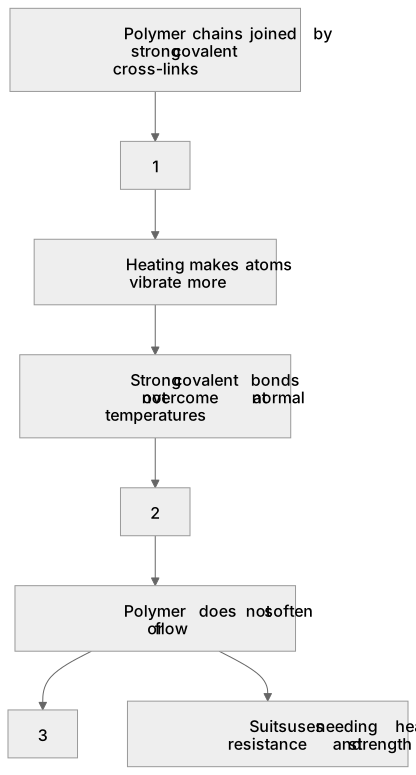
Thermosetting polymers have polymer chains that are joined to one another by strong covalent cross-links, forming a rigid three-dimensional network. When the material is heated, the chains cannot slide past each other because the cross-links hold them firmly in place. The thermal energy makes the atoms vibrate more, but the covalent bonds in the network are far too strong to be overcome by the temperatures normally used, so the polymer does not soften or flow. Instead it may char or decompose at very high temperatures. This rigid, infusible behaviour makes thermosetting polymers such as those used in electrical plugs, pan handles and some adhesives suitable where heat resistance and strength are needed.
What earns the marks
- Thermosetting polymers contain polymer chains joined together by strong covalent cross-links.
- The cross-links produce a rigid three-dimensional network rather than separate, free-moving chains.
- Heating makes the atoms vibrate more, but the strong covalent bonds of the network are not overcome at normal temperatures.
- Because the chains cannot slide over one another, the polymer does not soften or flow when heated.
- At very high temperatures the material may char or decompose rather than melt.
Common mistakes and how to put them right
Saying thermosetting polymers have no intermolecular forces.
Put it right: They do, but the covalent cross-links between chains dominate the behaviour.
Claiming the cross-links break on heating so the polymer melts.
Put it right: The covalent bonds are too strong to be overcome at normal temperatures.
Confusing the two polymer types and stating that thermosetting polymers can be remelted and reshaped.
Put it right: They cannot, because of their cross-linked network.
Exam tips
- Contrast the two polymer types directly: thermosoftening has weak forces between separate chains, whereas thermosetting has strong covalent cross-links between chains.
- Use the phrase 'three-dimensional network' to describe the cross-linked structure of a thermosetting polymer.
- Explain the consequence, not just the structure: because chains cannot slide, the polymer does not melt, which makes it useful for heat-resistant items.
Try the lesson
The start of the Ceramics, polymers and composites: Thermosetting polymers do not melt when they are heated. lesson, made from checked teaching notes for this specification point.
Have a go first
What happens to a thermosetting polymer when it is heated strongly?
Listen
Thermosetting polymers have polymer chains that are joined to one another by strong covalent cross-links, forming a rigid three-dimensional network. When the material is heated, the chains cannot slide past each other because the cross-links hold them firmly in place. The thermal energy makes the atoms vibrate more, but the covalent bonds in the network are far too strong to be overcome by the temperatures normally used, so the polymer does not soften or flow. Instead it may char or decompose at very high temperatures. This rigid, infusible behaviour makes thermosetting polymers such as those used in electrical plugs, pan handles and some adhesives suitable where heat resistance and strength are needed. A strong answer earns marks for these points. Thermosetting polymers contain polymer chains joined together by strong covalent cross-links. The cross-links produce a rigid three-dimensional network rather than separate, free-moving chains. Heating makes the atoms vibrate more, but the strong covalent bonds of the network are not overcome at normal temperatures. Because the chains cannot slide over one another, the polymer does not soften or flow when heated. Exam tip: Contrast the two polymer types directly: thermosoftening has weak forces between separate chains, whereas thermosetting has strong covalent cross-links between chains.
See it
Key words
Say what each word means before you turn the card.
Covalent cross-links
Try answering aloud or in your head before turning the card.
Three-dimensional network
Try answering aloud or in your head before turning the card.
Thermosetting polymers
Try answering aloud or in your head before turning the card.
Char or decompose
Try answering aloud or in your head before turning the card.
See every definition
- Covalent cross-links
- Strong bonds that join polymer chains to one another, holding them firmly in place so they cannot slide past each other.
- Three-dimensional network
- A rigid structure formed when polymer chains are joined to one another by strong covalent cross-links.
- Thermosetting polymers
- Polymers whose chains are joined by strong covalent cross-links, so they do not melt when heated and may char or decompose at very high temperatures.
- Char or decompose
- What a thermosetting polymer may do at very high temperatures instead of melting, because the covalent bonds of the network are too strong to be overcome.
Label the diagram
Some boxes have lost their names. Pick the right name for each number.
1Box 1
2Box 2
3Box 3
There is more to this lesson
The full lesson goes on to check your understanding and help you earn the marks. Create a free account to carry on, with your progress saved.
A week of Premium from your first lesson · Then the free plan continues · No card, no charge
Test your understanding of Ceramics, polymers and composites: Thermosetting polymers do not melt when they are heated.
Active recall beats re-reading. Take an instant quiz now to test what you’ve learned and lock it into long-term memory.
A week of Premium from your first lesson · Then the free plan continues · No card, no charge