AQA · GCSE · Chemistry
Course version: 8462 · Version from Sept 2018
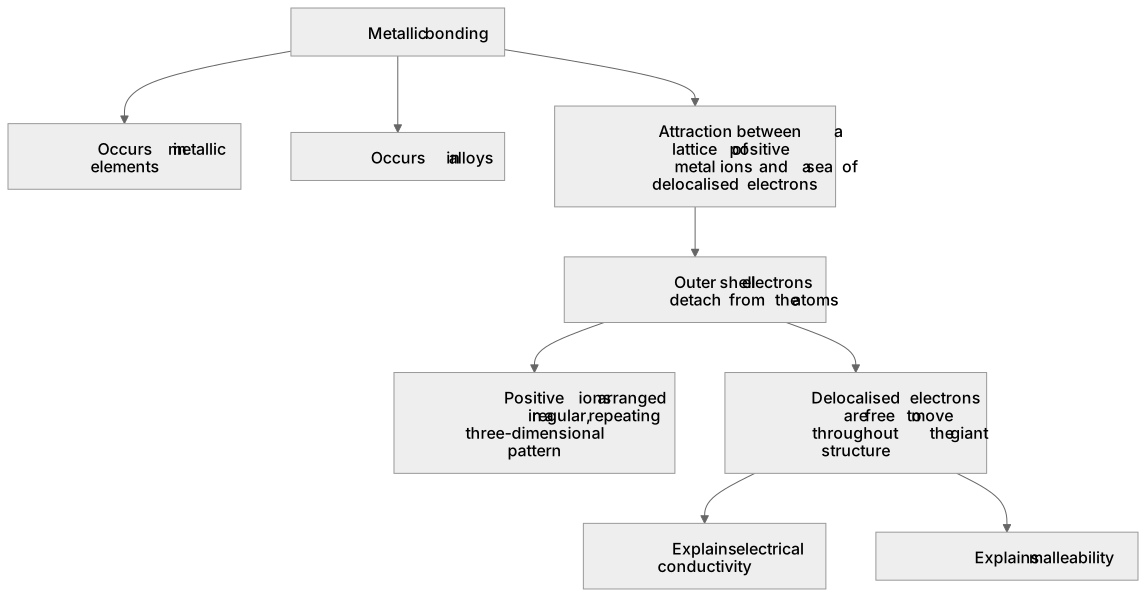
Chemical bonds: Metallic bonding occurs in metallic elements and alloys.
Metallic bonding is the strong electrostatic attraction between a lattice of positive metal ions and a sea of delocalised electrons.
Checked against the AQA 8462 specification (opens in a new tab) on .
- Point 5 of 6
- 3 key terms
Study notes
From the checked teaching notes for this specification point.
The idea
Metallic bonding is the strong electrostatic attraction between a lattice of positive metal ions and a sea of delocalised electrons. This type of bonding is characteristic of all metallic elements, such as copper and iron, as well as alloys, which are mixtures of a metal with at least one other element, like steel or brass. In a solid metal, the outer shell electrons detach from the atoms, leaving behind positively charged ions arranged in a regular, repeating three-dimensional pattern. The delocalised electrons are free to move throughout this giant structure, which explains key metallic properties such as electrical conductivity and malleability.
What earns the marks
- Define metallic bonding as the attraction between positive metal ions and delocalised electrons.
- Identify that metallic bonding occurs in pure metals and alloys.
- Describe the structure of a metal as a giant lattice of positive ions.
- Explain that the outer shell electrons in a metal are delocalised and free to move.
Common mistakes and how to put them right
Describing metallic bonding as the sharing of electrons between atoms.
Put it right: Metallic bonding involves a lattice of positive ions and a sea of delocalised electrons.
Referring to the particles in a metallic lattice as atoms.
Put it right: The particles in the lattice are positive metal ions.
Stating that alloys contain ionic bonds because they are mixtures.
Put it right: Alloys still feature metallic bonding, though the lattice is distorted by different sized atoms.
Exam tips
- Use the phrase 'sea of delocalised electrons' when describing metallic bonding to secure marks.
- Ensure you refer to the fixed particles in the lattice as 'positive ions' rather than 'atoms' or 'protons'.
- Remember that alloys are mixtures, not compounds, but they still rely on metallic bonding to hold their structure together.
Try the lesson
The start of the Chemical bonds: Metallic bonding occurs in metallic elements and alloys. lesson, made from checked teaching notes for this specification point.
Have a go first
In which types of substance does metallic bonding occur?
Listen
Metallic bonding is the strong electrostatic attraction between a lattice of positive metal ions and a sea of delocalised electrons. This type of bonding is characteristic of all metallic elements, such as copper and iron, as well as alloys, which are mixtures of a metal with at least one other element, like steel or brass. In a solid metal, the outer shell electrons detach from the atoms, leaving behind positively charged ions arranged in a regular, repeating three-dimensional pattern. The delocalised electrons are free to move throughout this giant structure, which explains key metallic properties such as electrical conductivity and malleability. A strong answer earns marks for these points. Define metallic bonding as the attraction between positive metal ions and delocalised electrons. Identify that metallic bonding occurs in pure metals and alloys. Describe the structure of a metal as a giant lattice of positive ions. Explain that the outer shell electrons in a metal are delocalised and free to move. A common slip: Describing metallic bonding as the sharing of electrons between atoms. Instead, metallic bonding involves a lattice of positive ions and a sea of delocalised electrons. Exam tip: Use the phrase 'sea of delocalised electrons' when describing metallic bonding to secure marks.
See it
Key words
Say what each word means before you turn the card.
Metallic bonding
Try answering aloud or in your head before turning the card.
Alloys
Try answering aloud or in your head before turning the card.
Delocalised electrons
Try answering aloud or in your head before turning the card.
See every definition
- Metallic bonding
- The strong electrostatic attraction between a lattice of positive metal ions and a sea of delocalised electrons.
- Alloys
- Mixtures of a metal with at least one other element, which still feature metallic bonding.
- Delocalised electrons
- Outer shell electrons that detach from the atoms and are free to move throughout the giant structure.
Label the diagram
Some boxes have lost their names. Pick the right name for each number.
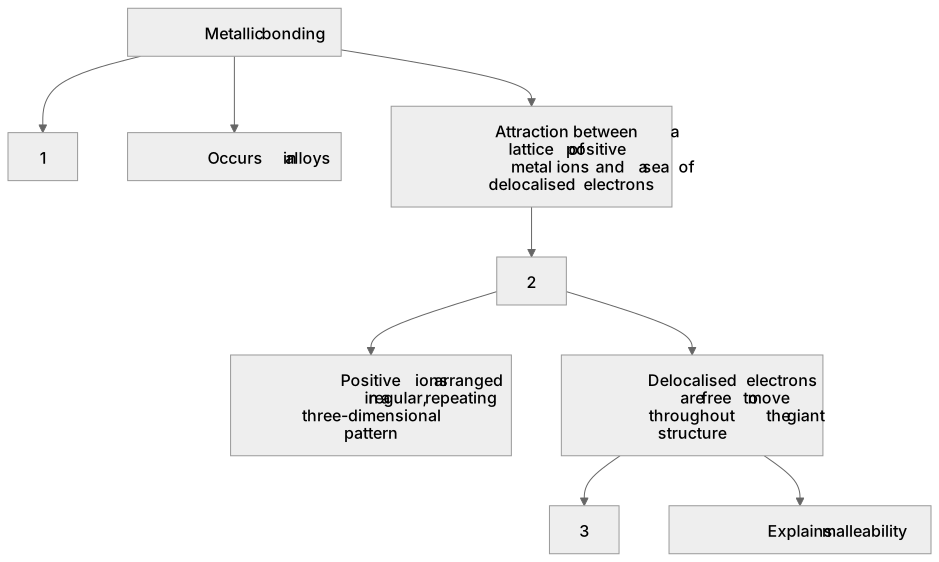
1Box 1
2Box 2
3Box 3
There is more to this lesson
The full lesson goes on to check your understanding and help you earn the marks. Create a free account to carry on, with your progress saved.
A week of Premium from your first lesson · Then the free plan continues · No card, no charge
Test your understanding of Chemical bonds: Metallic bonding occurs in metallic elements and alloys.
Active recall beats re-reading. Take an instant quiz now to test what you’ve learned and lock it into long-term memory.
A week of Premium from your first lesson · Then the free plan continues · No card, no charge