AQA · GCSE · Chemistry
Course version: 8462 · Version from Sept 2018
Chromatography can be used to separate mixtures and can give information…
Full specification wording
Chromatography: Chromatography can be used to separate mixtures and can give information to help identify substances.
Chromatography is a separation technique in which a mixture is carried by a mobile phase through a stationary phase.
Checked against the AQA 8462 specification (opens in a new tab) on .
- Point 1 of 4
- 4 key terms
Study notes
From the checked teaching notes for this specification point.
The idea
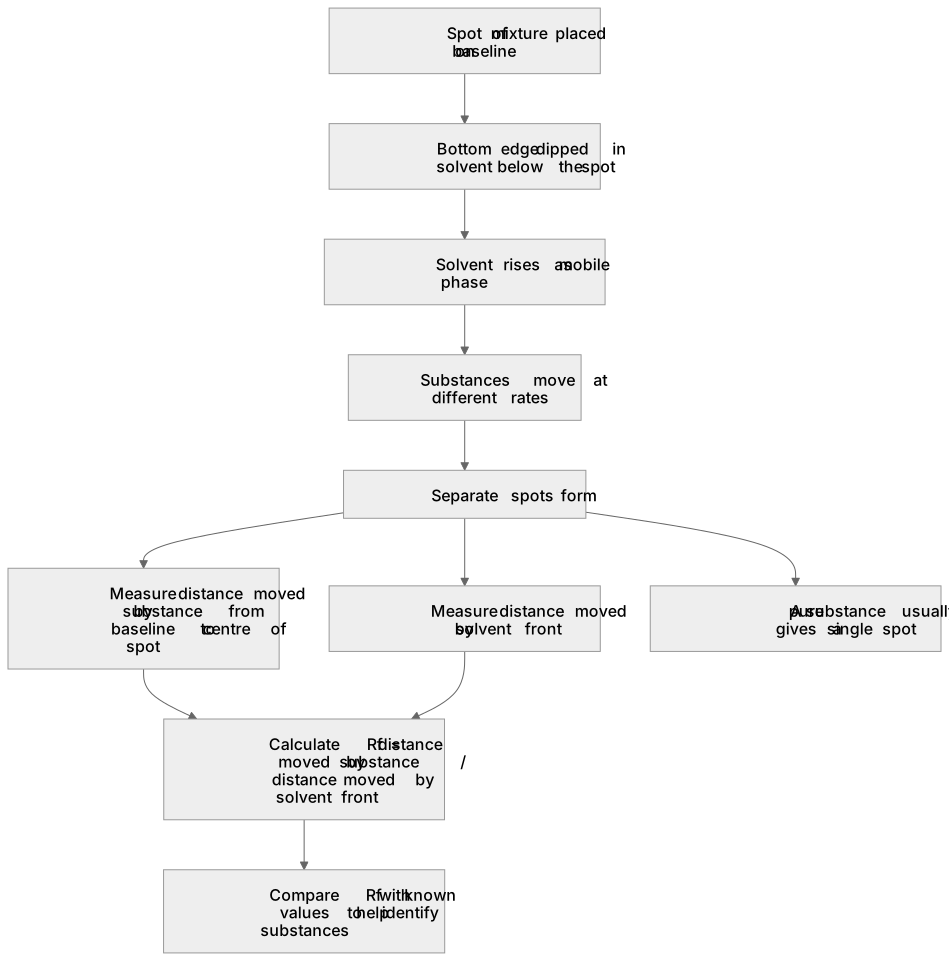
Chromatography is a separation technique in which a mixture is carried by a mobile phase through a stationary phase. Because different substances are distributed differently between the two phases, they travel different distances and separate. In paper chromatography, a spot of mixture is placed on chromatography paper and the bottom edge is dipped into a solvent below the spot. The solvent is the mobile phase and the water held in the paper is the stationary phase. As the solvent rises, substances move at different rates and form separate spots. The distance moved by a substance compared with the distance moved by the solvent front gives an Rf value. Rf values can be compared with known values to help identify substances, and a pure substance usually gives a single spot.
What earns the marks
- State that chromatography separates substances in a mixture because they move at different rates through the stationary and mobile phases.
- Describe the practical method: place a spot of mixture on the baseline, dip the bottom of the paper in solvent below the spot, and allow the solvent to rise.
- Calculate Rf as the distance moved by the substance divided by the distance moved by the solvent front.
- Use Rf values or the number of spots to help identify substances, comparing results with known values.
- Explain that a pure substance typically produces a single spot in a given solvent.
Common mistakes and how to put them right
Placing the spot below the solvent level.
Put it right by ensuring the baseline is above the solvent so the mixture does not dissolve into the solvent reservoir.
Measuring the distance moved by the substance from the top of the paper.
Put it right by measuring from the baseline to the centre of the spot.
Treating Rf as a fixed value for a substance in every solvent.
Put it right by stating that Rf depends on the solvent and conditions used.
Exam tips
- Show the Rf calculation clearly, including the measured distances and the division.
- When identifying a substance, compare its Rf value with a known value obtained under the same conditions.
- Describe the method in order, including where the spot is placed and why the solvent must stay below the baseline.
Try the lesson
The start of the Chromatography: Chromatography can be used to separate mixtures and can give information to help identify substances. lesson, made from checked teaching notes for this specification point.
Have a go first
Which statement describes what chromatography can do?
Listen
Chromatography is a separation technique in which a mixture is carried by a mobile phase through a stationary phase. Because different substances are distributed differently between the two phases, they travel different distances and separate. In paper chromatography, a spot of mixture is placed on chromatography paper and the bottom edge is dipped into a solvent below the spot. The solvent is the mobile phase and the water held in the paper is the stationary phase. As the solvent rises, substances move at different rates and form separate spots. The distance moved by a substance compared with the distance moved by the solvent front gives an Rf value. Rf values can be compared with known values to help identify substances, and a pure substance usually gives a single spot. A strong answer earns marks for these points. State that chromatography separates substances in a mixture because they move at different rates through the stationary and mobile phases. Describe the practical method: place a spot of mixture on the baseline, dip the bottom of the paper in solvent below the spot, and allow the solvent to rise. Calculate Rf as the distance moved by the substance divided by the distance moved by the solvent front. Use Rf values or the number of spots to help identify substances, comparing results with known values. A common slip: Placing the spot below the solvent level. Instead, ensuring the baseline is above the solvent so the mixture does not dissolve into the solvent reservoir. Exam tip: Show the Rf calculation clearly, including the measured distances and the division.
See it
Key words
Say what each word means before you turn the card.
Chromatography
Try answering aloud or in your head before turning the card.
Stationary and mobile phases
Try answering aloud or in your head before turning the card.
Rf values
Try answering aloud or in your head before turning the card.
Identification of substances
Try answering aloud or in your head before turning the card.
See every definition
- Chromatography
- A separation technique in which a mixture is carried by a mobile phase through a stationary phase, and substances separate because they move at different rates.
- Stationary and mobile phases
- In paper chromatography, the solvent is the mobile phase and the water held in the paper is the stationary phase.
- Rf values
- The distance moved by a substance compared with the distance moved by the solvent front, which can be compared with known values to help identify substances.
- Identification of substances
- Comparing Rf values with known values to help identify substances, where a pure substance usually gives a single spot.
Label the diagram
Some boxes have lost their names. Pick the right name for each number.
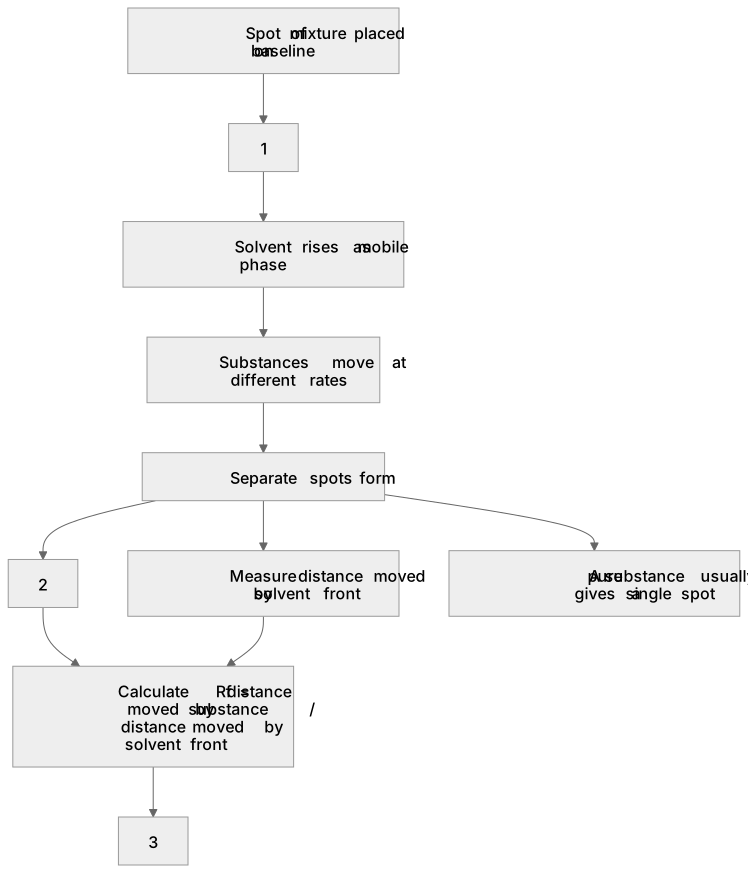
1Box 1
2Box 2
3Box 3
There is more to this lesson
The full lesson goes on to check your understanding and help you earn the marks. Create a free account to carry on, with your progress saved.
A week of Premium from your first lesson · Then the free plan continues · No card, no charge
Test your understanding of Chromatography: Chromatography can be used to separate mixtures and can give information to help identify substances.
Active recall beats re-reading. Take an instant quiz now to test what you’ve learned and lock it into long-term memory.
A week of Premium from your first lesson · Then the free plan continues · No card, no charge