AQA · GCSE · Chemistry
Course version: 8462 · Version from Sept 2018
The transition elements are metals with similar properties which are…
Full specification wording
Comparison with Group 1 elements: The transition elements are metals with similar properties which are different from those of the elements in Group 1.
Transition elements occupy the central block of the periodic table, between Groups 2 and 3, and are metals.
Checked against the AQA 8462 specification (opens in a new tab) on .
- Point 1 of 3
- 2 key terms
Study notes
From the checked teaching notes for this specification point.
The idea
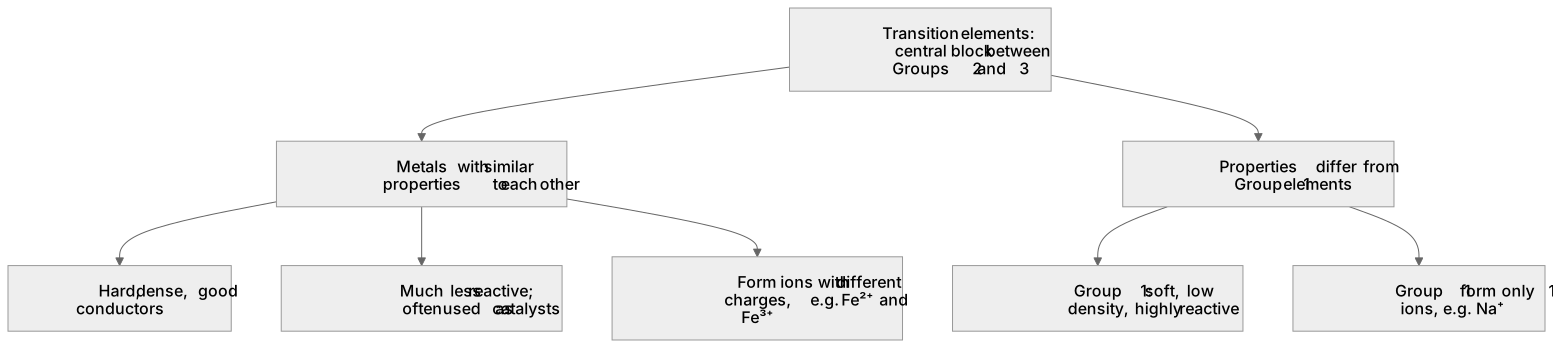
Transition elements occupy the central block of the periodic table, between Groups 2 and 3, and are metals. Their properties are broadly similar to one another but differ markedly from the Group 1 alkali metals. Group 1 metals such as sodium are soft, low density and extremely reactive, forming 1⁺ ions and reacting vigorously with water. Transition metals such as iron and copper are generally harder, denser and much less reactive, and they can form ions with several different charges. For example, iron forms Fe²⁺ and Fe³⁺, whereas sodium forms only Na⁺. Transition metals also tend to have high melting points and are often used as catalysts. Recognising these contrasts helps you predict behaviour and explain why transition metals are suited to structural and catalytic uses.
What earns the marks
- Transition elements are metals located in the central block of the periodic table between Groups 2 and 3.
- Transition elements show similar properties to each other, such as being hard, dense and good conductors.
- Group 1 elements are soft, low density and highly reactive metals that form 1⁺ ions.
- Transition elements are generally much less reactive than Group 1 elements and are often used as catalysts.
- Transition elements can form ions with different charges, for example Fe²⁺ and Fe³⁺, unlike Group 1 elements which form only 1⁺ ions.
- Transition elements often form coloured compounds, whereas Group 1 compounds are typically white or colourless.
Common mistakes and how to put them right
Treating all metals as equally reactive.
Put it right by stating that Group 1 metals react vigorously with water while most transition metals react slowly or not at all.
Assuming transition elements form only one ion.
Put it right by giving examples such as Fe²⁺ and Fe³⁺ to show variable oxidation states.
Placing transition elements in Group 1.
Put it right by locating them in the central block between Groups 2 and 3.
Exam tips
- Use a table to compare one named Group 1 metal with one named transition metal across the required properties.
- When asked to compare, give a property of each element rather than describing only one side.
- Link each property to a use, such as high density and strength for structural metals or catalytic behaviour for industrial reactions.
Try the lesson
The start of the Comparison with Group 1 elements: The transition elements are metals with similar properties which are different from those of the elements in Group 1. lesson, made from checked teaching notes for this specification point.
Have a go first
Which statement describes a property shared by the transition elements but not by the Group 1 elements?
Listen
Transition elements occupy the central block of the periodic table, between Groups 2 and 3, and are metals. Their properties are broadly similar to one another but differ markedly from the Group 1 alkali metals. Group 1 metals such as sodium are soft, low density and extremely reactive, forming 1⁺ ions and reacting vigorously with water. Transition metals such as iron and copper are generally harder, denser and much less reactive, and they can form ions with several different charges. For example, iron forms Fe²⁺ and Fe³⁺, whereas sodium forms only Na⁺. Transition metals also tend to have high melting points and are often used as catalysts. Recognising these contrasts helps you predict behaviour and explain why transition metals are suited to structural and catalytic uses. A strong answer earns marks for these points. Transition elements are metals located in the central block of the periodic table between Groups 2 and 3. Transition elements show similar properties to each other, such as being hard, dense and good conductors. Group 1 elements are soft, low density and highly reactive metals that form 1⁺ ions. Transition elements are generally much less reactive than Group 1 elements and are often used as catalysts. A common slip: Treating all metals as equally reactive. Instead, stating that Group 1 metals react vigorously with water while most transition metals react slowly or not at all. Exam tip: Use a table to compare one named Group 1 metal with one named transition metal across the required properties.
See it
Key words
Say what each word means before you turn the card.
Transition elements
Try answering aloud or in your head before turning the card.
Group 1 elements
Try answering aloud or in your head before turning the card.
See every definition
- Transition elements
- Metals located in the central block of the periodic table between Groups 2 and 3, showing similar properties to each other.
- Group 1 elements
- Soft, low density and highly reactive metals that form 1⁺ ions.
Label the diagram
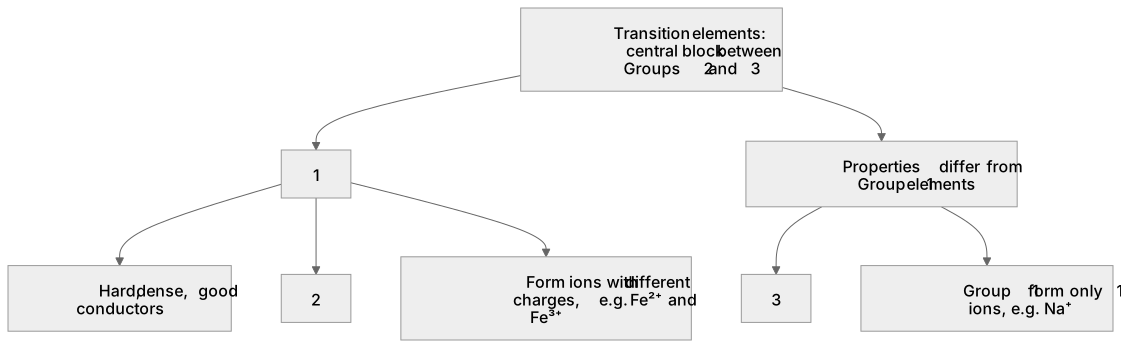
Some boxes have lost their names. Pick the right name for each number.
1Box 1
2Box 2
3Box 3
There is more to this lesson
The full lesson goes on to check your understanding and help you earn the marks. Create a free account to carry on, with your progress saved.
A week of Premium from your first lesson · Then the free plan continues · No card, no charge
Test your understanding of Comparison with Group 1 elements: The transition elements are metals with similar properties which are different from those of the elements in Group 1.
Active recall beats re-reading. Take an instant quiz now to test what you’ve learned and lock it into long-term memory.
A week of Premium from your first lesson · Then the free plan continues · No card, no charge