AQA · GCSE · Chemistry
Course version: 8462 · Version from Sept 2018
Students should understand the use of the multipliers in equations in…
Full specification wording
Conservation of mass and balanced chemical equations: Students should understand the use of the multipliers in equations in normal script before a formula and in subscript within a formula.
Chemical formulae use two different multiplier positions with distinct meanings.
Checked against the AQA 8462 specification (opens in a new tab) on .
- Point 3 of 3
- 4 key terms
Study notes
From the checked teaching notes for this specification point.
The idea
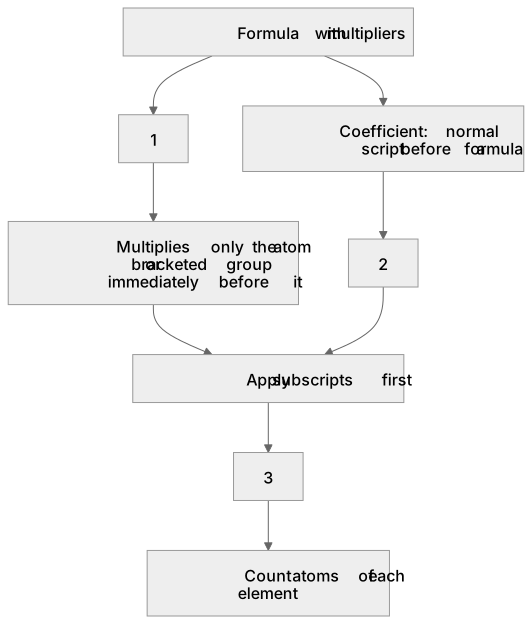
Chemical formulae use two different multiplier positions with distinct meanings. A subscript, written small and low after a symbol, multiplies only the atom immediately before it within that formula unit: H₂O contains two hydrogen atoms and one oxygen atom, and Ca(OH)₂ contains one calcium, two oxygen and two hydrogen atoms because the bracket groups the OH unit. A coefficient in normal script before a formula multiplies the whole formula unit: 2H₂O means two water molecules, giving four hydrogen atoms and two oxygen atoms in total. When counting atoms in an equation, apply subscripts first, then coefficients. For example, 2Ca(NO₃)₂ contains two calcium atoms, four nitrogen atoms and twelve oxygen atoms. This distinction underpins balancing equations and all mole and mass calculations.
What earns the marks
- A subscript applies only to the atom or bracketed group immediately before it, not to earlier elements in the formula.
- A coefficient in normal script before a formula multiplies every atom in that formula unit.
- When counting atoms, evaluate subscripts within the formula before applying any coefficient.
- Brackets with a subscript multiply every element inside the bracket, as in Ca(OH)₂.
- Correct interpretation of multipliers is needed to balance equations and to calculate relative formula masses.
- In 2Ca(NO₃)₂ the coefficient doubles the whole formula, giving 2 Ca, 4 N and 12 O atoms.
Common mistakes and how to put them right
Treating a subscript as multiplying the whole formula, so reading H₂O as four hydrogen atoms.
Put it right: The subscript multiplies only the preceding symbol, giving two hydrogen atoms.
Applying a coefficient to only the first element of a formula, so reading 2CO₂ as two carbon and two oxygen atoms.
Put it right: The coefficient multiplies every atom, giving two carbon and four oxygen atoms.
Ignoring brackets when counting, so reading Ca(OH)₂ as one oxygen and one hydrogen.
Put it right: The subscript after the bracket multiplies each element inside, giving two oxygen and two hydrogen atoms.
Exam tips
- Underline or circle each coefficient and subscript before counting atoms so you do not confuse their roles.
- Write out an atom tally for each side of an equation; this makes balancing errors visible and easy to correct.
- Check bracketed groups separately, multiplying each element inside by the subscript outside the bracket.
- If a count seems odd, re-read the formula from left to right, applying subscripts before coefficients.
Try the lesson
The start of the Conservation of mass and balanced chemical equations: Students should understand the use of the multipliers in equations in normal script before a formula and in subscript within a formula. lesson, made from checked teaching notes for this specification point.
Have a go first
In the formula 3CO₂, what does the large number 3 in front of the formula tell you?
Listen
Chemical formulae use two different multiplier positions with distinct meanings. A subscript, written small and low after a symbol, multiplies only the atom immediately before it within that formula unit: H₂O contains two hydrogen atoms and one oxygen atom, and Ca(OH)₂ contains one calcium, two oxygen and two hydrogen atoms because the bracket groups the OH unit. A coefficient in normal script before a formula multiplies the whole formula unit: 2H₂O means two water molecules, giving four hydrogen atoms and two oxygen atoms in total. When counting atoms in an equation, apply subscripts first, then coefficients. For example, 2Ca(NO₃)₂ contains two calcium atoms, four nitrogen atoms and twelve oxygen atoms. This distinction underpins balancing equations and all mole and mass calculations. A strong answer earns marks for these points. A subscript applies only to the atom or bracketed group immediately before it, not to earlier elements in the formula. A coefficient in normal script before a formula multiplies every atom in that formula unit. When counting atoms, evaluate subscripts within the formula before applying any coefficient. Brackets with a subscript multiply every element inside the bracket, as in Ca(OH)₂. A common slip: Treating a subscript as multiplying the whole formula, so reading H₂O as four hydrogen atoms. Instead, the subscript multiplies only the preceding symbol, giving two hydrogen atoms. Exam tip: Underline or circle each coefficient and subscript before counting atoms so you do not confuse their roles.
See it

Key words
Say what each word means before you turn the card.
Subscript
Try answering aloud or in your head before turning the card.
Coefficient
Try answering aloud or in your head before turning the card.
Brackets
Try answering aloud or in your head before turning the card.
Counting atoms
Try answering aloud or in your head before turning the card.
See every definition
- Subscript
- A small, low number written after a symbol that multiplies only the atom or bracketed group immediately before it within that formula unit.
- Coefficient
- A number in normal script before a formula that multiplies the whole formula unit, so every atom in that formula unit is multiplied.
- Brackets
- A grouping in a formula where a subscript after the bracket multiplies every element inside the bracket.
- Counting atoms
- Applying subscripts within the formula first and then coefficients, so each element's atoms in the formula unit are multiplied correctly.
Label the diagram
Some boxes have lost their names. Pick the right name for each number.
1Box 1
2Box 2
3Box 3
There is more to this lesson
The full lesson goes on to check your understanding and help you earn the marks. Create a free account to carry on, with your progress saved.
A week of Premium from your first lesson · Then the free plan continues · No card, no charge
Test your understanding of Conservation of mass and balanced chemical equations: Students should understand the use of the multipliers in equations in normal script before a formula and in subscript within a formula.
Active recall beats re-reading. Take an instant quiz now to test what you’ve learned and lock it into long-term memory.
A week of Premium from your first lesson · Then the free plan continues · No card, no charge