AQA · GCSE · Chemistry
Course version: 8462 · Version from Sept 2018
The law of conservation of mass states that no atoms are lost or made…
Full specification wording
Conservation of mass and balanced chemical equations: The law of conservation of mass states that no atoms are lost or made during a chemical reaction so the mass of the products equals the mass of the reactants.
During a chemical reaction, bonds break and new bonds form, but the atoms themselves are rearranged rather than created or destroyed.
Checked against the AQA 8462 specification (opens in a new tab) on .
- Point 1 of 3
- 3 key terms
Study notes
From the checked teaching notes for this specification point.
The idea
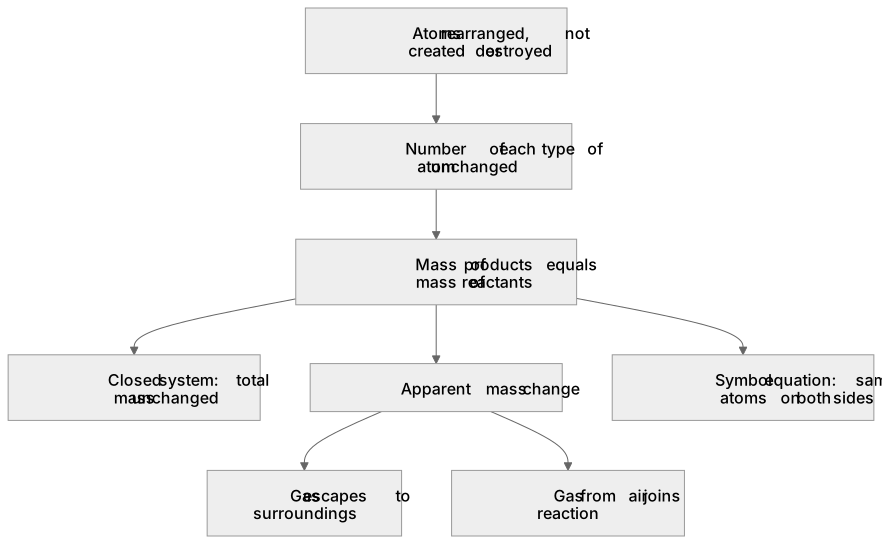
During a chemical reaction, bonds break and new bonds form, but the atoms themselves are rearranged rather than created or destroyed. Because the total number of each type of atom stays the same, the total mass of the products equals the total mass of the reactants. This is the law of conservation of mass. For example, when magnesium reacts with oxygen, the white magnesium oxide produced has a greater mass than the magnesium alone because oxygen atoms from the air have joined the magnesium; the mass of magnesium plus the mass of oxygen that reacted equals the mass of magnesium oxide formed. In a closed system, the total mass before and after a reaction is unchanged. If a reaction appears to lose or gain mass, it is usually because a gas has escaped to the surroundings or a gas from the air has been incorporated into the product.
What earns the marks
- State that atoms are rearranged in a chemical reaction and are neither created nor destroyed.
- Explain that the total mass of the products equals the total mass of the reactants because the number of each type of atom is unchanged.
- Apply the law to a practical situation, such as a reaction in a closed vessel where the mass reading stays constant.
- Explain an apparent mass change by identifying a gas that has left the reaction mixture or a gas from the air that has joined it.
- Use the law to support the idea that a symbol equation must have the same number of each type of atom on both sides.
Common mistakes and how to put them right
Thinking that mass can disappear when a gas is produced.
Put it right: The gas has moved into the surroundings, so the mass of the reaction mixture falls but the total mass of all substances is unchanged.
Believing that a reaction can create new atoms.
Put it right: Atoms are rearranged into new substances, not made.
Assuming that mass always stays the same in an open container.
Put it right: A gas may escape or be taken in, so the measured mass can change even though total mass is conserved.
Exam tips
- Name the gas that escapes or is gained when explaining an apparent change in mass, for example carbon dioxide escaping or oxygen being gained from the air.
- Use the phrase closed system when describing a situation where the measured mass stays constant.
- Link your explanation back to atoms being rearranged, because this is the reason the masses are equal.
Try the lesson
The start of the Conservation of mass and balanced chemical equations: The law of conservation of mass states that no atoms are lost or made during a chemical reaction so the mass of the products equals the mass of the reactants. lesson, made from checked teaching notes for this specification point.
Have a go first
In a closed container, 12 g of magnesium reacts completely with 8 g of oxygen. What mass of magnesium oxide is produced?
Listen
During a chemical reaction, bonds break and new bonds form, but the atoms themselves are rearranged rather than created or destroyed. Because the total number of each type of atom stays the same, the total mass of the products equals the total mass of the reactants. This is the law of conservation of mass. For example, when magnesium reacts with oxygen, the white magnesium oxide produced has a greater mass than the magnesium alone because oxygen atoms from the air have joined the magnesium; the mass of magnesium plus the mass of oxygen that reacted equals the mass of magnesium oxide formed. In a closed system, the total mass before and after a reaction is unchanged. If a reaction appears to lose or gain mass, it is usually because a gas has escaped to the surroundings or a gas from the air has been incorporated into the product. A strong answer earns marks for these points. State that atoms are rearranged in a chemical reaction and are neither created nor destroyed. Explain that the total mass of the products equals the total mass of the reactants because the number of each type of atom is unchanged. Apply the law to a practical situation, such as a reaction in a closed vessel where the mass reading stays constant. Explain an apparent mass change by identifying a gas that has left the reaction mixture or a gas from the air that has joined it. A common slip: Thinking that mass can disappear when a gas is produced. Instead, the gas has moved into the surroundings, so the mass of the reaction mixture falls but the total mass of all substances is unchanged. Exam tip: Name the gas that escapes or is gained when explaining an apparent change in mass, for example carbon dioxide escaping or oxygen being gained from the air.
See it
Key words
Say what each word means before you turn the card.
Conservation of mass
Try answering aloud or in your head before turning the card.
Rearrangement of atoms
Try answering aloud or in your head before turning the card.
Closed systems and gas exchange
Try answering aloud or in your head before turning the card.
See every definition
- Conservation of mass
- No atoms are lost or made during a chemical reaction, so the mass of the products equals the mass of the reactants.
- Rearrangement of atoms
- During a chemical reaction, bonds break and new bonds form, but the atoms themselves are rearranged rather than created or destroyed.
- Closed systems and gas exchange
- In a closed system the total mass before and after a reaction is unchanged, but an apparent mass change is usually because a gas has escaped or a gas from the air has been incorporated.
Label the diagram
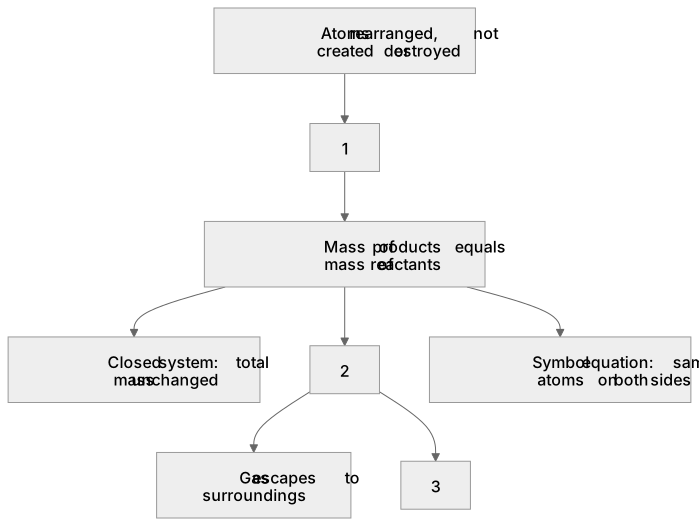
Some boxes have lost their names. Pick the right name for each number.
1Box 1
2Box 2
3Box 3
There is more to this lesson
The full lesson goes on to check your understanding and help you earn the marks. Create a free account to carry on, with your progress saved.
A week of Premium from your first lesson · Then the free plan continues · No card, no charge
Test your understanding of Conservation of mass and balanced chemical equations: The law of conservation of mass states that no atoms are lost or made during a chemical reaction so the mass of the products equals the mass of the reactants.
Active recall beats re-reading. Take an instant quiz now to test what you’ve learned and lock it into long-term memory.
A week of Premium from your first lesson · Then the free plan continues · No card, no charge