AQA · GCSE · Chemistry
Course version: 8462 · Version from Sept 2018
Students should be able to recognise common substances that consist of…
Full specification wording
Covalent bonding: Students should be able to recognise common substances that consist of small molecules from their chemical formula.
A chemical formula shows the number and type of atoms in a substance.
Checked against the AQA 8462 specification (opens in a new tab) on .
- Point 4 of 8
- 4 key terms
Study notes
From the checked teaching notes for this specification point.
The idea
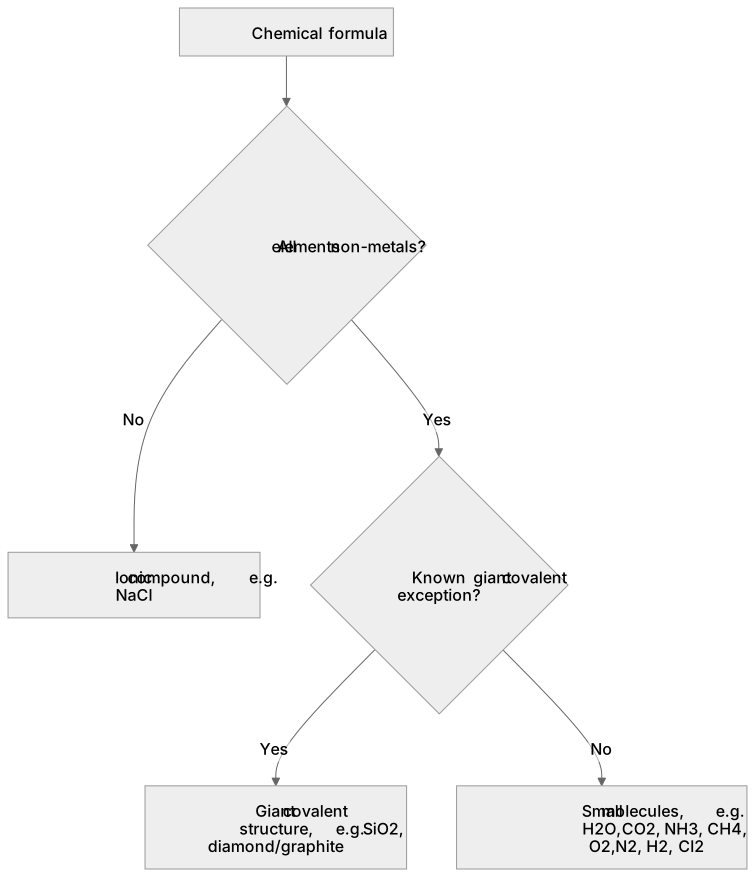
A chemical formula shows the number and type of atoms in a substance. If the formula contains only a few non-metal atoms, the substance is likely to consist of small molecules. For example, H₂O, CO₂, NH₃, CH₄, HCl, O₂, N₂, H₂ and Cl₂ are all small molecules. However, you must memorise exceptions like SiO₂ (silicon dioxide) and diamond/graphite (C), which are giant covalent structures despite having simple empirical formulas. By contrast, NaCl represents an ionic lattice because it contains a metal and a non-metal. To identify small molecules, check that all elements are non-metals and ensure the substance is not a known giant covalent exception. This skill helps you predict low melting points, low boiling points and no electrical conductivity.
What earns the marks
- A chemical formula shows the type and number of atoms in a substance.
- Small molecules contain only a few non-metal atoms, for example H₂O, CO₂, NH₃, CH₄, HCl, O₂, N₂, H₂ and Cl₂.
- Formulas such as SiO₂ represent giant covalent structures, not small molecules, even though they contain only non-metals.
- Formulas such as NaCl represent ionic compounds, not small molecules, because they contain a metal and a non-metal.
- Recognising small molecules from formulas allows prediction of low melting and boiling points and no electrical conductivity.
Common mistakes and how to put them right
Treating every formula containing non-metals as a small molecule.
Put it right by memorising exceptions like SiO₂ which is a giant covalent structure.
Assuming that a formula with two elements is always a small molecule.
Put it right by identifying ionic compounds such as NaCl.
Counting atoms incorrectly in formulas with subscripts.
Put it right by multiplying the subscript by any number outside a bracket, as in Ca(OH)₂.
Exam tips
- Check that all elements are non-metals and confirm the substance is not a known giant covalent exception (like SiO₂) before deciding it is a small molecule.
- Learn a short list of common small molecules, including H₂O, CO₂, NH₃, CH₄, HCl, O₂, N₂, H₂ and Cl₂.
- If a formula represents a giant covalent or ionic structure, do not describe it as a small molecule.
Try the lesson
The start of the Covalent bonding: Students should be able to recognise common substances that consist of small molecules from their chemical formula. lesson, made from checked teaching notes for this specification point.
Have a go first
Which chemical formula represents a common substance that consists of small molecules?
See it
Key words
Say what each word means before you turn the card.
Chemical formula
Try answering aloud or in your head before turning the card.
Small molecules
Try answering aloud or in your head before turning the card.
Giant covalent structures
Try answering aloud or in your head before turning the card.
Ionic lattice
Try answering aloud or in your head before turning the card.
See every definition
- Chemical formula
- Shows the number and type of atoms in a substance.
- Small molecules
- Contain only a few non-metal atoms, for example H₂O, CO₂, NH₃, CH₄, HCl, O₂, N₂, H₂ and Cl₂.
- Giant covalent structures
- Structures such as SiO₂ and diamond/graphite (C) that have simple empirical formulas but are not small molecules.
- Ionic lattice
- Represented by NaCl because it contains a metal and a non-metal.
There is more to this lesson
The full lesson goes on to check your understanding and help you earn the marks. Create a free account to carry on, with your progress saved.
A week of Premium from your first lesson · Then the free plan continues · No card, no charge
Test your understanding of Covalent bonding: Students should be able to recognise common substances that consist of small molecules from their chemical formula.
Active recall beats re-reading. Take an instant quiz now to test what you’ve learned and lock it into long-term memory.
A week of Premium from your first lesson · Then the free plan continues · No card, no charge