AQA · GCSE · Chemistry
Course version: 8462 · Version from Sept 2018
The covalent bonds in molecules and giant structures can be represented in…
Full specification wording
Covalent bonding: The covalent bonds in molecules and giant structures can be represented in the following forms: Polymers can be represented in the form: where n is a large number.
Covalent bonds can be shown in several ways.
Checked against the AQA 8462 specification (opens in a new tab) on .
- Point 7 of 8
- 4 key terms
Study notes
From the checked teaching notes for this specification point.
The idea
Covalent bonds can be shown in several ways. A dot and cross diagram shows the outer-shell electrons of each atom, with shared pairs in the overlap. A line between two atoms represents a single covalent bond, and a double line represents a double bond. Ball and stick models show the three-dimensional shape, while displayed formulae show every atom and bond in two dimensions. Polymers are represented by drawing the repeating unit inside brackets with the letter n outside, where n is a large number of repeating units. For example, poly(ethene) is shown as the ethene repeating unit in brackets with n outside. The value of n is not a fixed number; it simply shows that many units are joined together.
What earns the marks
- A dot and cross diagram shows outer-shell electrons, with shared pairs in the overlap between atoms.
- A single line between two atoms represents one shared pair of electrons, and a double line represents two shared pairs.
- Ball and stick models show the arrangement of atoms in three dimensions but do not show electron pairs.
- A polymer is represented by placing the repeating unit in brackets with n outside, where n is a large number.
- The repeating unit must show the correct atoms and bonds, with bonds extending beyond the brackets to show the chain continues.
Common mistakes and how to put them right
Drawing a polymer repeating unit without brackets or without n.
Put it right by enclosing the repeating unit in brackets and writing n outside.
Showing a double bond inside a polymer repeating unit.
Put it right by drawing single bonds only, because the double bond opens during polymerisation.
Treating n as a small fixed number such as 2 or 3.
Put it right by stating that n is a large number of repeating units.
Exam tips
- When drawing a polymer, check that the bonds at each end of the repeating unit pass through the brackets.
- Use a line for each single bond and two parallel lines for a double bond, and keep the number of lines consistent with the atoms shown.
- If asked what n represents, state that it is a large number of repeating units, not a specific value.
Try the lesson
The start of the Covalent bonding: The covalent bonds in molecules and giant structures can be represented in the following forms: Polymers can be represented in the form: where n is a large number. lesson, made from checked teaching notes for this specification point.
Have a go first
In the displayed formula of a polymer, what does the symbol n represent?
Listen
Covalent bonds can be shown in several ways. A dot and cross diagram shows the outer-shell electrons of each atom, with shared pairs in the overlap. A line between two atoms represents a single covalent bond, and a double line represents a double bond. Ball and stick models show the three-dimensional shape, while displayed formulae show every atom and bond in two dimensions. Polymers are represented by drawing the repeating unit inside brackets with the letter n outside, where n is a large number of repeating units. For example, poly(ethene) is shown as the ethene repeating unit in brackets with n outside. The value of n is not a fixed number; it simply shows that many units are joined together. A strong answer earns marks for these points. A dot and cross diagram shows outer-shell electrons, with shared pairs in the overlap between atoms. A single line between two atoms represents one shared pair of electrons, and a double line represents two shared pairs. Ball and stick models show the arrangement of atoms in three dimensions but do not show electron pairs. A polymer is represented by placing the repeating unit in brackets with n outside, where n is a large number. A common slip: Drawing a polymer repeating unit without brackets or without n. Instead, enclosing the repeating unit in brackets and writing n outside. Exam tip: When drawing a polymer, check that the bonds at each end of the repeating unit pass through the brackets.
See it

Key words
Say what each word means before you turn the card.
Dot and cross diagrams
Try answering aloud or in your head before turning the card.
Polymer notation
Try answering aloud or in your head before turning the card.
Repeating units
Try answering aloud or in your head before turning the card.
n
Try answering aloud or in your head before turning the card.
See every definition
- Dot and cross diagrams
- A representation that shows the outer-shell electrons of each atom, with shared pairs in the overlap between atoms.
- Polymer notation
- A representation in which the repeating unit is placed in brackets with n outside, where n is a large number.
- Repeating units
- The unit placed in brackets with n outside, showing the correct atoms and bonds, with bonds extending beyond the brackets to show the chain continues.
- n
- A large number of repeating units, not a specific value.
Label the diagram
Some boxes have lost their names. Pick the right name for each number.
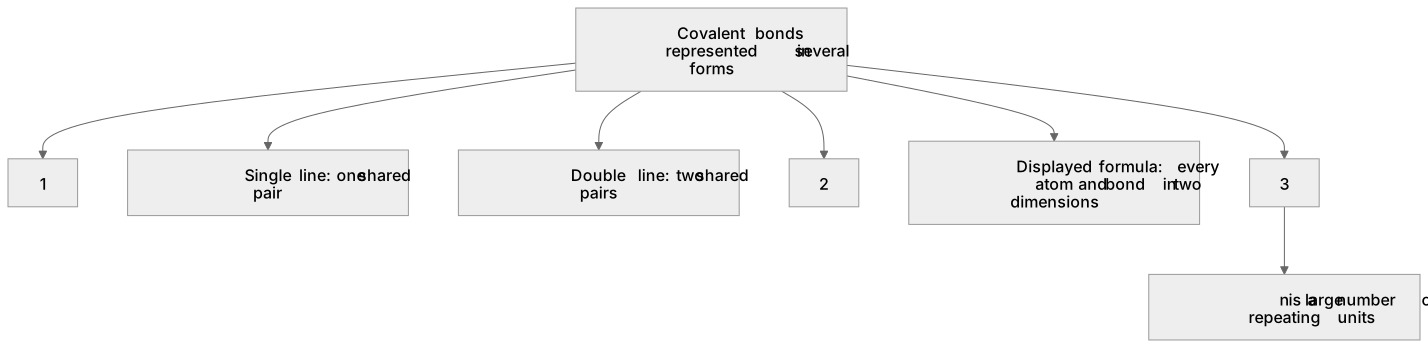
1Box 1
2Box 2
3Box 3
There is more to this lesson
The full lesson goes on to check your understanding and help you earn the marks. Create a free account to carry on, with your progress saved.
A week of Premium from your first lesson · Then the free plan continues · No card, no charge
Test your understanding of Covalent bonding: The covalent bonds in molecules and giant structures can be represented in the following forms: Polymers can be represented in the form: where n is a large number.
Active recall beats re-reading. Take an instant quiz now to test what you’ve learned and lock it into long-term memory.
A week of Premium from your first lesson · Then the free plan continues · No card, no charge