AQA · GCSE · Chemistry
Course version: 8462 · Version from Sept 2018
Hydrocarbons can be broken down (cracked) to produce smaller, more useful…
Full specification wording
Cracking and alkenes: Hydrocarbons can be broken down (cracked) to produce smaller, more useful molecules.
Cracking breaks large hydrocarbon molecules into smaller ones that are more useful as fuels and as starting materials for making polymers and other chemicals.
Checked against the AQA 8462 specification (opens in a new tab) on .
- Point 1 of 11
- 4 key terms
Study notes
From the checked teaching notes for this specification point.
The idea
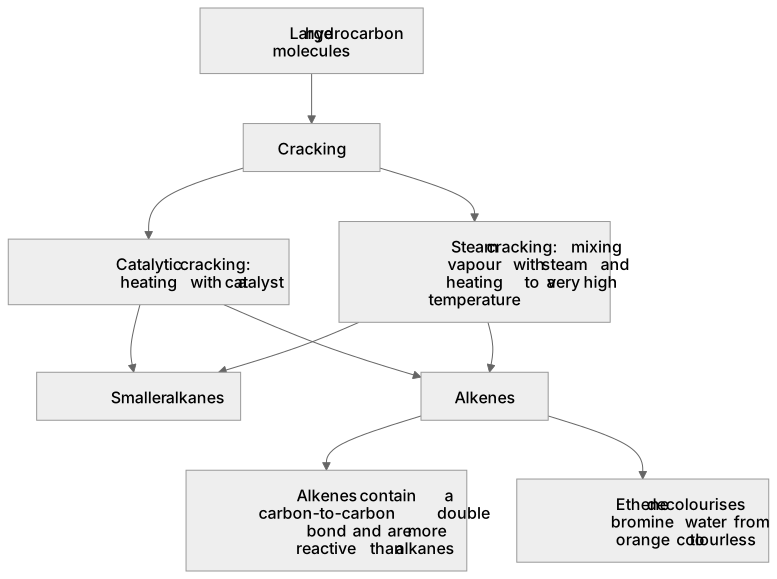
Cracking breaks large hydrocarbon molecules into smaller ones that are more useful as fuels and as starting materials for making polymers and other chemicals. It can be done by heating the vaporised hydrocarbon with a catalyst, called catalytic cracking, or by mixing the vapour with steam and heating to a very high temperature, called steam cracking. The products include smaller alkanes and alkenes; alkenes contain a carbon-to-carbon double bond and are more reactive than alkanes. For example, cracking decane can give octane and ethene. Ethene can be tested by shaking it with bromine water, which changes from orange to colourless. Cracking therefore helps match the supply of hydrocarbon fractions to demand, since longer-chain fractions are less useful as fuels.
What earns the marks
- Cracking breaks large hydrocarbon molecules into smaller molecules.
- The products are smaller alkanes and alkenes.
- Cracking can be carried out by heating with a catalyst or by mixing with steam and heating to a high temperature.
- Alkenes contain a carbon-to-carbon double bond and are more reactive than alkanes.
- Smaller molecules are more useful as fuels and as feedstock for polymers.
- Ethene can be identified because it decolourises bromine water from orange to colourless.
Common mistakes and how to put them right
Saying cracking joins small molecules together.
Put it right by stating that cracking breaks large molecules down into smaller ones.
Stating that cracking produces only alkanes.
Put it right by stating that alkenes are also produced.
Describing the bromine water test as turning from colourless to orange.
Put it right by stating that bromine water changes from orange to colourless.
Exam tips
- Name the type of cracking, catalytic or steam, and give the essential condition such as a catalyst or mixing with steam and heating to a high temperature.
- State that the products are smaller alkanes and alkenes, and give a named example such as ethene.
- When describing the bromine water test, give the starting colour and the final colour in the correct order.
Try the lesson
The start of the Cracking and alkenes: Hydrocarbons can be broken down (cracked) to produce smaller, more useful molecules. lesson, made from checked teaching notes for this specification point.
Have a go first
What is the main purpose of cracking large hydrocarbon molecules?
Listen
Cracking breaks large hydrocarbon molecules into smaller ones that are more useful as fuels and as starting materials for making polymers and other chemicals. It can be done by heating the vaporised hydrocarbon with a catalyst, called catalytic cracking, or by mixing the vapour with steam and heating to a very high temperature, called steam cracking. The products include smaller alkanes and alkenes; alkenes contain a carbon-to-carbon double bond and are more reactive than alkanes. For example, cracking decane can give octane and ethene. Ethene can be tested by shaking it with bromine water, which changes from orange to colourless. Cracking therefore helps match the supply of hydrocarbon fractions to demand, since longer-chain fractions are less useful as fuels. A strong answer earns marks for these points. Cracking breaks large hydrocarbon molecules into smaller molecules. The products are smaller alkanes and alkenes. Cracking can be carried out by heating with a catalyst or by mixing with steam and heating to a high temperature. Alkenes contain a carbon-to-carbon double bond and are more reactive than alkanes. A common slip: Saying cracking joins small molecules together. Instead, stating that cracking breaks large molecules down into smaller ones. Exam tip: Name the type of cracking, catalytic or steam, and give the essential condition such as a catalyst or mixing with steam and heating to a high temperature.
See it
Key words
Say what each word means before you turn the card.
Cracking
Try answering aloud or in your head before turning the card.
Alkenes
Try answering aloud or in your head before turning the card.
Bromine water test
Try answering aloud or in your head before turning the card.
Matching supply of fractions to demand
Try answering aloud or in your head before turning the card.
See every definition
- Cracking
- Breaking large hydrocarbon molecules down into smaller molecules that are more useful as fuels and as starting materials for making polymers and other chemicals.
- Alkenes
- Hydrocarbons that contain a carbon-to-carbon double bond and are more reactive than alkanes.
- Bromine water test
- Shaking a substance with bromine water, which changes from orange to colourless, to identify ethene.
- Matching supply of fractions to demand
- Cracking helps match the supply of hydrocarbon fractions to demand, since longer-chain fractions are less useful as fuels.
Label the diagram
Some boxes have lost their names. Pick the right name for each number.
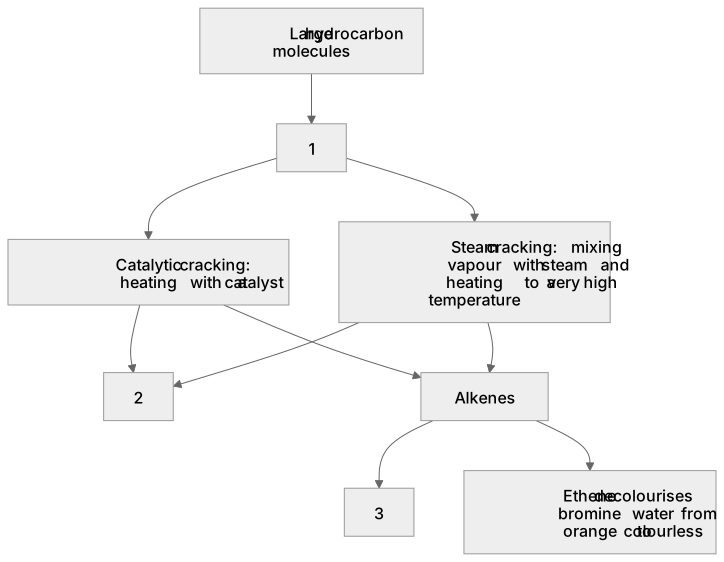
1Box 1
2Box 2
3Box 3
There is more to this lesson
The full lesson goes on to check your understanding and help you earn the marks. Create a free account to carry on, with your progress saved.
A week of Premium from your first lesson · Then the free plan continues · No card, no charge
Test your understanding of Cracking and alkenes: Hydrocarbons can be broken down (cracked) to produce smaller, more useful molecules.
Active recall beats re-reading. Take an instant quiz now to test what you’ve learned and lock it into long-term memory.
A week of Premium from your first lesson · Then the free plan continues · No card, no charge