AQA · GCSE · Chemistry
Course version: 8462 · Version from Sept 2018
Students should be able to describe in general terms the conditions used…
Full specification wording
Cracking and alkenes: Students should be able to describe in general terms the conditions used for catalytic cracking and steam cracking.
To describe cracking conditions, compare temperature, catalyst and feedstock state.
Checked against the AQA 8462 specification (opens in a new tab) on .
- Point 3 of 11
- 2 key terms
Study notes
From the checked teaching notes for this specification point.
The idea
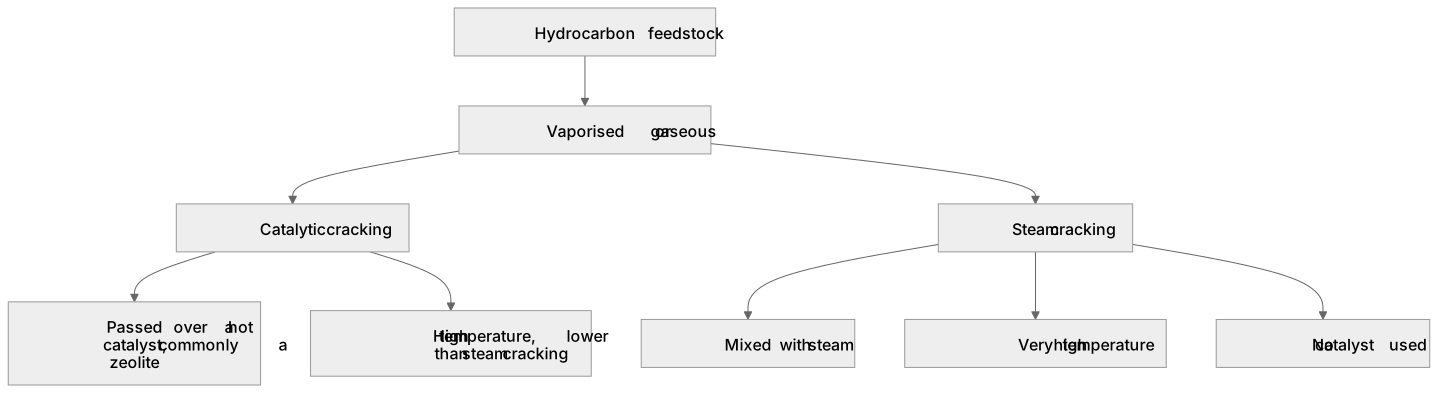
To describe cracking conditions, compare temperature, catalyst and feedstock state. Catalytic cracking vaporises long-chain hydrocarbons and passes them over a hot catalyst, typically a zeolite, at a moderately high temperature; the catalyst lowers the energy needed and speeds up the reaction. Steam cracking mixes the hydrocarbon feedstock with steam at a very high temperature without a catalyst. In both methods the feedstock must be gaseous or vaporised so molecules can react. For example, a refinery may crack decane over a zeolite, or steam-crack naphtha to make ethene. You do not need exact numerical values, but you should state that temperature is high, that catalytic cracking uses a catalyst, and that steam cracking uses steam.
What earns the marks
- Catalytic cracking: hydrocarbon vapour passed over a hot catalyst, commonly a zeolite.
- Catalytic cracking: a high temperature is used, but the catalyst allows reaction at a lower temperature than steam cracking.
- Steam cracking: hydrocarbon feedstock mixed with steam at a very high temperature.
- Steam cracking: no catalyst is used.
- In both methods the hydrocarbon feedstock is vaporised or gaseous so that molecules can react.
Common mistakes and how to put them right
Swapping the conditions, for example saying steam cracking uses a catalyst.
Put it right by linking catalyst only with catalytic cracking.
Giving exact temperatures as if they were fixed facts.
Put it right by describing conditions generally as high or very high temperature.
Forgetting that the feedstock is vaporised.
Put it right by stating that gaseous hydrocarbon molecules contact the catalyst or steam.
Exam tips
- Use a two-column comparison in your notes: method, catalyst, steam, temperature.
- When asked to describe conditions, give the method name plus at least one condition for each.
- Avoid quoting precise temperatures unless the question supplies them; general terms are sufficient.
Try the lesson
The start of the Cracking and alkenes: Students should be able to describe in general terms the conditions used for catalytic cracking and steam cracking. lesson, made from checked teaching notes for this specification point.
Have a go first
Which general conditions are required for catalytic cracking?
Listen
To describe cracking conditions, compare temperature, catalyst and feedstock state. Catalytic cracking vaporises long-chain hydrocarbons and passes them over a hot catalyst, typically a zeolite, at a moderately high temperature; the catalyst lowers the energy needed and speeds up the reaction. Steam cracking mixes the hydrocarbon feedstock with steam at a very high temperature without a catalyst. In both methods the feedstock must be gaseous or vaporised so molecules can react. For example, a refinery may crack decane over a zeolite, or steam-crack naphtha to make ethene. You do not need exact numerical values, but you should state that temperature is high, that catalytic cracking uses a catalyst, and that steam cracking uses steam. A strong answer earns marks for these points. Catalytic cracking: hydrocarbon vapour passed over a hot catalyst, commonly a zeolite. Catalytic cracking: a high temperature is used, but the catalyst allows reaction at a lower temperature than steam cracking. Steam cracking: hydrocarbon feedstock mixed with steam at a very high temperature. Steam cracking: no catalyst is used. A common slip: Swapping the conditions, for example saying steam cracking uses a catalyst. Instead, linking catalyst only with catalytic cracking. Exam tip: Use a two-column comparison in your notes: method, catalyst, steam, temperature.
See it
Key words
Say what each word means before you turn the card.
Catalytic cracking
Try answering aloud or in your head before turning the card.
Steam cracking
Try answering aloud or in your head before turning the card.
See every definition
- Catalytic cracking
- Hydrocarbon vapour is passed over a hot catalyst, commonly a zeolite, at a high temperature, and the catalyst allows reaction at a lower temperature than steam cracking.
- Steam cracking
- The hydrocarbon feedstock is mixed with steam at a very high temperature and no catalyst is used.
Label the diagram
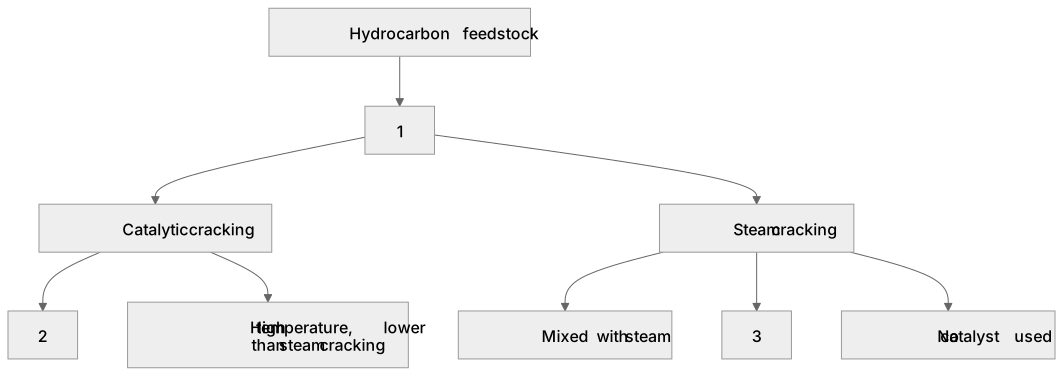
Some boxes have lost their names. Pick the right name for each number.
1Box 1
2Box 2
3Box 3
There is more to this lesson
The full lesson goes on to check your understanding and help you earn the marks. Create a free account to carry on, with your progress saved.
A week of Premium from your first lesson · Then the free plan continues · No card, no charge
Test your understanding of Cracking and alkenes: Students should be able to describe in general terms the conditions used for catalytic cracking and steam cracking.
Active recall beats re-reading. Take an instant quiz now to test what you’ve learned and lock it into long-term memory.
A week of Premium from your first lesson · Then the free plan continues · No card, no charge