AQA · GCSE · Chemistry
Course version: 8462 · Version from Sept 2018
Crude oil is a finite resource found in rocks. Crude oil is the remains of…
Full specification wording
Crude oil, hydrocarbons and alkanes: Crude oil is a finite resource found in rocks. Crude oil is the remains of an ancient biomass consisting mainly of plankton that was buried in mud.
Crude oil is a mixture of hydrocarbons found in rocks and is described as a finite resource because it is being used up faster than it forms and cannot be replaced on a human timescale.
Checked against the AQA 8462 specification (opens in a new tab) on .
- Point 1 of 4
- 2 key terms
Study notes
From the checked teaching notes for this specification point.
The idea
Crude oil is a mixture of hydrocarbons found in rocks and is described as a finite resource because it is being used up faster than it forms and cannot be replaced on a human timescale. It formed over millions of years from the remains of ancient biomass, mainly plankton, that was buried in mud. Heat and pressure over geological time converted this biomass into crude oil. Because formation takes millions of years, once extracted and burned, crude oil is effectively gone. This matters because fuels and petrochemical feedstocks depend on it, so alternatives and conservation are important.
For example: Petrol, diesel and kerosene are fractions obtained from crude oil, and their supply is limited.
What earns the marks
- State that crude oil is a finite resource, meaning it is being used up faster than it is formed.
- State that crude oil is found in rocks.
- Describe crude oil as the remains of ancient biomass.
- Identify plankton as the main component of the biomass from which crude oil formed.
- Explain that the biomass was buried in mud and subjected to heat and pressure over millions of years.
- Link the finite nature of crude oil to the need for conservation or alternative energy sources.
Common mistakes and how to put them right
Describing crude oil as a single compound.
Put it right: It is a mixture of hydrocarbons.
Saying crude oil formed from dinosaurs.
Put it right: It formed mainly from plankton.
Stating that crude oil is renewable because it is still forming.
Put it right: It is finite because formation takes millions of years.
Exam tips
- Use the word 'finite' and explain it in terms of rate of use compared with rate of formation.
- Name plankton as the main source of the biomass when describing the origin of crude oil.
- Mention burial in mud and the action of heat and pressure over millions of years.
Try the lesson
The start of the Crude oil, hydrocarbons and alkanes: Crude oil is a finite resource found in rocks. Crude oil is the remains of an ancient biomass consisting mainly of plankton that was buried in mud. lesson, made from checked teaching notes for this specification point.
Have a go first
Crude oil is described as a finite resource. What does the word finite mean in this context?
Listen
Crude oil is a mixture of hydrocarbons found in rocks and is described as a finite resource because it is being used up faster than it forms and cannot be replaced on a human timescale. It formed over millions of years from the remains of ancient biomass, mainly plankton, that was buried in mud. Heat and pressure over geological time converted this biomass into crude oil. Because formation takes millions of years, once extracted and burned, crude oil is effectively gone. This matters because fuels and petrochemical feedstocks depend on it, so alternatives and conservation are important. For example, petrol, diesel and kerosene are fractions obtained from crude oil, and their supply is limited. A strong answer earns marks for these points. State that crude oil is a finite resource, meaning it is being used up faster than it is formed. State that crude oil is found in rocks. Describe crude oil as the remains of ancient biomass. Identify plankton as the main component of the biomass from which crude oil formed. A common slip: Describing crude oil as a single compound. Instead, it is a mixture of hydrocarbons. Exam tip: Use the word 'finite' and explain it in terms of rate of use compared with rate of formation.
See it
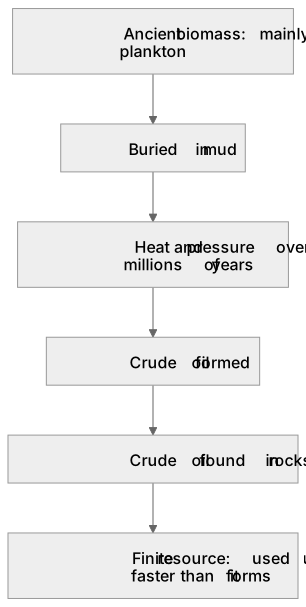
Put it in order
Put these steps in the order they happen.
- 1. Heat and pressure over millions of years
- 2. Buried in mud
- 3. Ancient biomass: mainly plankton
- 4. Finite resource: used up faster than it forms
- 5. Crude oil found in rocks
- 6. Crude oil formed
Key words
Say what each word means before you turn the card.
Finite resources
Try answering aloud or in your head before turning the card.
Origin of crude oil
Try answering aloud or in your head before turning the card.
See every definition
- Finite resources
- Resources that are being used up faster than they form and cannot be replaced on a human timescale.
- Origin of crude oil
- The remains of an ancient biomass consisting mainly of plankton that was buried in mud.
Label the diagram
Some boxes have lost their names. Pick the right name for each number.
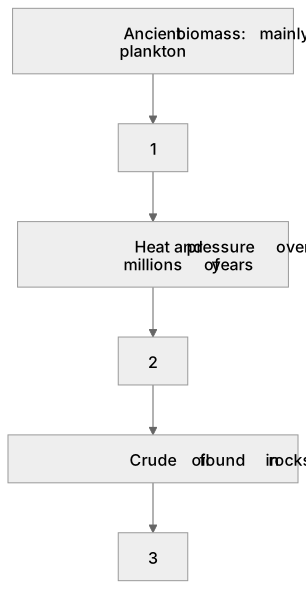
1Box 1
2Box 2
3Box 3
There is more to this lesson
The full lesson goes on to check your understanding and help you earn the marks. Create a free account to carry on, with your progress saved.
A week of Premium from your first lesson · Then the free plan continues · No card, no charge
Test your understanding of Crude oil, hydrocarbons and alkanes: Crude oil is a finite resource found in rocks. Crude oil is the remains of an ancient biomass consisting mainly of plankton that was buried in mud.
Active recall beats re-reading. Take an instant quiz now to test what you’ve learned and lock it into long-term memory.
A week of Premium from your first lesson · Then the free plan continues · No card, no charge