AQA · GCSE · Chemistry
Course version: 8462 · Version from Sept 2018
DNA (deoxyribonucleic acid) is a large molecule essential for life.
Full specification wording
DNA (deoxyribonucleic acid) and other naturally occurring polymers: DNA (deoxyribonucleic acid) is a large molecule essential for life.
DNA is a naturally occurring polymer with a very large molecular size, which is why it is described as a large molecule or macromolecule.
Checked against the AQA 8462 specification (opens in a new tab) on .
- Point 1 of 5
- 4 key terms
Study notes
From the checked teaching notes for this specification point.
The idea
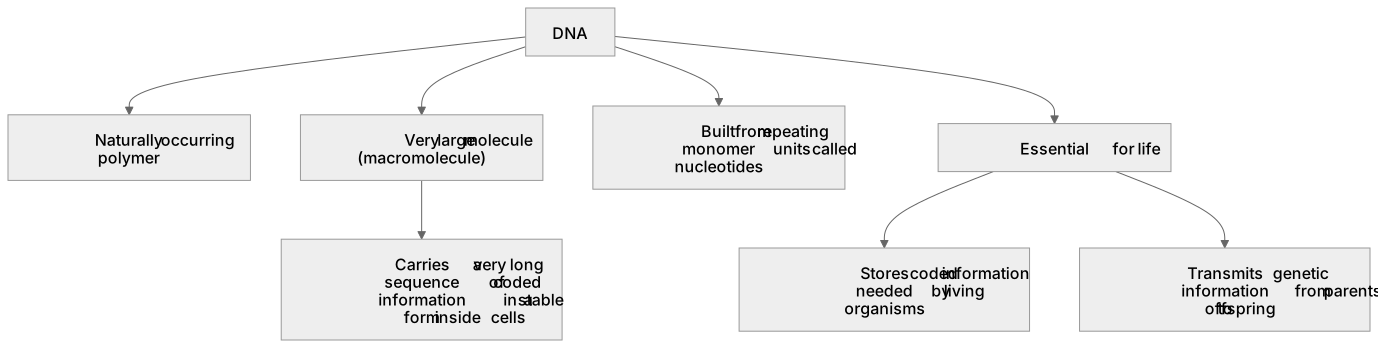
DNA is a naturally occurring polymer with a very large molecular size, which is why it is described as a large molecule or macromolecule. It is essential for life because it stores the information that living organisms need to grow, develop and function, and it is passed from parents to offspring. In chemistry terms, DNA is a polymer made from repeating monomer units called nucleotides. Its large size allows it to carry a very long sequence of coded information in a stable form inside cells. For example, the instructions for making proteins are encoded in the order of nucleotides along a DNA chain. You should be able to state that DNA is a large molecule, recognise it as a natural polymer and explain its importance to living organisms.
What earns the marks
- DNA is a naturally occurring polymer rather than a synthetic one.
- DNA is a very large molecule, often described as a macromolecule.
- DNA carries coded information needed by living organisms.
- DNA is essential for life because it stores and transmits genetic information.
- DNA is built from repeating monomer units called nucleotides.
Common mistakes and how to put them right
Describing DNA as a small molecule.
Put it right: DNA is a very large molecule made of many repeating units.
Classifying DNA as a synthetic polymer.
Put it right: DNA is a naturally occurring polymer found in living organisms.
Saying DNA is essential for all viruses.
Put it right: DNA is essential for all living organisms, but many viruses (which are not strictly living) use RNA instead.
Exam tips
- Use the phrase naturally occurring polymer when describing DNA.
- State that DNA is a large molecule and give its role in storing genetic information.
- Link the size of DNA to its ability to carry a long coded sequence.
- Avoid vague statements such as DNA is important; specify what it stores and why that matters.
Try the lesson
The start of the DNA (deoxyribonucleic acid) and other naturally occurring polymers: DNA (deoxyribonucleic acid) is a large molecule essential for life. lesson, made from checked teaching notes for this specification point.
Have a go first
DNA is described as a large molecule that is essential for life. What is the main role of DNA in a living organism?
Listen
DNA is a naturally occurring polymer with a very large molecular size, which is why it is described as a large molecule or macromolecule. It is essential for life because it stores the information that living organisms need to grow, develop and function, and it is passed from parents to offspring. In chemistry terms, DNA is a polymer made from repeating monomer units called nucleotides. Its large size allows it to carry a very long sequence of coded information in a stable form inside cells. For example, the instructions for making proteins are encoded in the order of nucleotides along a DNA chain. You should be able to state that DNA is a large molecule, recognise it as a natural polymer and explain its importance to living organisms. A strong answer earns marks for these points. DNA is a naturally occurring polymer rather than a synthetic one. DNA is a very large molecule, often described as a macromolecule. DNA carries coded information needed by living organisms. DNA is essential for life because it stores and transmits genetic information. A common slip: Describing DNA as a small molecule: the error is ignoring its polymer nature. Instead, DNA is a very large molecule made of many repeating units. Exam tip: Use the phrase naturally occurring polymer when describing DNA.
See it
Key words
Say what each word means before you turn the card.
Naturally occurring polymers
Try answering aloud or in your head before turning the card.
Macromolecules
Try answering aloud or in your head before turning the card.
Genetic information storage
Try answering aloud or in your head before turning the card.
Biological importance of DNA
Try answering aloud or in your head before turning the card.
See every definition
- Naturally occurring polymers
- DNA is a naturally occurring polymer rather than a synthetic one, found in living organisms.
- Macromolecules
- DNA is a very large molecule, often described as a macromolecule, made of many repeating units.
- Genetic information storage
- DNA is essential for life because it stores and transmits genetic information needed by living organisms.
- Biological importance of DNA
- DNA carries coded information needed by living organisms, which is passed from parents to offspring.
Label the diagram
Some boxes have lost their names. Pick the right name for each number.
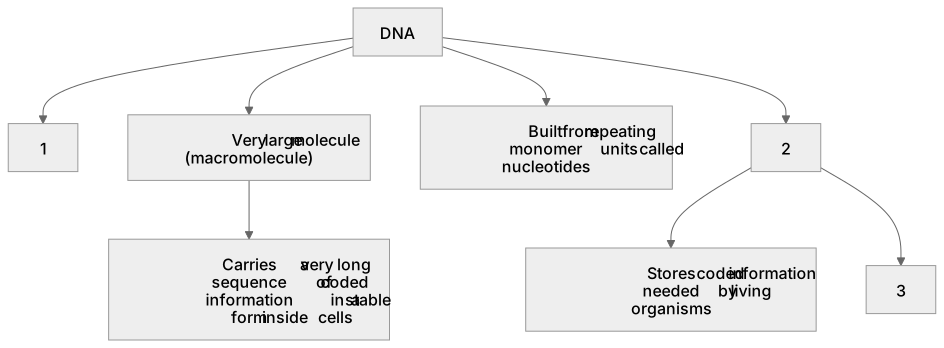
1Box 1
2Box 2
3Box 3
There is more to this lesson
The full lesson goes on to check your understanding and help you earn the marks. Create a free account to carry on, with your progress saved.
A week of Premium from your first lesson · Then the free plan continues · No card, no charge
Test your understanding of DNA (deoxyribonucleic acid) and other naturally occurring polymers: DNA (deoxyribonucleic acid) is a large molecule essential for life.
Active recall beats re-reading. Take an instant quiz now to test what you’ve learned and lock it into long-term memory.
A week of Premium from your first lesson · Then the free plan continues · No card, no charge