AQA · GCSE · Chemistry
Course version: 8462 · Version from Sept 2018
At the negative electrode (cathode), hydrogen is produced if the metal is…
Full specification wording
Electrolysis of aqueous solutions: At the negative electrode (cathode), hydrogen is produced if the metal is more reactive than hydrogen.
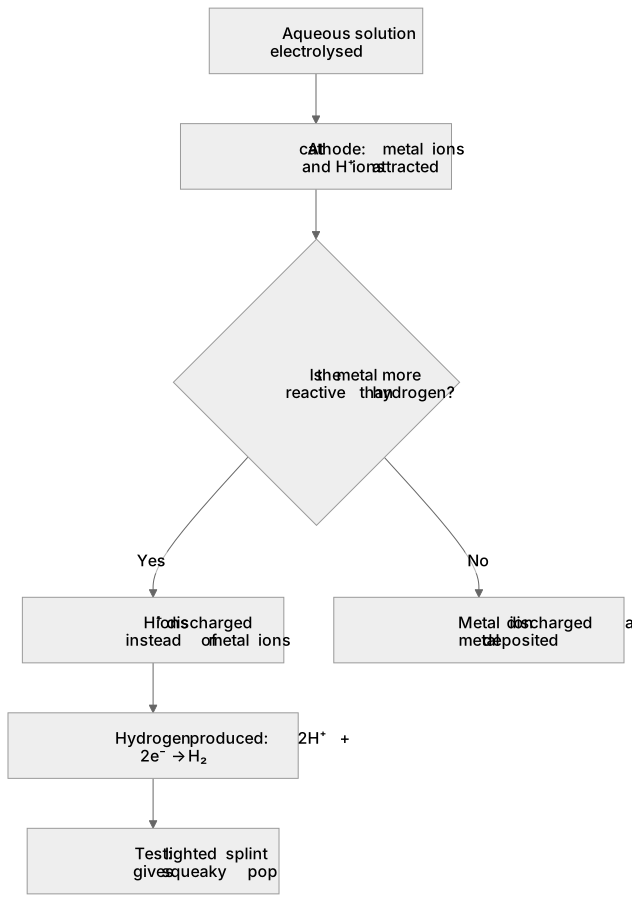
When an aqueous solution is electrolysed, both metal ions and H⁺ ions from water are attracted to the negative electrode.
Checked against the AQA 8462 specification (opens in a new tab) on .
- Point 2 of 6
- 4 key terms
Study notes
From the checked teaching notes for this specification point.
The idea
When an aqueous solution is electrolysed, both metal ions and H⁺ ions from water are attracted to the negative electrode. The ion that gains electrons more readily is discharged. If the metal is more reactive than hydrogen, its ions are less easily reduced, so H⁺ ions are reduced instead and hydrogen gas is produced: 2H⁺ + 2e⁻ → H₂. For example, in sodium chloride solution, hydrogen is produced at the cathode rather than sodium. If the metal is less reactive than hydrogen, such as copper, the metal ion is discharged and the metal is deposited: Cu²⁺ + 2e⁻ → Cu. The gas can be identified by a lighted splint giving a squeaky pop.
What earns the marks
- At the cathode, both metal ions and H⁺ ions from water are attracted.
- If the metal is more reactive than hydrogen, H⁺ ions are discharged instead of the metal ions.
- The cathode half-equation for hydrogen production is 2H⁺ + 2e⁻ → H₂.
- If the metal is less reactive than hydrogen, the metal ion is discharged and the metal is deposited at the cathode.
- Hydrogen can be identified by a lighted splint producing a squeaky pop.
Common mistakes and how to put them right
Writing that a reactive metal such as sodium is deposited at the cathode.
Put it right by stating that hydrogen is produced instead.
Placing hydrogen production at the positive electrode.
Put it right by placing it at the negative electrode (cathode).
Omitting electrons from the half-equation.
Put it right by writing 2H⁺ + 2e⁻ → H₂.
Exam tips
- Compare the metal's position in the reactivity series with hydrogen before predicting the cathode product.
- Give the half-equation for hydrogen production when hydrogen is the product.
- State a simple test for hydrogen to confirm the product.
Try the lesson
The start of the Electrolysis of aqueous solutions: At the negative electrode (cathode), hydrogen is produced if the metal is more reactive than hydrogen. lesson, made from checked teaching notes for this specification point.
Have a go first
At the negative electrode, when is hydrogen produced during the electrolysis of an aqueous solution?
Listen
When an aqueous solution is electrolysed, both metal ions and H⁺ ions from water are attracted to the negative electrode. The ion that gains electrons more readily is discharged. If the metal is more reactive than hydrogen, its ions are less easily reduced, so H⁺ ions are reduced instead and hydrogen gas is produced: 2H⁺ + 2e⁻ → H₂. For example, in sodium chloride solution, hydrogen is produced at the cathode rather than sodium. If the metal is less reactive than hydrogen, such as copper, the metal ion is discharged and the metal is deposited: Cu²⁺ + 2e⁻ → Cu. The gas can be identified by a lighted splint giving a squeaky pop. A strong answer earns marks for these points. At the cathode, both metal ions and H⁺ ions from water are attracted. If the metal is more reactive than hydrogen, H⁺ ions are discharged instead of the metal ions. The cathode half-equation for hydrogen production is 2H⁺ + 2e⁻ → H₂. If the metal is less reactive than hydrogen, the metal ion is discharged and the metal is deposited at the cathode. A common slip: Writing that a reactive metal such as sodium is deposited at the cathode. Instead, stating that hydrogen is produced instead. Exam tip: Compare the metal's position in the reactivity series with hydrogen before predicting the cathode product.
See it
Key words
Say what each word means before you turn the card.
Selective discharge at the cathode
Try answering aloud or in your head before turning the card.
Reactivity series and reduction
Try answering aloud or in your head before turning the card.
Half-equations for reduction
Try answering aloud or in your head before turning the card.
Gas identification tests
Try answering aloud or in your head before turning the card.
See every definition
- Selective discharge at the cathode
- At the negative electrode, the ion that gains electrons more readily is discharged, so either hydrogen or the metal is produced.
- Reactivity series and reduction
- If the metal is more reactive than hydrogen, its ions are less easily reduced, so H⁺ ions are reduced instead and hydrogen gas is produced.
- Half-equations for reduction
- The cathode half-equation for hydrogen production is 2H⁺ + 2e⁻ → H₂, and for a metal less reactive than hydrogen such as copper it is Cu²⁺ + 2e⁻ → Cu.
- Gas identification tests
- Hydrogen can be identified by a lighted splint giving a squeaky pop.
Label the diagram
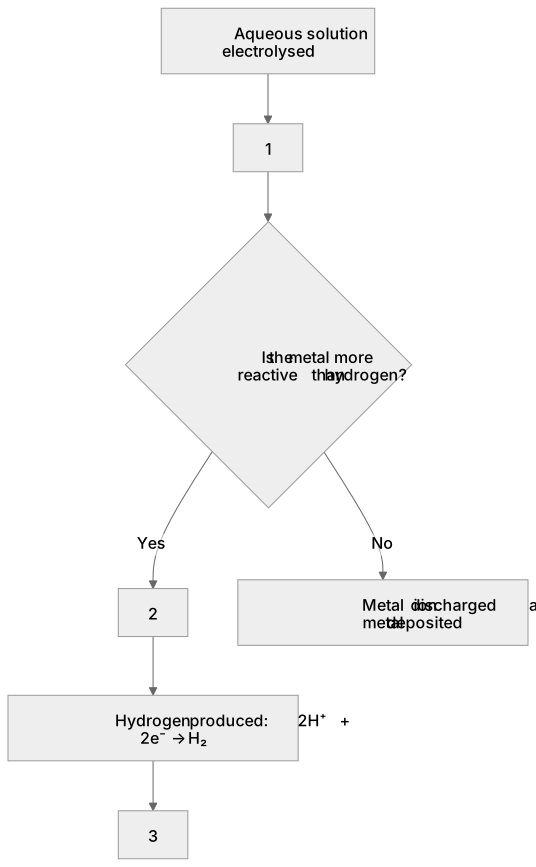
Some boxes have lost their names. Pick the right name for each number.
1Box 1
2Box 2
3Box 3
There is more to this lesson
The full lesson goes on to check your understanding and help you earn the marks. Create a free account to carry on, with your progress saved.
A week of Premium from your first lesson · Then the free plan continues · No card, no charge
Test your understanding of Electrolysis of aqueous solutions: At the negative electrode (cathode), hydrogen is produced if the metal is more reactive than hydrogen.
Active recall beats re-reading. Take an instant quiz now to test what you’ve learned and lock it into long-term memory.
A week of Premium from your first lesson · Then the free plan continues · No card, no charge