AQA · GCSE · Chemistry
Course version: 8462 · Version from Sept 2018
Required practical 3: investigate what happens when aqueous solutions are…
Full specification wording
Electrolysis of aqueous solutions: Required practical 3: investigate what happens when aqueous solutions are electrolysed using inert electrodes. This should be an investigation involving developing a hypothesis.
In this practical, you electrolyse different aqueous solutions using inert electrodes such as graphite and observe the products at each electrode.
Checked against the AQA 8462 specification (opens in a new tab) on .
- Point 6 of 6
- 4 key terms
Study notes
From the checked teaching notes for this specification point.
The idea
In this practical, you electrolyse different aqueous solutions using inert electrodes such as graphite and observe the products at each electrode. You develop a hypothesis linking the ions present to the products, for example that a solution containing halide ions will produce a halogen at the anode. You then test the hypothesis by electrolysing solutions such as sodium chloride, copper chloride and sodium sulfate, recording observations at the cathode and anode. Observations may include gas bubbles, colour changes, litmus or indicator tests, and identification of gases. You evaluate whether results support the hypothesis and explain any anomalies using ion discharge rules.
What earns the marks
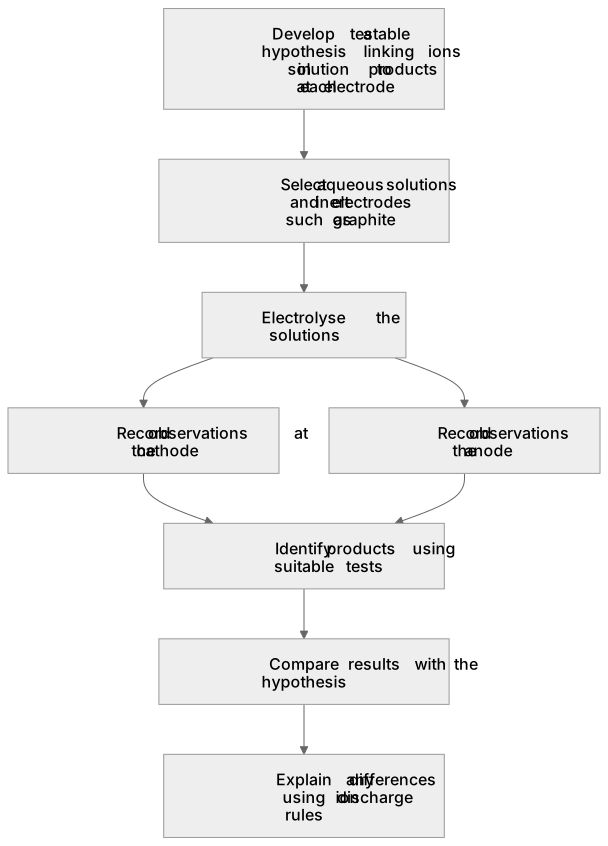
- Develop a testable hypothesis linking the ions in solution to the products at each electrode.
- Select appropriate aqueous solutions and inert electrodes for the investigation.
- Record observations at both electrodes, such as bubbles, colour or gas test results.
- Identify products using suitable tests, for example a glowing splint for oxygen or damp litmus for chlorine.
- Compare results with the hypothesis and explain any differences using ion discharge rules.
- Describe how to control variables such as solution concentration, voltage and electrode material.
Common mistakes and how to put them right
Using reactive metal electrodes that take part in the reaction.
Put it right by choosing inert graphite electrodes.
Recording only one electrode's observations.
Put it right by observing and recording both the cathode and the anode.
Treating a single trial as conclusive.
Put it right by repeating the investigation and checking reproducibility.
Exam tips
- State your hypothesis clearly before describing the method.
- Link each observation to a named product and the ion responsible.
- Describe a specific confirmatory test for each gas rather than saying 'a gas was produced'.
Try the lesson
The start of the Electrolysis of aqueous solutions: Required practical 3: investigate what happens when aqueous solutions are electrolysed using inert electrodes. This should be an investigation involving developing a hypothesis. lesson, made from checked teaching notes for this specification point.
Have a go first
When investigating the electrolysis of an aqueous solution in a school laboratory, which type of electrode is typically used to prevent the electrode from reacting with the products?
Listen
In this practical, you electrolyse different aqueous solutions using inert electrodes such as graphite and observe the products at each electrode. You develop a hypothesis linking the ions present to the products, for example that a solution containing halide ions will produce a halogen at the anode. You then test the hypothesis by electrolysing solutions such as sodium chloride, copper chloride and sodium sulfate, recording observations at the cathode and anode. Observations may include gas bubbles, colour changes, litmus or indicator tests, and identification of gases. You evaluate whether results support the hypothesis and explain any anomalies using ion discharge rules. A strong answer earns marks for these points. Develop a testable hypothesis linking the ions in solution to the products at each electrode. Select appropriate aqueous solutions and inert electrodes for the investigation. Record observations at both electrodes, such as bubbles, colour or gas test results. Identify products using suitable tests, for example a glowing splint for oxygen or damp litmus for chlorine. A common slip: Using reactive metal electrodes that take part in the reaction. Instead, choosing inert graphite electrodes. Exam tip: State your hypothesis clearly before describing the method.
See it
Key words
Say what each word means before you turn the card.
Hypothesis development and testing
Try answering aloud or in your head before turning the card.
Observation and product identification
Try answering aloud or in your head before turning the card.
Inert electrodes and control variables
Try answering aloud or in your head before turning the card.
Required practical investigation
Try answering aloud or in your head before turning the card.
See every definition
- Hypothesis development and testing
- Developing a testable hypothesis linking the ions in solution to the products at each electrode, then testing it by electrolysing solutions and recording observations.
- Observation and product identification
- Recording observations at both electrodes, such as bubbles, colour or gas test results, and identifying products using suitable tests.
- Inert electrodes and control variables
- Choosing inert graphite electrodes and controlling variables such as solution concentration, voltage and electrode material.
- Required practical investigation
- An investigation of what happens when aqueous solutions are electrolysed using inert electrodes, involving developing a hypothesis.
Label the diagram
Some boxes have lost their names. Pick the right name for each number.
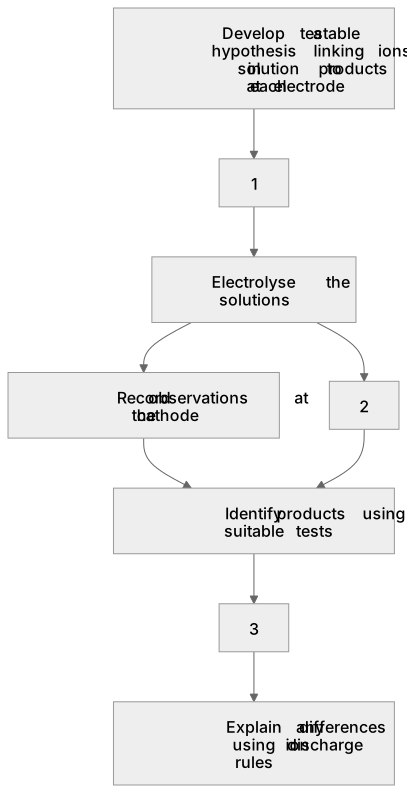
1Box 1
2Box 2
3Box 3
There is more to this lesson
The full lesson goes on to check your understanding and help you earn the marks. Create a free account to carry on, with your progress saved.
A week of Premium from your first lesson · Then the free plan continues · No card, no charge
Test your understanding of Electrolysis of aqueous solutions: Required practical 3: investigate what happens when aqueous solutions are electrolysed using inert electrodes. This should be an investigation involving developing a hypothesis.
Active recall beats re-reading. Take an instant quiz now to test what you’ve learned and lock it into long-term memory.
A week of Premium from your first lesson · Then the free plan continues · No card, no charge