AQA · GCSE · Chemistry
Course version: 8462 · Version from Sept 2018
This happens because in the aqueous solution water molecules break down…
Full specification wording
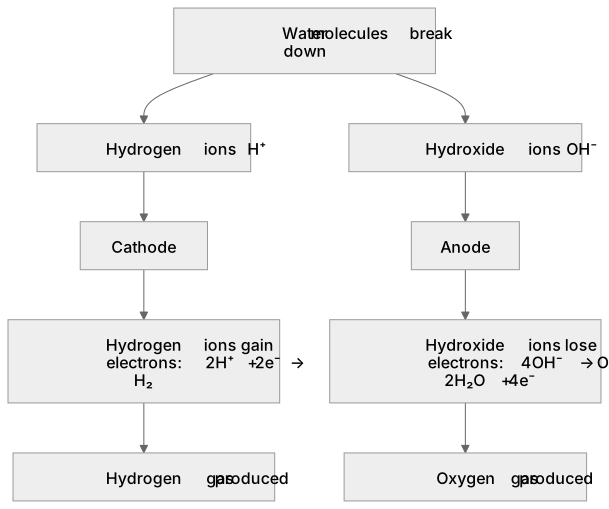
Electrolysis of aqueous solutions: This happens because in the aqueous solution water molecules break down producing hydrogen ions and hydroxide ions that are discharged.
Water is a weak electrolyte because only a small fraction of its molecules dissociate into ions: H₂O ⇌ H⁺ + OH⁻.
Checked against the AQA 8462 specification (opens in a new tab) on .
- Point 4 of 6
- 3 key terms
Study notes
From the checked teaching notes for this specification point.
The idea
Water is a weak electrolyte because only a small fraction of its molecules dissociate into ions: H₂O ⇌ H⁺ + OH⁻. In an aqueous solution, these ions join those from the dissolved ionic compound, so both positive and negative ions are available at the electrodes. At the cathode, hydrogen ions gain electrons to form hydrogen gas: 2H⁺ + 2e⁻ → H₂. At the anode, hydroxide ions lose electrons to form oxygen gas: 4OH⁻ → O₂ + 2H₂O + 4e⁻. This explains why hydrogen and oxygen can be produced even when the dissolved compound contains neither hydrogen nor oxygen as simple ions. The ions discharged depend on which species is easiest to oxidise or reduce under the conditions used.
What earns the marks
- State that water molecules break down into hydrogen ions and hydroxide ions.
- Recognise that these ions are discharged at the electrodes, giving hydrogen at the cathode and oxygen at the anode.
- Write the cathode half-equation: 2H⁺ + 2e⁻ → H₂.
- Write the anode half-equation: 4OH⁻ → O₂ + 2H₂O + 4e⁻.
- Explain that the ions from water compete with ions from the dissolved compound.
- Link the discharge of water-derived ions to the products observed in a named example.
Common mistakes and how to put them right
Believing that water is a strong electrolyte and fully ionises.
Put it right by describing water as only slightly ionised, so few ions are present.
Writing hydrogen ions as H⁺ without showing electron gain at the cathode.
Put it right by including 2e⁻ in the half-equation.
Assuming hydroxide ions are positive.
Put it right by using the formula OH⁻ with a superscript minus sign.
Exam tips
- Quote the water dissociation equilibrium H₂O ⇌ H⁺ + OH⁻ when explaining the source of the ions.
- Match each half-equation to the correct electrode before writing it.
- Use the words 'discharged' and 'electrons gained or lost' to show understanding of redox at electrodes.
Try the lesson
The start of the Electrolysis of aqueous solutions: This happens because in the aqueous solution water molecules break down producing hydrogen ions and hydroxide ions that are discharged. lesson, made from checked teaching notes for this specification point.
Have a go first
In an aqueous solution being electrolysed, which ions are produced when water molecules break down?
Listen
Water is a weak electrolyte because only a small fraction of its molecules dissociate into ions: H₂O ⇌ H⁺ + OH⁻. In an aqueous solution, these ions join those from the dissolved ionic compound, so both positive and negative ions are available at the electrodes. At the cathode, hydrogen ions gain electrons to form hydrogen gas: 2H⁺ + 2e⁻ → H₂. At the anode, hydroxide ions lose electrons to form oxygen gas: 4OH⁻ → O₂ + 2H₂O + 4e⁻. This explains why hydrogen and oxygen can be produced even when the dissolved compound contains neither hydrogen nor oxygen as simple ions. The ions discharged depend on which species is easiest to oxidise or reduce under the conditions used. A strong answer earns marks for these points. State that water molecules break down into hydrogen ions and hydroxide ions. Recognise that these ions are discharged at the electrodes, giving hydrogen at the cathode and oxygen at the anode. Write the cathode half-equation: 2H⁺ + 2e⁻ → H₂. Write the anode half-equation: 4OH⁻ → O₂ + 2H₂O + 4e⁻. A common slip: Believing that water is a strong electrolyte and fully ionises. Instead, describing water as only slightly ionised, so few ions are present. Exam tip: Quote the water dissociation equilibrium H₂O ⇌ H⁺ + OH⁻ when explaining the source of the ions.
See it
Key words
Say what each word means before you turn the card.
Water as a source of ions
Try answering aloud or in your head before turning the card.
Redox at electrodes
Try answering aloud or in your head before turning the card.
Half-equations for hydrogen and oxygen
Try answering aloud or in your head before turning the card.
See every definition
- Water as a source of ions
- Water molecules break down producing hydrogen ions and hydroxide ions, and water is a weak electrolyte because only a small fraction of its molecules dissociate into ions.
- Redox at electrodes
- At the cathode hydrogen ions gain electrons to form hydrogen gas, and at the anode hydroxide ions lose electrons to form oxygen gas.
- Half-equations for hydrogen and oxygen
- At the cathode 2H⁺ + 2e⁻ → H₂, and at the anode 4OH⁻ → O₂ + 2H₂O + 4e⁻.
Label the diagram
Some boxes have lost their names. Pick the right name for each number.
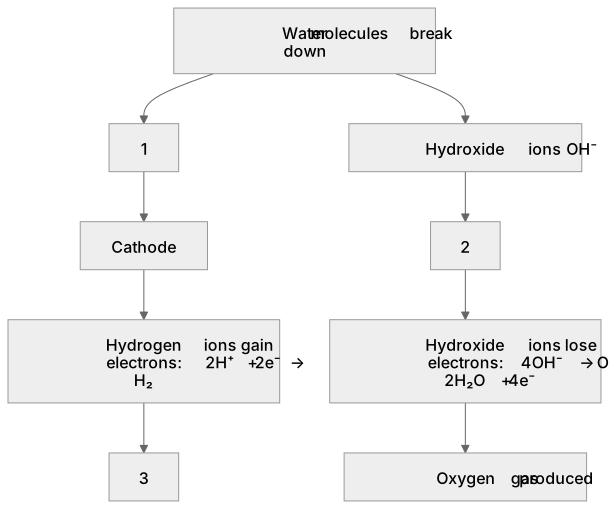
1Box 1
2Box 2
3Box 3
There is more to this lesson
The full lesson goes on to check your understanding and help you earn the marks. Create a free account to carry on, with your progress saved.
A week of Premium from your first lesson · Then the free plan continues · No card, no charge
Test your understanding of Electrolysis of aqueous solutions: This happens because in the aqueous solution water molecules break down producing hydrogen ions and hydroxide ions that are discharged.
Active recall beats re-reading. Take an instant quiz now to test what you’ve learned and lock it into long-term memory.
A week of Premium from your first lesson · Then the free plan continues · No card, no charge