AQA · GCSE · Chemistry
Course version: 8462 · Version from Sept 2018
Students should be able to predict the products of the electrolysis of…
Full specification wording
Electrolysis of molten ionic compounds: Students should be able to predict the products of the electrolysis of binary ionic compounds in the molten state.
In a binary ionic compound, only two ions are present.
Checked against the AQA 8462 specification (opens in a new tab) on .
- Point 2 of 2
- 2 key terms
Study notes
From the checked teaching notes for this specification point.
The idea
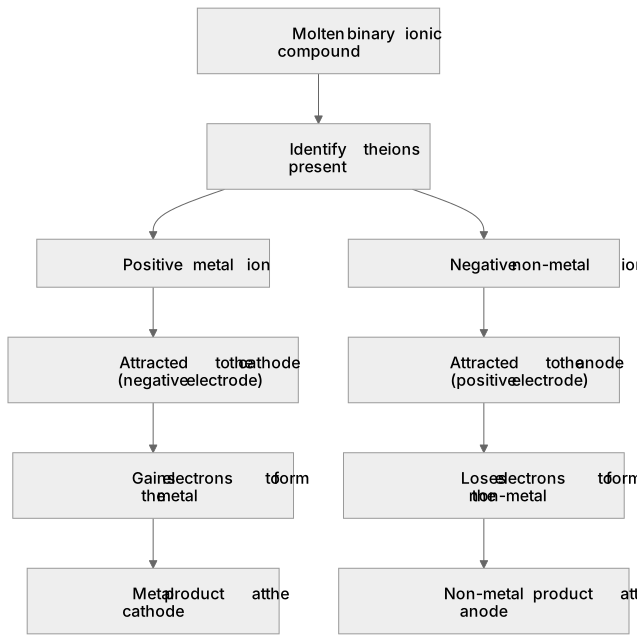
In a binary ionic compound, only two ions are present. When the solid is melted, these ions become free to move and carry charge. At the cathode (negative electrode), the positive metal ion gains electrons to form the metal: for PbBr₂, Pb²⁺ + 2e⁻ → Pb. At the anode (positive electrode), the negative non-metal ion loses electrons to form the non-metal: 2Br⁻ → Br₂ + 2e⁻. Thus electrolysis of molten lead bromide gives lead and bromine. The method is: identify the ions, assign each to the electrode that attracts it, then write the product. If the compound contains a metal and a non-metal, the metal appears at the cathode and the non-metal at the anode. This skill is assessed by asking you to name or write the products for a given molten binary compound, often with equations.
What earns the marks
- Identify the positive metal ion and the negative non-metal ion in the binary compound.
- State that the positive metal ion is attracted to the cathode and gains electrons to form the metal.
- State that the negative non-metal ion is attracted to the anode and loses electrons to form the non-metal.
- Write balanced half-equations for each electrode, including state symbols where appropriate.
- Name the products correctly, for example lead at the cathode and bromine at the anode for molten lead bromide.
- Explain that the ions must be free to move, which occurs in the molten state but not in the solid state.
Common mistakes and how to put them right
Thinking that the metal forms at the anode.
Put it right by recalling that positive ions move to the negative electrode (cathode).
Writing the non-metal as a single atom rather than a diatomic molecule.
Put it right by using the formula of the molecule, such as Br₂ or Cl₂.
Forgetting to balance the electrons in half-equations.
Put it right by ensuring the number of electrons lost equals the number gained in the overall process.
Assuming that water is present.
Put it right by noting that the compound is molten and anhydrous, so water is not a reactant.
Exam tips
- Underline the metal and non-metal in the formula before predicting products.
- Use the phrase 'positive ions move to the cathode' to make your reasoning clear.
- Check that each half-equation is balanced for both atoms and charge.
Try the lesson
The start of the Electrolysis of molten ionic compounds: Students should be able to predict the products of the electrolysis of binary ionic compounds in the molten state. lesson, made from checked teaching notes for this specification point.
Have a go first
Molten lead bromide is a binary ionic compound. What is produced at the negative electrode during its electrolysis?
Listen
In a binary ionic compound, only two ions are present. When the solid is melted, these ions become free to move and carry charge. At the cathode (negative electrode), the positive metal ion gains electrons to form the metal: for PbBr₂, Pb²⁺ + 2e⁻ → Pb. At the anode (positive electrode), the negative non-metal ion loses electrons to form the non-metal: 2Br⁻ → Br₂ + 2e⁻. Thus electrolysis of molten lead bromide gives lead and bromine. The method is: identify the ions, assign each to the electrode that attracts it, then write the product. If the compound contains a metal and a non-metal, the metal appears at the cathode and the non-metal at the anode. This skill is assessed by asking you to name or write the products for a given molten binary compound, often with equations. A strong answer earns marks for these points. Identify the positive metal ion and the negative non-metal ion in the binary compound. State that the positive metal ion is attracted to the cathode and gains electrons to form the metal. State that the negative non-metal ion is attracted to the anode and loses electrons to form the non-metal. Write balanced half-equations for each electrode, including state symbols where appropriate. A common slip: Thinking that the metal forms at the anode. Instead, recalling that positive ions move to the negative electrode (cathode). Exam tip: Underline the metal and non-metal in the formula before predicting products.
See it
Key words
Say what each word means before you turn the card.
Molten state
Try answering aloud or in your head before turning the card.
Electrodes and ion movement
Try answering aloud or in your head before turning the card.
See every definition
- Molten state
- State in which the ions of the compound are free to move, unlike in the solid state.
- Electrodes and ion movement
- Positive metal ions are attracted to the cathode and gain electrons, while negative non-metal ions are attracted to the anode and lose electrons.
Label the diagram
Some boxes have lost their names. Pick the right name for each number.
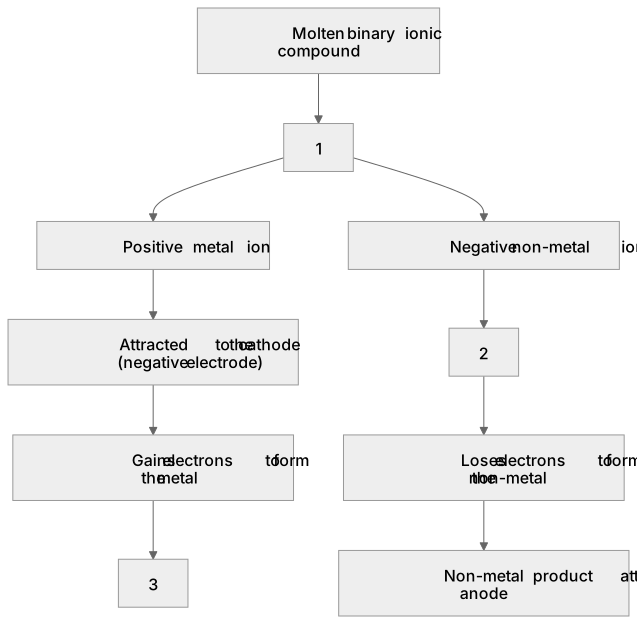
1Box 1
2Box 2
3Box 3
There is more to this lesson
The full lesson goes on to check your understanding and help you earn the marks. Create a free account to carry on, with your progress saved.
A week of Premium from your first lesson · Then the free plan continues · No card, no charge
Test your understanding of Electrolysis of molten ionic compounds: Students should be able to predict the products of the electrolysis of binary ionic compounds in the molten state.
Active recall beats re-reading. Take an instant quiz now to test what you’ve learned and lock it into long-term memory.
A week of Premium from your first lesson · Then the free plan continues · No card, no charge