AQA · GCSE · Chemistry
Course version: 8462 · Version from Sept 2018
If a reversible reaction is exothermic in one direction, it is endothermic…
Full specification wording
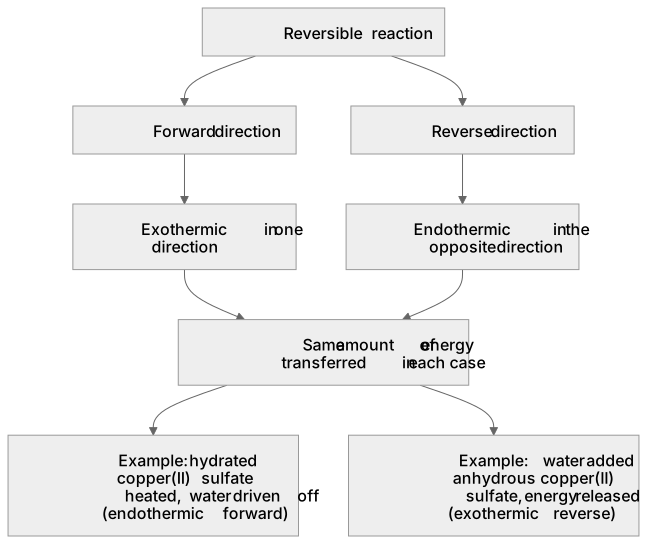
Energy changes and reversible reactions: If a reversible reaction is exothermic in one direction, it is endothermic in the opposite direction. The same amount of energy is transferred in each case. For example:
A reversible reaction can proceed in both directions, and the two directions have opposite energy changes.
Checked against the AQA 8462 specification (opens in a new tab) on .
- 3 key terms
Study notes
From the checked teaching notes for this specification point.
The idea
A reversible reaction can proceed in both directions, and the two directions have opposite energy changes. If the forward reaction releases energy to the surroundings, it is exothermic; the reverse reaction must then absorb the same quantity of energy from the surroundings and is endothermic. The energy transferred is equal in magnitude but opposite in sign, so the energy change for the reverse direction is the negative of that for the forward direction. For example, heating hydrated copper(II) sulfate drives off water to form anhydrous copper(II) sulfate, an endothermic forward change; adding water to the anhydrous solid regenerates the hydrated salt and releases energy, so the reverse change is exothermic. The same amount of energy is transferred in each case, meaning no energy is created or destroyed overall.
What earns the marks
- States that a reversible reaction can occur in both the forward and reverse directions.
- Identifies that if one direction is exothermic, the opposite direction is endothermic.
- Explains that the energy transferred in the forward direction is equal in magnitude to the energy transferred in the reverse direction.
- Uses the sign convention correctly: an exothermic change has a negative energy change and an endothermic change has a positive energy change.
- Applies the idea to a named example, such as hydrated copper(II) sulfate losing water when heated and anhydrous copper(II) sulfate releasing energy when water is added.
- Recognises that the equality of energy transfer follows from the principle of conservation of energy.
Common mistakes and how to put them right
Thinking that both directions of a reversible reaction can be exothermic.
Put it right: The directions have opposite energy changes, one exothermic and one endothermic.
Assuming the reverse reaction transfers a different amount of energy.
Put it right: The same amount of energy is transferred in each direction.
Confusing the terms exothermic and endothermic when describing the reverse direction.
Put it right: Link exothermic to energy release and endothermic to energy absorption, then reverse the label for the opposite direction.
Exam tips
- When asked about a reversible reaction, state the energy change for one direction and immediately deduce the opposite sign for the other direction.
- Use a concrete example such as hydrated copper(II) sulfate and anhydrous copper(II) sulfate to show both directions and their energy changes.
- Check that any numerical energy value quoted for the reverse direction has the same magnitude but the opposite sign to the forward value.
Try the lesson
The start of the Energy changes and reversible reactions: If a reversible reaction is exothermic in one direction, it is endothermic in the opposite direction. The same amount of energy is transferred in each case. For example: lesson, made from checked teaching notes for this specification point.
Have a go first
A reversible reaction releases 46 kJ of energy when it goes in the forward direction. How much energy is absorbed when the same reaction goes in the reverse direction?
Listen
A reversible reaction can proceed in both directions, and the two directions have opposite energy changes. If the forward reaction releases energy to the surroundings, it is exothermic; the reverse reaction must then absorb the same quantity of energy from the surroundings and is endothermic. The energy transferred is equal in magnitude but opposite in sign, so the energy change for the reverse direction is the negative of that for the forward direction. For example, heating hydrated copper(II) sulfate drives off water to form anhydrous copper(II) sulfate, an endothermic forward change; adding water to the anhydrous solid regenerates the hydrated salt and releases energy, so the reverse change is exothermic. The same amount of energy is transferred in each case, meaning no energy is created or destroyed overall. A strong answer earns marks for these points. States that a reversible reaction can occur in both the forward and reverse directions. Identifies that if one direction is exothermic, the opposite direction is endothermic. Explains that the energy transferred in the forward direction is equal in magnitude to the energy transferred in the reverse direction. Uses the sign convention correctly: an exothermic change has a negative energy change and an endothermic change has a positive energy change. A common slip: Thinking that both directions of a reversible reaction can be exothermic. Instead, the directions have opposite energy changes, one exothermic and one endothermic. Exam tip: When asked about a reversible reaction, state the energy change for one direction and immediately deduce the opposite sign for the other direction.
See it
Key words
Say what each word means before you turn the card.
Reversible reactions
Try answering aloud or in your head before turning the card.
Exothermic and endothermic changes
Try answering aloud or in your head before turning the card.
Conservation of energy
Try answering aloud or in your head before turning the card.
See every definition
- Reversible reactions
- Reactions that can proceed in both directions, with the two directions having opposite energy changes.
- Exothermic and endothermic changes
- An exothermic change releases energy to the surroundings, while an endothermic change absorbs energy from the surroundings.
- Conservation of energy
- The principle from which the equality of energy transfer in each direction follows, meaning no energy is created or destroyed overall.
Label the diagram
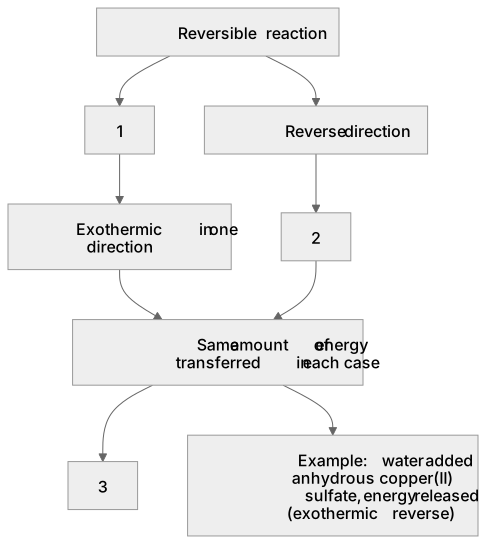
Some boxes have lost their names. Pick the right name for each number.
1Box 1
2Box 2
3Box 3
There is more to this lesson
The full lesson goes on to check your understanding and help you earn the marks. Create a free account to carry on, with your progress saved.
A week of Premium from your first lesson · Then the free plan continues · No card, no charge
Test your understanding of Energy changes and reversible reactions: If a reversible reaction is exothermic in one direction, it is endothermic in the opposite direction. The same amount of energy is transferred in each case. For example:
Active recall beats re-reading. Take an instant quiz now to test what you’ve learned and lock it into long-term memory.
A week of Premium from your first lesson · Then the free plan continues · No card, no charge