AQA · GCSE · Chemistry
Course version: 8462 · Version from Sept 2018
When a reversible reaction occurs in apparatus which prevents the escape…
Full specification wording
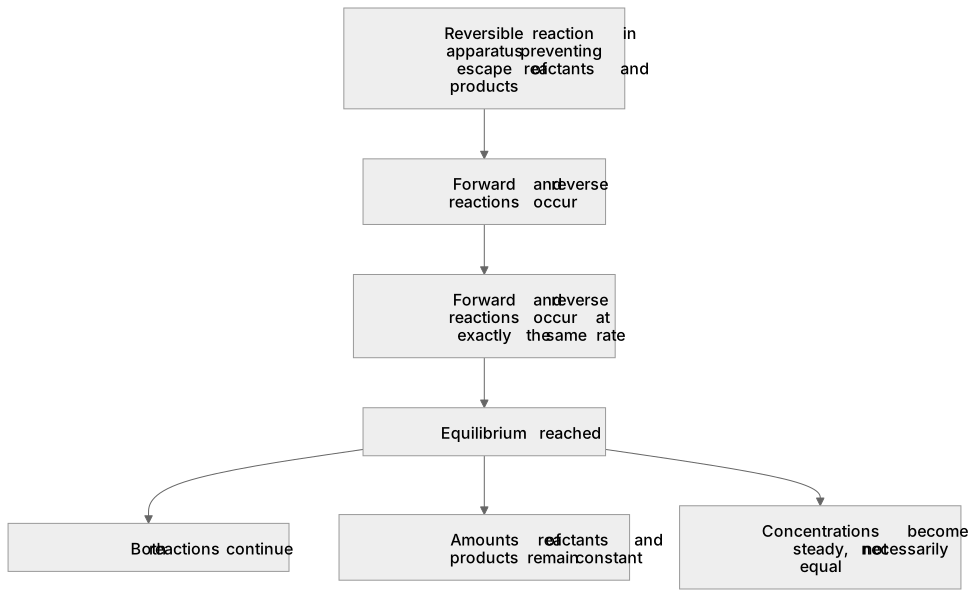
Equilibrium: When a reversible reaction occurs in apparatus which prevents the escape of reactants and products, equilibrium is reached when the forward and reverse reactions occur at exactly the same rate.
In a closed system, no reactants or products can escape.
Checked against the AQA 8462 specification (opens in a new tab) on .
- 3 key terms
Study notes
From the checked teaching notes for this specification point.
The idea
In a closed system, no reactants or products can escape. A reversible reaction therefore continues in both directions, and eventually the rates of the forward and reverse reactions become equal. At this point the reaction is at equilibrium. Equilibrium does not mean the reaction has stopped: both reactions continue, but at exactly the same rate, so the amounts of reactants and products remain constant. The concentrations of reactants and products become steady, although they are not necessarily equal to each other.
For example: In a sealed container, hydrogen and iodine can react to form hydrogen iodide while hydrogen iodide decomposes back to hydrogen and iodine; once the two rates match, the mixture is at equilibrium.
What earns the marks
- States that equilibrium requires a closed system in which reactants and products cannot escape.
- Explains that at equilibrium the forward and reverse reactions continue to occur.
- Identifies that the rates of the forward and reverse reactions are exactly equal at equilibrium.
- Recognises that the amounts or concentrations of reactants and products remain constant at equilibrium.
- Distinguishes dynamic equilibrium from a stopped reaction.
- Applies the idea to a named reversible reaction in a sealed container.
Common mistakes and how to put them right
Thinking that the reaction stops at equilibrium.
Put it right: Both forward and reverse reactions continue at equal rates.
Assuming the amounts of reactants and products must be equal at equilibrium.
Put it right: They remain constant but are not necessarily equal.
Believing equilibrium can be reached in an open system where products escape.
Put it right: A closed system is needed to prevent escape of reactants and products.
Exam tips
- Always mention that the system is closed when explaining how equilibrium is reached.
- Use the phrase exactly the same rate when describing the forward and reverse reactions at equilibrium.
- Explain that constant concentrations, not equal concentrations, are observed at equilibrium.
Try the lesson
The start of the Equilibrium: When a reversible reaction occurs in apparatus which prevents the escape of reactants and products, equilibrium is reached when the forward and reverse reactions occur at exactly the same rate. lesson, made from checked teaching notes for this specification point.
Have a go first
In a closed system, a reversible reaction reaches equilibrium. What is true about the rates of the forward and reverse reactions at equilibrium?
Listen
In a closed system, no reactants or products can escape. A reversible reaction therefore continues in both directions, and eventually the rates of the forward and reverse reactions become equal. At this point the reaction is at equilibrium. Equilibrium does not mean the reaction has stopped: both reactions continue, but at exactly the same rate, so the amounts of reactants and products remain constant. The concentrations of reactants and products become steady, although they are not necessarily equal to each other. For example, in a sealed container, hydrogen and iodine can react to form hydrogen iodide while hydrogen iodide decomposes back to hydrogen and iodine; once the two rates match, the mixture is at equilibrium. A strong answer earns marks for these points. States that equilibrium requires a closed system in which reactants and products cannot escape. Explains that at equilibrium the forward and reverse reactions continue to occur. Identifies that the rates of the forward and reverse reactions are exactly equal at equilibrium. Recognises that the amounts or concentrations of reactants and products remain constant at equilibrium. A common slip: Thinking that the reaction stops at equilibrium. Instead, both forward and reverse reactions continue at equal rates. Exam tip: Always mention that the system is closed when explaining how equilibrium is reached.
See it
Key words
Say what each word means before you turn the card.
Dynamic equilibrium
Try answering aloud or in your head before turning the card.
Closed systems
Try answering aloud or in your head before turning the card.
Reversible reactions
Try answering aloud or in your head before turning the card.
See every definition
- Dynamic equilibrium
- Equilibrium is reached when the forward and reverse reactions occur at exactly the same rate, so both reactions continue but the amounts of reactants and products remain constant.
- Closed systems
- Apparatus which prevents the escape of reactants and products, so no reactants or products can escape.
- Reversible reactions
- Reactions that continue in both directions, so the forward and reverse reactions occur at exactly the same rate at equilibrium.
Label the diagram
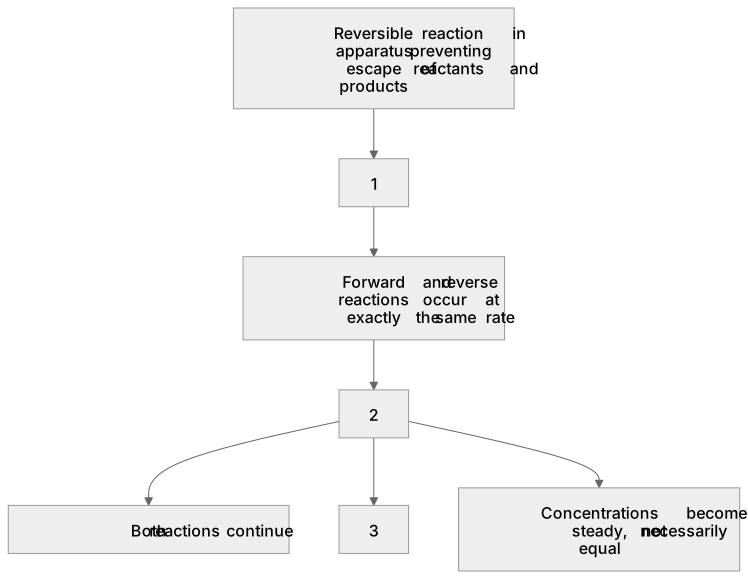
Some boxes have lost their names. Pick the right name for each number.
1Box 1
2Box 2
3Box 3
There is more to this lesson
The full lesson goes on to check your understanding and help you earn the marks. Create a free account to carry on, with your progress saved.
A week of Premium from your first lesson · Then the free plan continues · No card, no charge
Test your understanding of Equilibrium: When a reversible reaction occurs in apparatus which prevents the escape of reactants and products, equilibrium is reached when the forward and reverse reactions occur at exactly the same rate.
Active recall beats re-reading. Take an instant quiz now to test what you’ve learned and lock it into long-term memory.
A week of Premium from your first lesson · Then the free plan continues · No card, no charge