AQA · GCSE · Chemistry
Course version: 8462 · Version from Sept 2018
Flame emission spectroscopy is an example of an instrumental method used…
Full specification wording
Flame emission spectroscopy: Flame emission spectroscopy is an example of an instrumental method used to analyse metal ions in solutions.
Flame emission spectroscopy is an instrumental technique that identifies and measures metal ions in solution.
Checked against the AQA 8462 specification (opens in a new tab) on .
- Point 1 of 4
- 4 key terms
Study notes
From the checked teaching notes for this specification point.
The idea
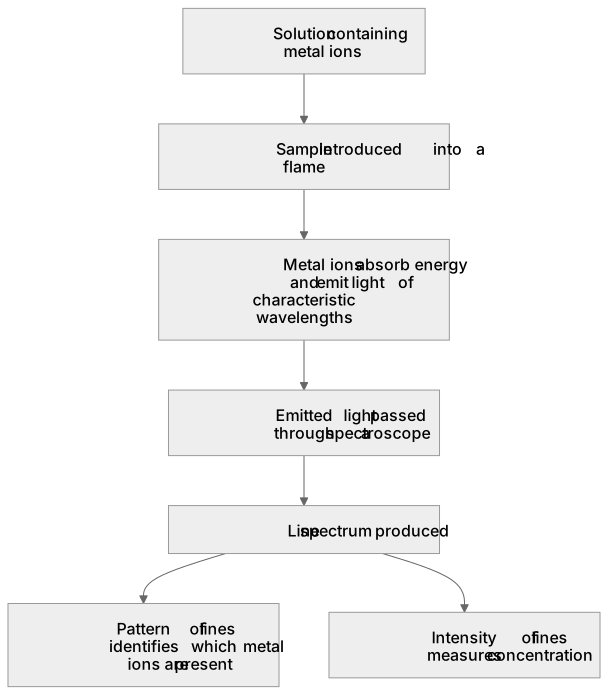
Flame emission spectroscopy is an instrumental technique that identifies and measures metal ions in solution. A sample of the solution is introduced into a flame, and the metal ions absorb energy and then emit light of characteristic wavelengths. The emitted light is passed through a spectroscope, producing a line spectrum. Because each metal ion gives its own pattern of lines, the spectrum can be used to identify which metal ions are present. The intensity of the lines can also be used to measure concentration. This makes flame emission spectroscopy useful for analysing solutions in contexts such as water quality testing, where several metal ions may need to be identified and measured quickly.
What earns the marks
- Flame emission spectroscopy is an instrumental method, meaning it uses a machine or instrument rather than simple chemical tests.
- The sample is introduced into a flame, where the metal ions emit light of characteristic wavelengths.
- The emitted light is passed through a spectroscope to produce a line spectrum.
- The line spectrum can be used to identify the metal ions present and to measure their concentrations.
Common mistakes and how to put them right
Confusing flame emission spectroscopy with flame tests.
Put it right: Flame emission spectroscopy uses a spectroscope and produces a line spectrum, while a flame test observes a colour by eye.
Saying it analyses atoms in solids directly.
Put it right: The metal ions must be in solution.
Saying it identifies non-metal ions.
Put it right: Flame emission spectroscopy is used for metal ions.
Exam tips
- Name the method fully as flame emission spectroscopy and state that it analyses metal ions in solution.
- Use the phrase instrumental method to show you understand it uses an instrument rather than a simple chemical test.
- Link the method to a use, such as identifying metal ions in a water sample, to show application.
Try the lesson
The start of the Flame emission spectroscopy: Flame emission spectroscopy is an example of an instrumental method used to analyse metal ions in solutions. lesson, made from checked teaching notes for this specification point.
Have a go first
Flame emission spectroscopy is an instrumental method. What is it primarily used to analyse?
Listen
Flame emission spectroscopy is an instrumental technique that identifies and measures metal ions in solution. A sample of the solution is introduced into a flame, and the metal ions absorb energy and then emit light of characteristic wavelengths. The emitted light is passed through a spectroscope, producing a line spectrum. Because each metal ion gives its own pattern of lines, the spectrum can be used to identify which metal ions are present. The intensity of the lines can also be used to measure concentration. This makes flame emission spectroscopy useful for analysing solutions in contexts such as water quality testing, where several metal ions may need to be identified and measured quickly. A strong answer earns marks for these points. Flame emission spectroscopy is an instrumental method, meaning it uses a machine or instrument rather than simple chemical tests. The sample is introduced into a flame, where the metal ions emit light of characteristic wavelengths. The emitted light is passed through a spectroscope to produce a line spectrum. The line spectrum can be used to identify the metal ions present and to measure their concentrations. A common slip: Confusing flame emission spectroscopy with flame tests: the error is treating them as the same method. Instead, flame emission spectroscopy uses a spectroscope and produces a line spectrum, while a flame test observes a colour by eye. Exam tip: Name the method fully as flame emission spectroscopy and state that it analyses metal ions in solution.
See it
Key words
Say what each word means before you turn the card.
Instrumental analysis
Try answering aloud or in your head before turning the card.
Metal ions in solution
Try answering aloud or in your head before turning the card.
Emission of light
Try answering aloud or in your head before turning the card.
Identification of elements
Try answering aloud or in your head before turning the card.
See every definition
- Instrumental analysis
- A method that uses a machine or instrument rather than simple chemical tests, and flame emission spectroscopy is an example of one.
- Metal ions in solution
- The type of sample the method requires, so the metal ions must be in solution for it to be applied.
- Emission of light
- What happens when the sample is introduced into a flame, where the metal ions emit light of characteristic wavelengths.
- Identification of elements
- Using the line spectrum produced through a spectroscope, since each metal ion gives its own pattern of lines, to identify which metal ions are present.
Label the diagram
Some boxes have lost their names. Pick the right name for each number.
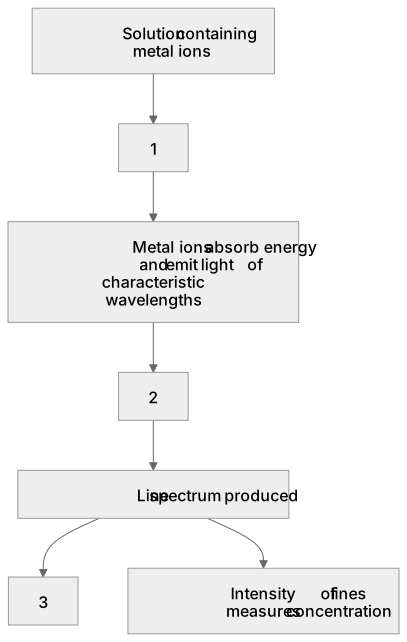
1Box 1
2Box 2
3Box 3
There is more to this lesson
The full lesson goes on to check your understanding and help you earn the marks. Create a free account to carry on, with your progress saved.
A week of Premium from your first lesson · Then the free plan continues · No card, no charge
Test your understanding of Flame emission spectroscopy: Flame emission spectroscopy is an example of an instrumental method used to analyse metal ions in solutions.
Active recall beats re-reading. Take an instant quiz now to test what you’ve learned and lock it into long-term memory.
A week of Premium from your first lesson · Then the free plan continues · No card, no charge