AQA · GCSE · Chemistry
Course version: 8462 · Version from Sept 2018
Flame tests: Flame tests can be used to identify some metal ions (cations).
A flame test identifies certain metal cations from the colour they give to a flame.
Checked against the AQA 8462 specification (opens in a new tab) on .
- Point 1 of 4
- 4 key terms
Study notes
From the checked teaching notes for this specification point.
The idea
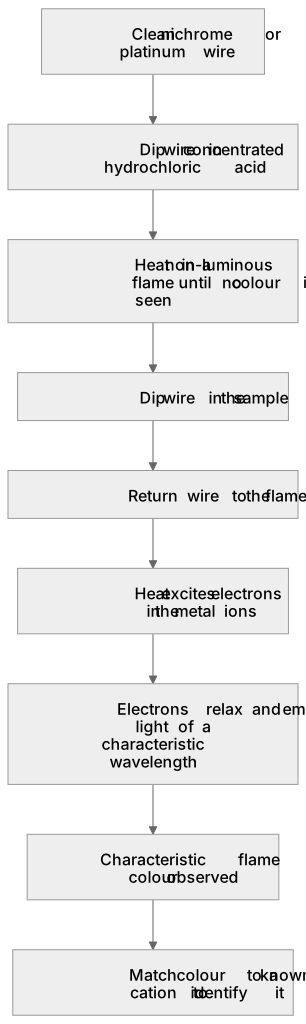
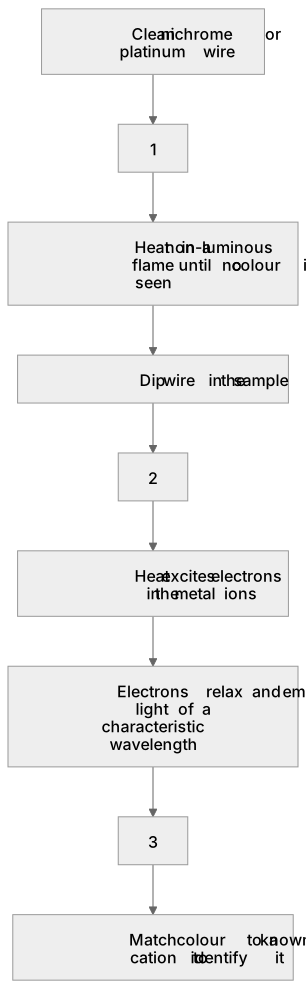
A flame test identifies certain metal cations from the colour they give to a flame. A clean nichrome or platinum wire is dipped in concentrated hydrochloric acid, heated in a non-luminous flame until no colour is seen, then dipped in the sample and returned to the flame. The heat excites electrons in the metal ions; as they relax, light of a characteristic wavelength is emitted, giving the flame its colour. The method is quick and needs little sample, but it only works for some cations and cannot detect non-metal ions. A positive result is a distinctive flame colour that matches a known cation, so the test is a qualitative identification rather than a measurement of amount.
What earns the marks
- States that a clean wire, such as nichrome or platinum, is used to hold the sample in the flame.
- Describes cleaning the wire with concentrated hydrochloric acid and heating until no colour is seen, to avoid contamination.
- Explains that the characteristic flame colour is produced by the metal cation in the sample.
- Explains that heating excites electrons and emitted light gives the observed colour.
- States that the test identifies some metal cations but not non-metal ions or all metal ions.
- Links a named flame colour to a specific cation to identify it.
Common mistakes and how to put them right
Using the same dirty wire for several samples.
Put it right: The error is contamination that gives a misleading colour, and the correction is to clean the wire with acid and heat it until the flame is colourless before each test.
Claiming the test identifies any ion.
Put it right: The error is overgeneralising, and the correction is to state that flame tests identify only some metal cations.
Treating the flame colour as a quantitative measure.
Put it right: The error is assuming the colour shows how much ion is present, and the correction is to describe the test as qualitative identification only.
Exam tips
- Describe the cleaning step before the test, because it is often worth a marking point.
- Use the phrase characteristic flame colour and name the cation it indicates.
- State one limitation of flame tests, such as masking by other ions or inability to detect non-metal ions.
Try the lesson
The start of the Flame tests: Flame tests can be used to identify some metal ions (cations). lesson, made from checked teaching notes for this specification point.
Have a go first
A clean nichrome wire is dipped into a solution and held in a blue Bunsen flame. The flame turns lilac. Which metal ion is present in the solution?
Listen
A flame test identifies certain metal cations from the colour they give to a flame. A clean nichrome or platinum wire is dipped in concentrated hydrochloric acid, heated in a non-luminous flame until no colour is seen, then dipped in the sample and returned to the flame. The heat excites electrons in the metal ions; as they relax, light of a characteristic wavelength is emitted, giving the flame its colour. The method is quick and needs little sample, but it only works for some cations and cannot detect non-metal ions. A positive result is a distinctive flame colour that matches a known cation, so the test is a qualitative identification rather than a measurement of amount. A strong answer earns marks for these points. States that a clean wire, such as nichrome or platinum, is used to hold the sample in the flame. Describes cleaning the wire with concentrated hydrochloric acid and heating until no colour is seen, to avoid contamination. Explains that the characteristic flame colour is produced by the metal cation in the sample. Explains that heating excites electrons and emitted light gives the observed colour. Exam tip: Describe the cleaning step before the test, because it is often worth a marking point.
See it
Key words
Say what each word means before you turn the card.
Flame test
Try answering aloud or in your head before turning the card.
Qualitative identification
Try answering aloud or in your head before turning the card.
Contamination
Try answering aloud or in your head before turning the card.
Limitations of flame tests
Try answering aloud or in your head before turning the card.
See every definition
- Flame test
- A test that can be used to identify some metal ions (cations) from the colour they give to a flame.
- Qualitative identification
- A positive result is a distinctive flame colour that matches a known cation, so the test identifies rather than measures the amount.
- Contamination
- A dirty wire gives a misleading colour, so the wire is cleaned with concentrated hydrochloric acid and heated until no colour is seen before each test.
- Limitations of flame tests
- The method only works for some cations and cannot detect non-metal ions.
Label the diagram
Some boxes have lost their names. Pick the right name for each number.
1Box 1
2Box 2
3Box 3
There is more to this lesson
The full lesson goes on to check your understanding and help you earn the marks. Create a free account to carry on, with your progress saved.
A week of Premium from your first lesson · Then the free plan continues · No card, no charge
Test your understanding of Flame tests: Flame tests can be used to identify some metal ions (cations).
Active recall beats re-reading. Take an instant quiz now to test what you’ve learned and lock it into long-term memory.
A week of Premium from your first lesson · Then the free plan continues · No card, no charge